
Systems Modeling Synthesis
Imagine you are the manager of a busy city park needing to balance its visitors. If you allow too many people inside, the grass dies and the trash bins overflow quickly. If you allow too few people inside, the park becomes lonely and loses its vibrant community spirit. Finding the perfect balance requires constant observation of the flow of people entering and leaving the gates. Systems modeling acts like this management tool for nature by tracking how different variables interact within a living group.
Integrating Multiple Population Variables
When scientists study living groups, they must look beyond simple birth and death rates to understand changes. A complex model combines resources, predators, and environmental space into one single mathematical framework for better accuracy. Earlier, we explored how invasive species can disrupt local food webs by consuming shared resources too quickly. We also looked at how isolated groups respond to limited space by slowing their overall reproduction cycles. By synthesizing these two concepts, we create a more holistic view of survival. Imagine a budget for a small business where income represents births and expenses represent deaths or resource loss. If the expenses exceed the income for too long, the business eventually fails regardless of how hard the staff works. Nature follows this same logic when environment limits act as a hard cap on population growth.
Key term: Systems modeling — the practice of creating a mathematical representation of a complex process to predict how its parts interact over time.
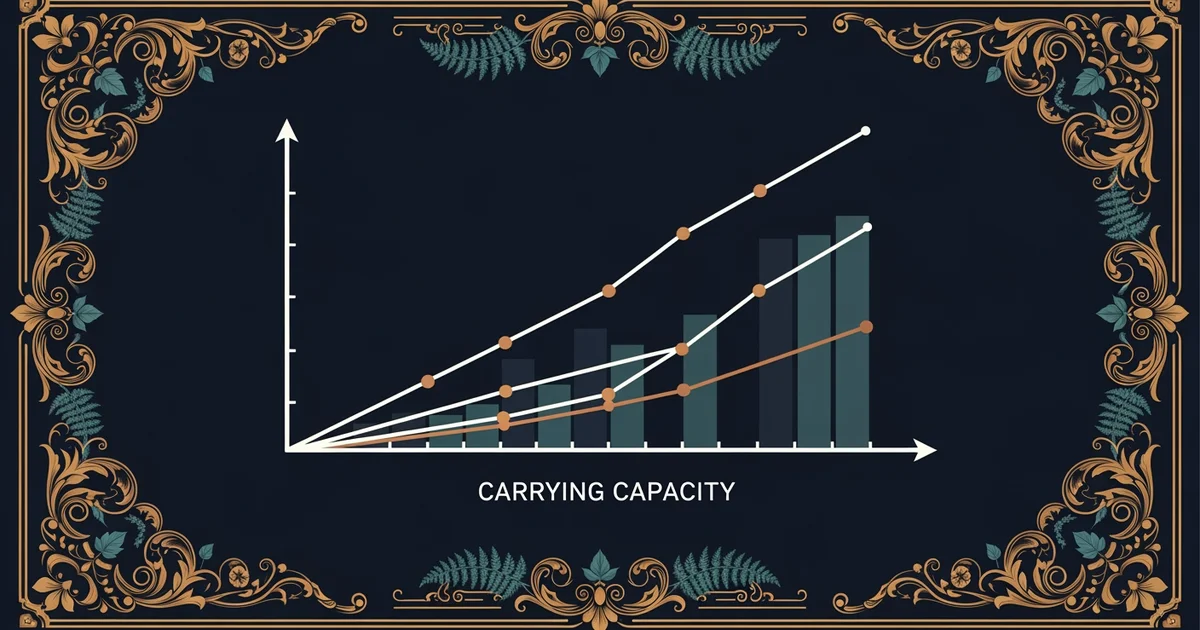
Mathematical patterns help us see that growth is never truly independent of the world surrounding the group. We must consider the carrying capacity of the environment, which is the maximum number of individuals that can survive there. If a population exceeds this limit, the environment suffers damage that lowers its ability to support future generations. This feedback loop creates a self-regulating system where the environment and the population constantly influence each other. A model might show that a high birth rate leads to a short-term population spike, but this spike inevitably triggers a sharp rise in the death rate. This happens because the resources, such as food or water, become scarce for every member of the group.
Building a Complex Simulation Model
To build a simulation, we must assign numerical values to these different environmental pressures and observe the result. We use variables to represent these forces in a way that allows us to test different scenarios.
| Variable Type | Represents | Impact on Population |
|---|---|---|
| Growth Rate | Births minus deaths | Increases total size |
| Resource Cap | Available food/water | Sets maximum limit |
| External Stress | Predators or disease | Decreases total size |
This table shows how we can break down a living system into manageable parts for easier calculation. When we combine these variables, we can predict if a group will remain stable or crash. For example, if we increase the resource cap, the population might grow, but only until another variable like disease or predation becomes the limiting factor. This brings us back to our foundation question: how do mathematical patterns predict the growth and survival of living groups within their environments? We answer this by showing that survival is a dynamic balance between internal growth potential and external environmental constraints. A lingering question remains for researchers: how do we account for sudden, unpredictable climate shifts that change the rules of the model overnight? We are still learning how to build models that can adapt to such massive, rapid environmental changes without breaking down.
Mathematical models synthesize multiple environmental variables to predict how populations reach a stable balance within their specific constraints.
Future projections will build upon these models to forecast how specific habitats might change over the coming decades.