
Logistic Growth Patterns
Imagine a small town with one bakery that serves a growing number of hungry residents every single day. As more people move into town, the bakery sells more bread, but it eventually runs out of oven space and flour supplies.
Understanding Growth Constraints
When populations grow without any real obstacles, they follow a pattern known as exponential growth where the numbers rise faster over time. This pattern assumes that resources like food, water, and space are always available in unlimited amounts for every individual. However, nature rarely provides infinite resources for any living group because environments have strict physical limits. Once a population grows too large, the lack of resources forces the growth rate to slow down significantly. This shift from rapid expansion to a stable state is what scientists call logistic growth. Think of it like a business that starts with high energy and quick sales but must eventually adjust to the actual size of the local market. The market represents the environment, and the bakery represents the population trying to survive within that specific space.
The Role of Carrying Capacity
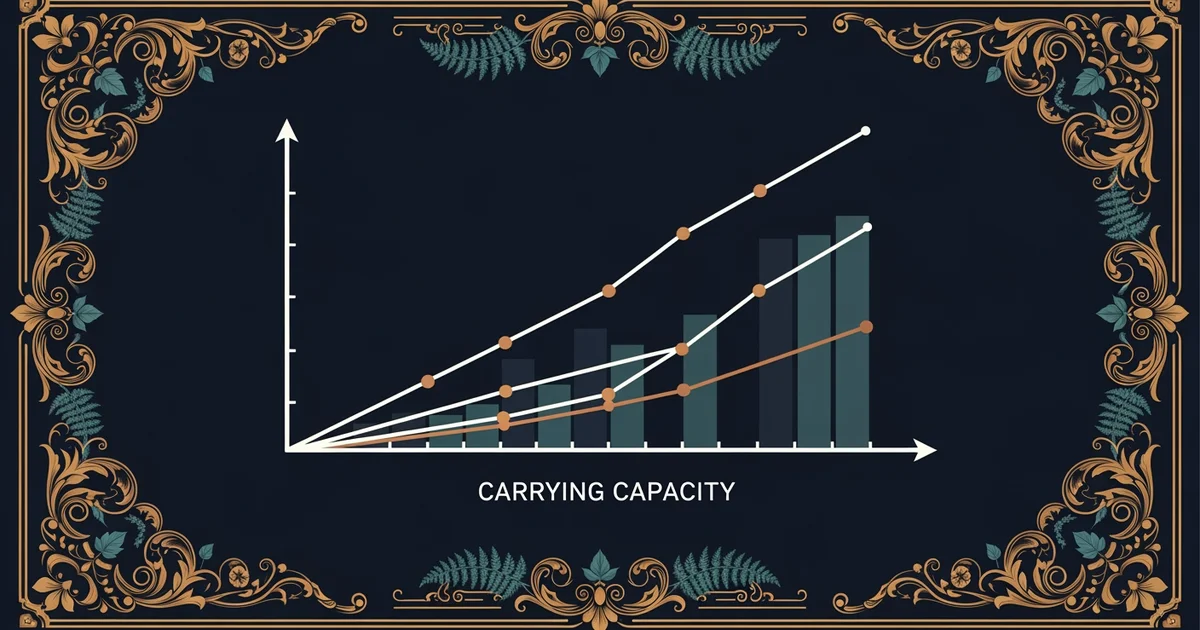
Because environments cannot support an infinite number of organisms, every habitat has a specific limit known as the carrying capacity. This value represents the maximum number of individuals that an area can sustain over a long period of time. When a population is far below this limit, it grows quickly because there is plenty of room and food for everyone. As the population size approaches this limit, competition for essential resources becomes much more intense among all the members. The growth rate begins to level off as the number of births starts to match the number of deaths. If you imagine a crowded elevator, the capacity is the point where no more people can fit inside without someone else having to step out. This balance point ensures that the environment does not become completely depleted of the vital resources needed for future survival.
| Growth Type | Resource Availability | Population Curve Shape |
|---|---|---|
| Exponential | Unlimited resources | Steep upward J-curve |
| Logistic | Limited resources | Flattening S-shaped curve |
| Stable | Balanced resources | Flat line at capacity |
We can see how these two models differ by looking at how they respond to environmental pressure over time. The exponential model ignores the reality of scarcity, while the logistic model embraces the fact that space and food are finite. Most natural populations eventually follow the logistic path because they must eventually deal with the reality of their surroundings. If a group grows too fast and exceeds its capacity, it often experiences a sharp decline due to starvation or disease. By following the logistic curve, a population stays closer to the sustainable limit without causing total collapse of its ecosystem.
Key term: Carrying capacity — the maximum population size of a species that a specific environment can sustain indefinitely given the available resources.
This mathematical pattern helps researchers predict how different species will react when their living conditions change or when new competitors arrive. By using these models, we can better understand why some groups thrive while others struggle to maintain their numbers in a changing world. The math behind these curves provides a clear picture of how life balances its own expansion against the harsh rules of nature. It is a constant tug of war between the urge to grow and the reality of limited space.
Logistic growth models show that population expansion is limited by the environment's ability to provide essential resources over time.
The next Station introduces mortality and survival, which determines how individual deaths affect the overall growth of a group.