
Resources and Limits
Imagine you are trying to fit twenty people into a small car meant for five passengers. The car simply cannot hold everyone safely, no matter how hard you push or how much you squeeze the doors. Nature operates under similar rules when groups of living things try to occupy a specific space. Every environment has a physical limit that dictates how many individuals can survive within its borders over time. This limit prevents populations from growing forever, ensuring that the available space and food remain enough for those who live there.
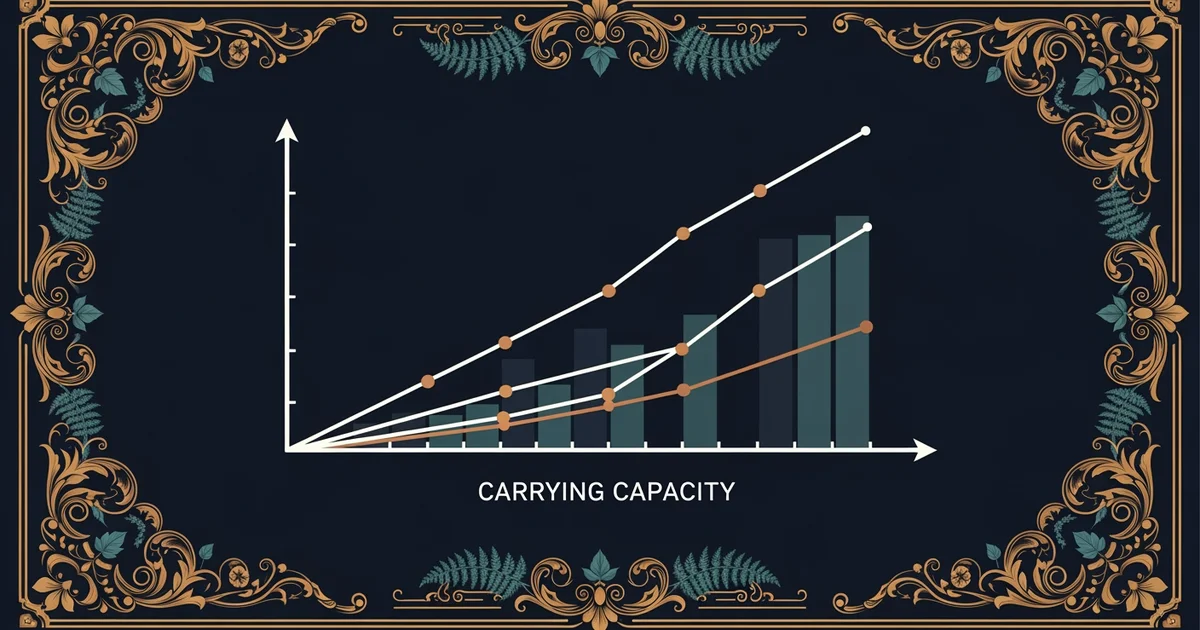
The Concept of Environmental Limits
When populations grow, they eventually encounter the harsh reality of finite resources like water, food, and shelter. Scientists use the term carrying capacity to describe the maximum number of individuals an environment can support without degrading the ecosystem. Think of this like a bank account with a fixed balance that never receives new deposits. If you withdraw money faster than the bank replaces it, your account balance will eventually hit zero. In the wild, if a population exceeds its carrying capacity, the lack of food or space causes the death rate to climb until the population shrinks back down.
Key term: Carrying capacity — the maximum population size of a species that an environment can sustain indefinitely given the available resources.
Environmental resistance acts as the collection of factors that keep a population from reaching its full potential for growth. These factors include competition for space, the presence of predators, and the spread of diseases within crowded groups. When resources become scarce, individuals must compete to survive, which changes how the entire group behaves. This process is not a choice but a natural balance that keeps ecosystems stable. Without these limits, a single species might consume every available resource, leading to a total collapse of the local environment.
Measuring Resource Constraints
To understand how these limits function, we must look at the specific factors that determine the carrying capacity for any given species. These factors vary greatly depending on the habitat and the needs of the organisms living there. The following table highlights common constraints that dictate how large a population can become before it hits a wall.
| Resource Type | Impact on Population | Example of Constraint |
|---|---|---|
| Food Supply | Limits total energy | Lack of available prey |
| Living Space | Limits physical room | Small nesting territories |
| Water Access | Limits basic survival | Seasonal drought cycles |
| Predator Load | Limits safety levels | Increased hunting pressure |
These constraints function as a filter that determines which individuals survive to reproduce and pass on their traits. If a forest provides enough berries for only one hundred bears, the population will hover around that number regardless of how many cubs are born each year. This is why we rarely see populations explode in size unless a new resource suddenly appears or a predator leaves the area. The environment essentially dictates the rules of the game, and every species must play by these mathematical boundaries to avoid disappearing entirely.
When an environment experiences a change in these resources, the carrying capacity shifts in response to the new conditions. A drought might lower the limit, while a new water source could raise it, allowing more individuals to thrive. Understanding these fluctuations helps us predict how groups will react to changes in their surroundings. It also shows that population size is not just about birth rates, but about the interplay between life and the physical world. By studying these patterns, we can see why certain groups remain stable while others struggle to survive in changing landscapes.
The carrying capacity represents the mathematical ceiling that prevents any living population from growing beyond the sustainable limits of its local environment.
Next, we will explore how these boundaries shape the specific curves of exponential growth models.