
Basic Arithmetic of Growth
Imagine you have a small savings account that adds a fixed amount of money every single month. If you track the balance over time, you will notice a steady, predictable climb that mirrors how basic populations grow without any external interference. This simple pattern forms the bedrock of understanding how living groups expand when they have plenty of room and food. By learning to calculate these shifts, you gain the ability to predict the future size of a group based on its current pace of change. Understanding these numbers is the first step toward mapping the complex survival strategies found in nature.
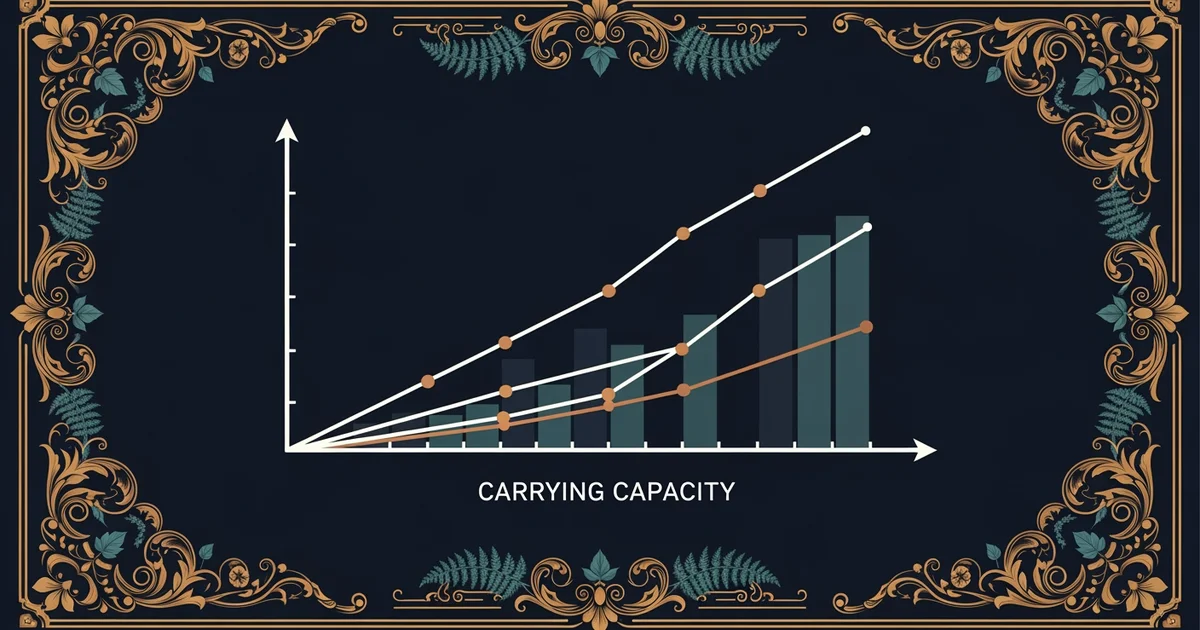
Measuring Consistent Numerical Growth
When a population grows by a constant amount during each time interval, we call this linear growth. You can visualize this pattern by imagining a staircase where every step represents the same number of new individuals joining the group. If a starting group of ten individuals adds two members every month, the total follows a simple arithmetic sequence. The math behind this is straightforward because you only need to add the same value repeatedly. This model works well for short periods where space and resources are abundant for every member.
Key term: Linear growth — a pattern of expansion where a population increases by a fixed amount during each equal time interval.
To calculate the total size of a group at any given time, you use a basic formula. If you start with an initial number, you multiply the rate of change by the total time elapsed. You then add that result to your starting figure to find the new total. This calculation helps you determine the exact count of a population without counting every individual one by one. It provides a clear way to forecast growth when the environment remains stable and predictable for everyone involved.
Calculating Rates of Change
Because populations do not always stay the same size, you must learn to measure the growth rate of a group. This rate shows how fast a population changes over a specific period, such as one year or one month. You find this value by dividing the total change in population by the time it took for that shift to happen. Think of this like checking the speed of a car on a highway to see how far it travels each hour. By knowing this rate, you can compare different groups to see which one is expanding more quickly.
| Observation Period | Starting Population | Ending Population | Net Change |
|---|---|---|---|
| Month One | 50 | 55 | 5 |
| Month Two | 55 | 60 | 5 |
| Month Three | 60 | 65 | 5 |
This table illustrates how a steady increase maintains a constant rate over time. When the change remains the same, the math stays simple and easy to manage for any researcher. If the net change were to fluctuate, you would need to find an average rate to keep your predictions accurate. Many natural populations follow this steady path until they encounter limits that force the growth to slow down or stop entirely. Keeping track of these numbers ensures you understand the health and stability of the group you are studying.
If you want to find the total population after a certain amount of time, you can follow these steps:
- Identify the starting number of individuals to establish your baseline for the calculation process.
- Determine the constant amount of growth that occurs during each single unit of time measured.
- Multiply the growth amount by the total number of time units that have passed by.
- Add this product to your starting number to reach the final total population count expected.
By following this sequence, you can project the size of any group that grows in a linear fashion. This method serves as a reliable tool for basic predictions in biology and ecology. As you move forward, you will see how these simple patterns encounter real-world obstacles that change the math. For now, mastering this arithmetic allows you to build a strong foundation for more advanced studies in population dynamics.
Predicting population change requires applying simple arithmetic to the constant rates observed within a stable environment.
Next, we will explore how limited resources create boundaries that stop populations from growing forever.