
Invasive Species Impact
When the brown tree snake arrived on the island of Guam inside cargo planes after the second world war, it found an ecosystem without any natural predators to stop its expansion. This accidental introduction serves as a grim real-world example of invasive species dynamics, which we previously explored in Station 12 regarding the basic principles of conservation management.
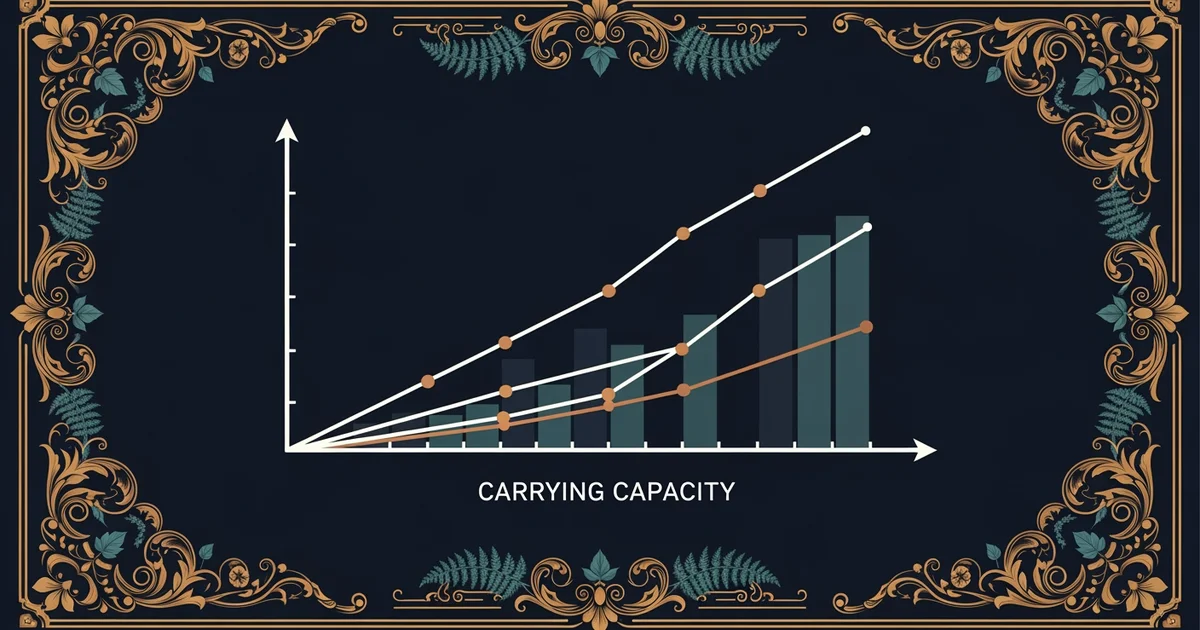
The Mathematical Mechanics of Unchecked Growth
Because the island lacked native species that could hunt or compete with the snakes, the population growth followed an exponential curve rather than a stable logistic model. In a balanced environment, a species encounters resistance from food scarcity, disease, or predators, which forces the population to level off at a value known as the carrying capacity. Without these constraints, the population size at time grows according to the formula , where represents the intrinsic growth rate. This rapid multiplication happens because every available resource is funneled directly into reproduction instead of survival or defense. When a species enters a new area, it effectively gains a blank check to consume all available energy in that local food web.
Key term: Carrying capacity — the maximum number of individuals of a species that an environment can support without degrading its natural resources.
Think of the invasive species like a new business entering an industry with zero taxes and no competition from established firms. While local companies must spend money on rent, advertising, and employee training, the new entrant keeps all its revenue to open more locations. The invasive species occupies this same privileged position because it does not have to spend energy avoiding predators or dealing with local pathogens. This lack of overhead allows the population to double in size much faster than native species that have evolved to live within strict environmental limits.
Quantifying the Ecological Disruption
To understand the impact of these species, we must look at how they alter the flow of energy through the ecosystem. The following table highlights the differences between native species and invasive ones in a new environment:
| Attribute | Native Species | Invasive Species |
|---|---|---|
| Population Control | High predation and disease | Very low or non-existent |
| Resource Access | Shared with many others | Dominates available supply |
| Growth Pattern | Logistic and stable | Exponential and rapid |
When these populations explode, they often trigger a trophic cascade that collapses the entire local food web. Native birds, for example, have no evolutionary defense against a predator that moves in ways they do not expect. As the invasive population grows, the native species decline because they cannot compete for the same resources or survive the increased predation. This shift is not just about numbers; it is about the fundamental loss of biodiversity that keeps an ecosystem healthy and resilient against future environmental changes.
- Resource monopolization: The invasive group consumes the majority of the available nutrients, leaving native populations with insufficient energy to reproduce or maintain their own numbers.
- Niche displacement: The newcomers occupy the living spaces and nesting grounds that were previously held by local animals, forcing the native species to move into less suitable territories.
- Pathogen transmission: Invasive species often carry diseases to which they are immune, but these diseases can be fatal to local populations that have never encountered such biological threats before.
By tracking these variables, scientists can predict the speed at which a new area will be overtaken by an invasive threat. The math shows that early intervention is the only way to prevent the exponential growth from reaching a point where the damage becomes permanent. Once the population hits a certain threshold, the energy required to remove the invaders becomes higher than the resources available for conservation efforts, leading to a total loss of the original habitat structure.
Predicting the growth of invasive species requires identifying the absence of natural constraints that would otherwise limit population expansion through competition and predation.
But this mathematical model breaks down when we attempt to simulate complex multi-species interactions within a changing climate.