
Conservation Management
In 1995, when wolves returned to Yellowstone National Park, the entire ecosystem shifted in ways that surprised local wildlife biologists. This event shows how protecting one key group changes the balance of every other living thing in that area. This is conservation management at work, which uses mathematical logic to keep nature stable. You must understand how groups interact to make sure no single species disappears from the map forever. By tracking numbers, we can decide where to focus our limited time and money to save the most lives.
Using Math to Save Species
Conservationists treat wildlife groups like a bank account where you must balance the deposits against the withdrawals. If too many individuals leave the group, the total balance drops until the species can no longer recover its strength. We use specific models to calculate the minimum number of members needed to keep the group healthy and growing. When the population count falls below this threshold, the risk of total loss becomes very high. We must intervene quickly to prevent a permanent collapse of the entire local food web.
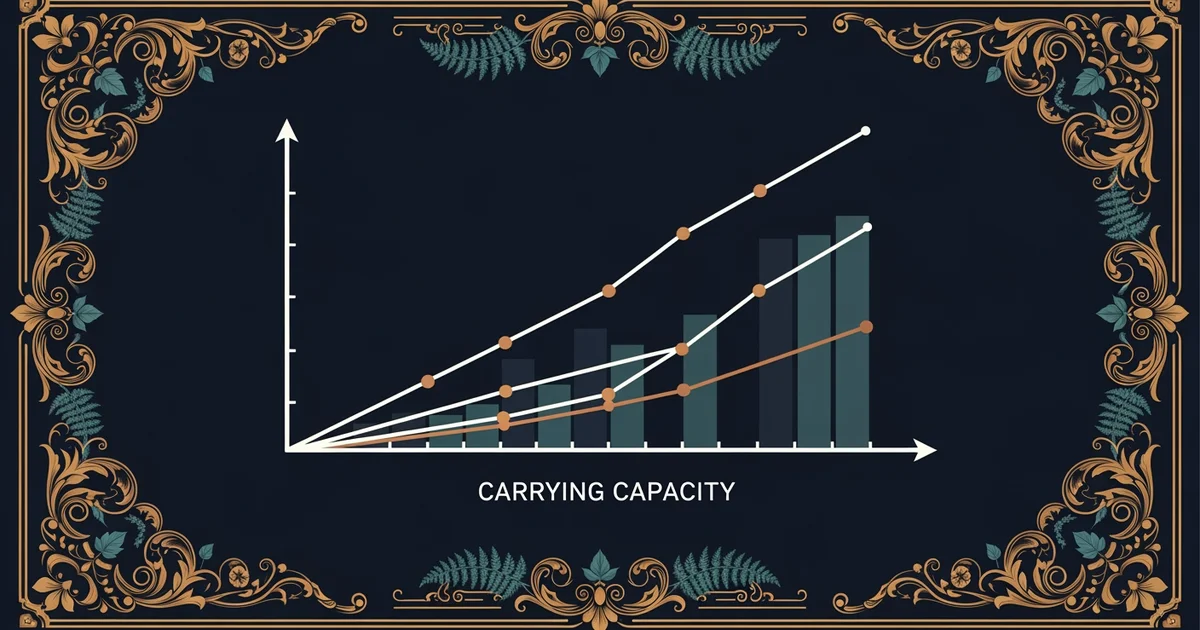
Key term: Carrying capacity — the maximum number of individuals an environment can support without degrading its own resources.
Managing these groups requires us to look at the birth rates and the death rates of the animals. We calculate the growth rate using the formula , where is the number of births and is the number of deaths. If remains positive, the group has a chance to expand into empty spaces within the habitat. We then compare this growth against the available space and food to see if the environment can handle more members. This logic helps us set boundaries for how many animals we can protect in a single zone.
Strategies for Protected Growth
To keep a group safe, we often create protected areas that act like high-security vaults for vulnerable species. These zones limit human activity and provide the resources needed for the animals to thrive without constant external pressure. We must also manage the movement of individuals between these zones to keep the gene pool diverse and healthy. If a group stays isolated for too long, they may face health issues that make them weaker over time. We use the following methods to ensure long-term stability for these fragile wild populations:
- Habitat restoration involves fixing damaged land so the species has enough space to find food and raise young.
- Population monitoring tracks the number of individuals to detect sudden drops before they become a major crisis.
- Corridor creation builds safe paths between isolated areas so animals can move freely to find new mates.
| Strategy | Primary Goal | Benefit to Group |
|---|---|---|
| Restoration | Provide space | Increases capacity |
| Monitoring | Alert systems | Faster response |
| Corridors | Genetic flow | Higher resilience |
These methods allow us to act like stewards of the land rather than just observers of nature. By using these tools, we can ensure that species survive even when the world around them changes very quickly. We must always balance the needs of the animals with the needs of the humans living nearby. This creates a sustainable path for both groups to exist in the same space without causing harm to the local environment. Proper management relies on data and careful planning to yield the best results for everyone involved.
Conservation management uses mathematical models to balance environmental resources with the needs of growing species to prevent total population collapse.
But this model breaks down when invasive species arrive and disrupt the established growth patterns of the local groups.