
Human Population Trends
In 1950, when global leaders observed the rapid population growth following the end of the second world war, they struggled to predict how resource consumption would scale alongside human numbers. This tension between finite environmental resources and infinite growth potential remains the central challenge for modern demographic analysis and planning. When we look at how human groups expand, we use the demographic transition theory to explain why birth and death rates change as societies develop. This is the logical evolution of the population growth models we explored in Station 10 regarding predator-prey dynamics.
Understanding Growth Phases
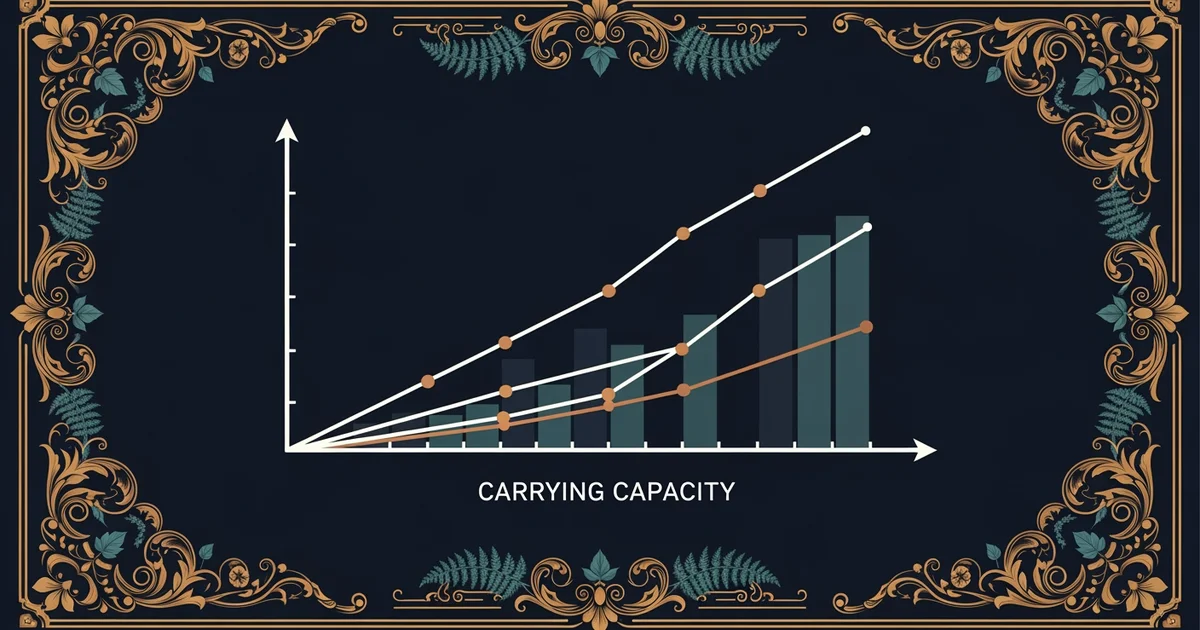
Societies typically move through predictable stages as they shift from agrarian structures to industrial economies. In the first phase, high birth rates are balanced by high death rates, resulting in very little total population growth over time. As medicine and sanitation improve, the death rate drops rapidly while the birth rate remains high for a period. This creates a massive spike in population size that acts like a pressure valve releasing steam in an engine. Eventually, social changes and economic shifts cause birth rates to fall, leading to a stable population size again. These shifts require careful mathematical tracking to ensure that infrastructure can support the changing needs of the people.
Key term: Demographic transition theory — a model that describes how population growth patterns change as countries move from high birth and death rates to low birth and death rates.
We can organize these stages based on how birth and death rates interact to influence the total size of a group. Understanding these patterns helps planners decide where to build schools, hospitals, or power grids for future generations.
| Stage | Birth Rate | Death Rate | Population Growth |
|---|---|---|---|
| High | High | High | Stable or slow |
| Early | High | Falling | Rapid increase |
| Late | Falling | Low | Slowing down |
| Low | Low | Low | Stable or shrinking |
Applying Mathematical Models
When we apply these models to real-world data, we must account for external variables that disrupt the expected path of growth. Economic incentives, cultural shifts, and government policies often act as variables that accelerate or delay the transition phases. Imagine a family budget where income represents resources and the number of people represents the population size needing support. If the family grows faster than the income, the standard of living drops, forcing the family to adjust their reproductive choices to match their financial reality. This economic analogy shows how individual decisions aggregate into large-scale demographic trends that define global health and stability.
Mathematical models allow us to project these trends into the future to identify potential crises before they happen. By using the growth rates from previous years, we calculate the doubling time of a population using the rule of seventy. If a population grows at one percent annually, it will double in size in seventy years. This simple logic provides a powerful tool for predicting the strain on food supplies and housing markets in developing nations. We must remember that these models are tools for estimation rather than perfect predictions of human behavior. Social and environmental factors can shift the variables at any moment, requiring us to update our calculations with new data constantly.
As we refine these models, we look for signs of stabilization or decline in specific regions. High-density urban areas often show different patterns compared to rural regions, proving that geography plays a massive role in population movement. By isolating these variables, we create a more accurate picture of how our species interacts with the planet. This application of logic helps us move from observing simple growth to managing our collective future with greater precision and foresight. We must remain vigilant about the limitations of our data when making long-term policy decisions for the global community.
Human population trends follow predictable stages of development that allow us to use mathematical models for forecasting future resource needs.
But these models often fail to account for sudden cultural shifts that change birth rates unexpectedly.