
Future Projections
Imagine you are trying to predict exactly how many people will visit a local park next summer. You look at past attendance records and notice that the numbers always rise when the weather gets warmer. By using these past trends, you create a mathematical model to estimate future visitor counts with reasonable accuracy. This process of looking forward using data is how scientists project the size of living groups. It helps us understand which species might thrive and which might face challenges in the coming years.
Understanding Growth Patterns
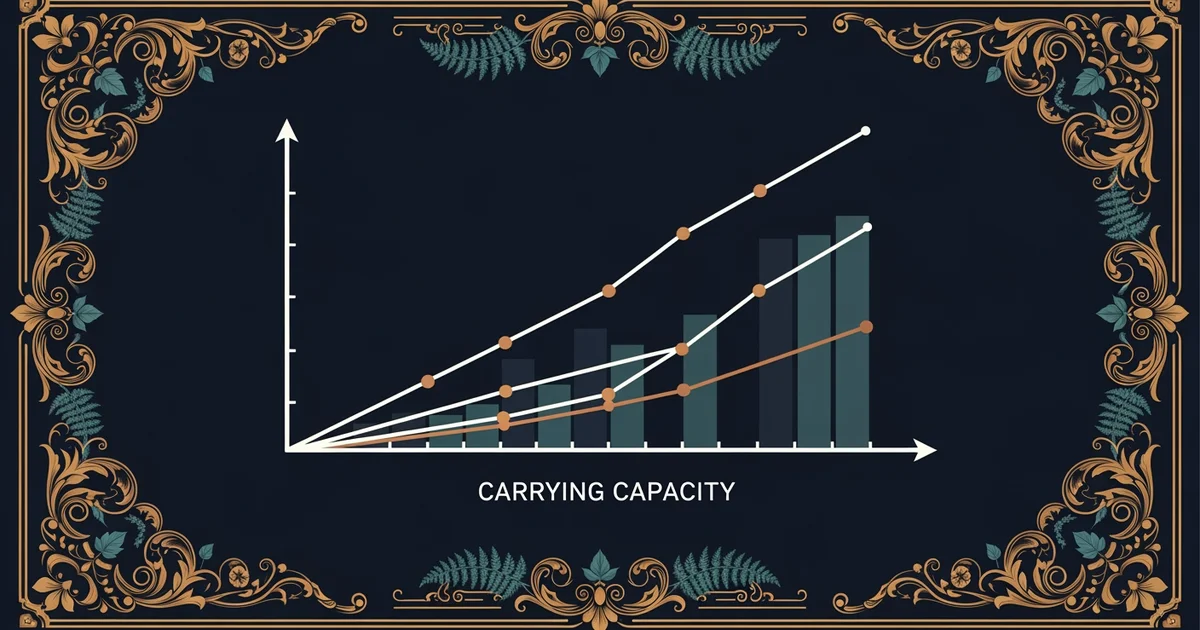
To forecast future population changes, we must first look at the carrying capacity of a specific environment. This concept represents the maximum number of individuals an area can support without running out of resources. If a group grows past this limit, the environment cannot provide enough food or water for everyone. Much like a business owner must plan their inventory based on the size of their shop, nature limits the number of organisms in a space. When we use math to model this, we often see a curve that starts by rising quickly but eventually levels off as space becomes scarce.
Mathematical models allow us to test different scenarios by changing specific variables within our equations. We might adjust the birth rate or the death rate to see how the total number of individuals shifts over time. These projections rely on the logic of systems modeling, which we explored in earlier stations. By combining the data from previous growth patterns with current environmental constraints, we gain a clear view of potential outcomes. This allows researchers to identify tipping points where a population might suddenly crash or flourish depending on external factors.
Predicting Future Outcomes
When we project these outcomes, we categorize the factors that influence survival into three distinct groups. Each factor plays a unique role in how a group maintains its balance within a shared habitat:
- Density-dependent factors include things like disease and competition for food that become more intense as the population grows larger, forcing the group to slow its rate of expansion.
- Density-independent factors involve events like severe weather or natural disasters that impact the group regardless of its size, creating sudden drops in the total number of individuals.
- Growth rate variables encompass the birth and death rates that determine the speed at which the population moves toward its maximum limit, defining the shape of the growth curve.
Key term: Extrapolation — the act of estimating future values by extending known data points beyond the range of our current observations.
We can compare these variables using a structured approach to see how they interact with each other. The following table shows how different environmental pressures affect the final population projection for a specific species group:
| Factor Type | Primary Influence | Impact on Population | Predictability |
|---|---|---|---|
| Density-Dependent | Resource Scarcity | Stabilizes growth | High |
| Density-Independent | Environmental Shifts | Causes fluctuations | Low |
| Growth Rate | Reproductive Speed | Determines peak time | Medium |
By analyzing this data, we can see why predicting the future of a group is so difficult. While we can calculate the theoretical limits of a habitat, we cannot always predict when a density-independent event will occur. This creates a tension between the mathematical certainty of our models and the messy reality of the natural world. Scientists often run thousands of simulations to account for these random events, providing a range of possible futures rather than a single answer. This approach helps us prepare for various outcomes, even when we cannot know exactly what will happen next.
Ultimately, the math shows us that populations are rarely static. They are constantly reacting to the limits of their environment and the shifting availability of resources. By mastering these projections, we learn how to manage conservation efforts and protect the balance of ecosystems. We use the logic of the past to build a better understanding of the future, ensuring that we can respond to changes before they become permanent problems. The ability to forecast is not about being perfect, but about being prepared for the most likely paths.
Mathematical projections allow us to anticipate the survival of living groups by balancing growth rates against the finite limits of their environment.
Understanding how to model these future changes is a vital skill for anyone interested in biology, ecology, or long-term resource management.