
Integrated Earth Models
Imagine trying to map the entire floor plan of a massive building while standing only in the dark basement. You cannot walk through the rooms or see the walls, so you must listen to the echoes of your own footsteps to guess the shape of the space. Scientists face this exact challenge when they study the hidden layers of our planet. They cannot travel to the core, so they rely on the way seismic waves bounce off deep boundaries to create a clear picture. By combining these sound-like vibrations with heat maps, researchers build a complete model of the Earth.
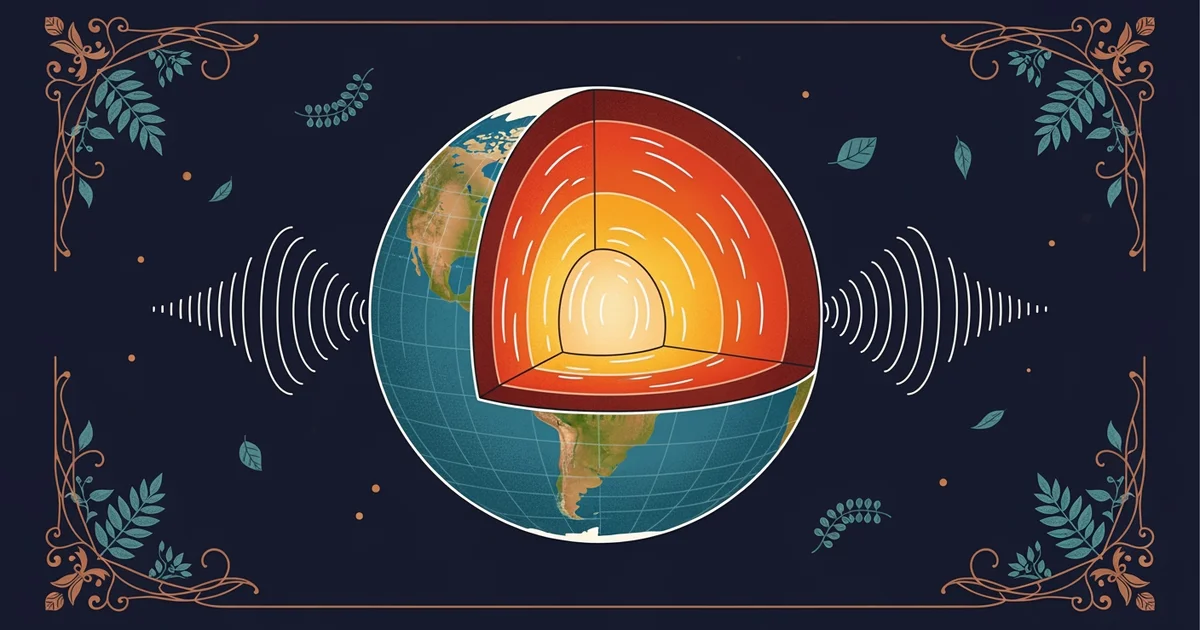
Synthesizing Seismic and Thermal Data
To build a true profile, experts must merge different types of data into one single view. Seismic waves act like a medical scan, revealing the density of rocks deep below our feet. When these waves hit a boundary between layers, they change speed or bounce back toward the surface. Thermal data provides the second piece of this complex puzzle by showing how heat moves through the planet. Just as you might judge the temperature of a coffee cup by touching the outside, scientists measure heat flow at the surface to infer the state of the inner layers. Integrating these two data streams allows us to see the difference between solid rock and flowing magma.
Key term: Integrated Earth Models — the process of combining diverse data sets like seismic speed and thermal flow to create a unified map of the planet's internal structure.
Think of this process like managing a complex household budget where you track both fixed bills and changing grocery costs. If you only looked at your bank balance, you would miss the reason for your spending habits. By tracking both the fixed costs and the variable costs, you gain a full picture of your financial health. Similarly, seismic data gives the fixed structure of the layers, while thermal data explains the dynamic energy flow. Together, they show how the planet stays active over billions of years.
Mapping the Planetary Layers
Once researchers combine these data sets, they can map the layers with much higher accuracy than before. The transition zones between the crust, mantle, and core become clearer when seismic and thermal models align. We can now identify where the mantle is hotter, causing it to rise toward the surface in slow cycles. These cycles of heat drive the movement of plates that shape our continents and oceans. The following table shows how these layers differ in their physical properties and the data used to track them.
| Layer | Primary State | Seismic Speed | Thermal Profile |
|---|---|---|---|
| Crust | Solid rock | Relatively slow | Low heat flow |
| Mantle | Plastic solid | Moderate speed | High heat flow |
| Core | Liquid metal | Very fast | Intense heat |
This table helps us distinguish between the brittle outer crust and the deep, flowing mantle. Seismic waves travel faster through the dense, hot core, while thermal data confirms the high energy levels found there. By comparing these values, we learn why the inner core remains solid despite the extreme heat. The pressure from the rest of the planet keeps the metal atoms locked in a rigid structure. This discovery would be impossible without looking at both seismic and thermal evidence at the same time.
Addressing Unresolved Planetary Tensions
Even with these advanced models, some questions remain unanswered by the research community today. We still struggle to understand the exact chemical makeup of the deepest mantle regions near the core. Some data suggests that ancient slab fragments sink all the way down, while other models show they stay trapped higher up. This tension between different data interpretations keeps the field active and exciting for new students. We must ask ourselves if our current tools are sensitive enough to detect these tiny chemical variations. The search for a perfect model continues as we refine our ability to interpret the signals from deep within the Earth.
True planetary understanding requires the fusion of multiple data sources to bridge the gap between surface observations and deep interior reality.
The next step in our journey will examine how these integrated models guide our future exploration frontiers.