
The Mystery of Earth's Interior
Imagine you are digging a hole in your backyard to find a hidden treasure chest. As you dig deeper, the soil changes color, the temperature rises, and the ground becomes much harder to break. You eventually realize that your shovel cannot reach the center of the world, no matter how hard you try to dig. Scientists face this exact problem when they try to study the deep layers of our planet. They cannot travel to the middle of the earth, so they must use clever methods to guess what exists beneath our feet.
The Layers Beneath Us
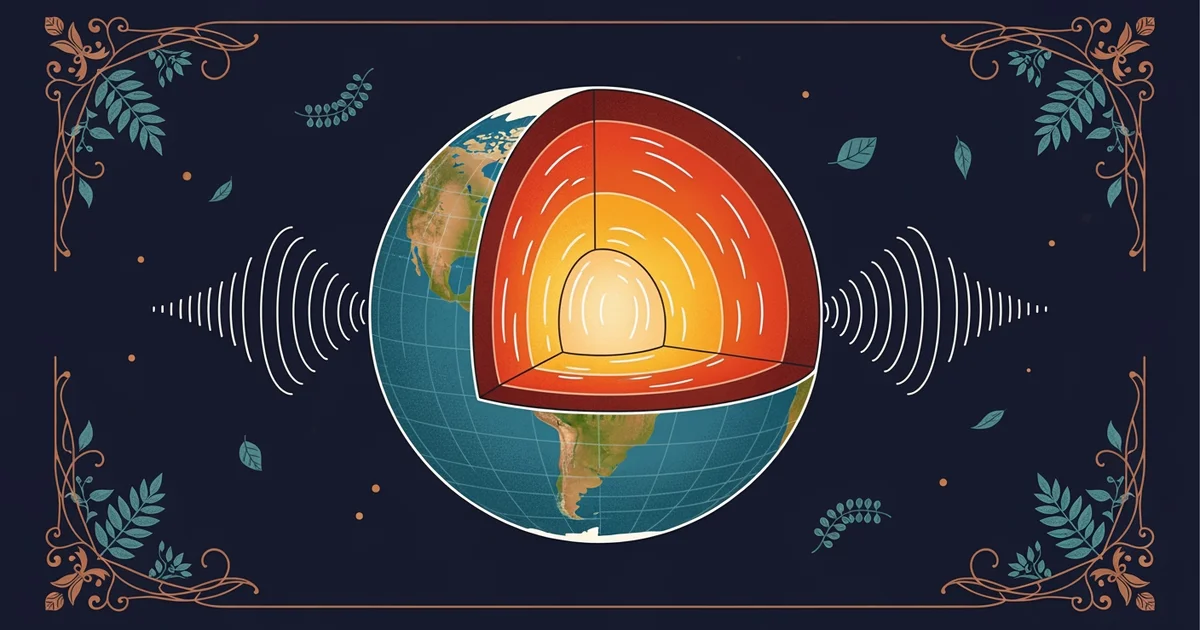
Earth is not a solid, uniform rock, but rather a complex structure made of distinct layers. Think of our planet like a giant, overcooked hard-boiled egg that has been dropped on the floor. The thin, outer shell represents the crust, which is the cool, solid surface where we live and build our cities. Below this shell lies the thick, hot mantle, which makes up most of the planet's volume. Finally, the center holds the dense core, which remains incredibly hot and pressurized compared to the surface layers. Just as the egg has different textures from the shell to the yolk, Earth changes its physical state as you move toward its center.
Key term: Crust — the thin, outermost solid layer of the planet that supports all life and human infrastructure.
Because we cannot drill through these layers, we rely on indirect evidence to understand their composition. We look at how energy waves travel through the planet during natural events to map out these hidden zones. This process is similar to how a doctor uses an ultrasound to see inside a body without needing surgery. By observing how these waves bounce or bend, experts can distinguish between solid rock and liquid metal. This allows us to create a detailed picture of the interior without ever setting foot inside the deep, dark depths.
Comparing Earth's Hidden Zones
To understand these layers better, we can look at their unique properties side by side. Each layer behaves differently depending on the heat and pressure it faces from the surrounding materials. The following table highlights the primary differences between these three major components of our home planet:
| Layer | State of Matter | Relative Thickness | Primary Characteristic |
|---|---|---|---|
| Crust | Solid rock | Very thin | Brittle and cool surface |
| Mantle | Semi-solid rock | Extremely thick | Slowly flowing, heated material |
| Core | Liquid and solid | Very dense | High heat and metallic iron |
These layers are not static, but rather interact in ways that shape our surface world. The movement of the mantle creates the forces that push continents around and build massive mountain ranges. Meanwhile, the core acts like a giant engine that generates the magnetic field protecting our atmosphere from space. Without these internal layers working together, our planet would look very different and likely could not support human life. We study these zones because they dictate everything from volcanic activity to the stability of the ground beneath our feet.
Understanding the interior is essential for predicting natural disasters and managing our limited global resources. While we remain stuck on the surface, our ability to look inward grows with every new technological advancement in mapping. By the end of this path, you will understand exactly how we map the unreachable center of our world.
Earth is composed of three distinct layers that vary in density, temperature, and physical state as you move toward the center.
By exploring how we study these layers, we will soon look at the historical attempts humans have made to drill through the crust.