
Seismic Wave Fundamentals
Imagine dropping a heavy stone into a still pond and watching the ripples move outward from the center. These circular waves travel across the water surface until they hit the shore and bounce back toward the middle. Scientists use a similar approach to study the hidden interior of our planet by measuring vibrations that travel through the ground. These vibrations act like invisible messengers that carry information about the deep materials they encounter along their long journey. By tracking these movements, researchers can map out the internal structure of the Earth without ever needing to drill through the thick crust.
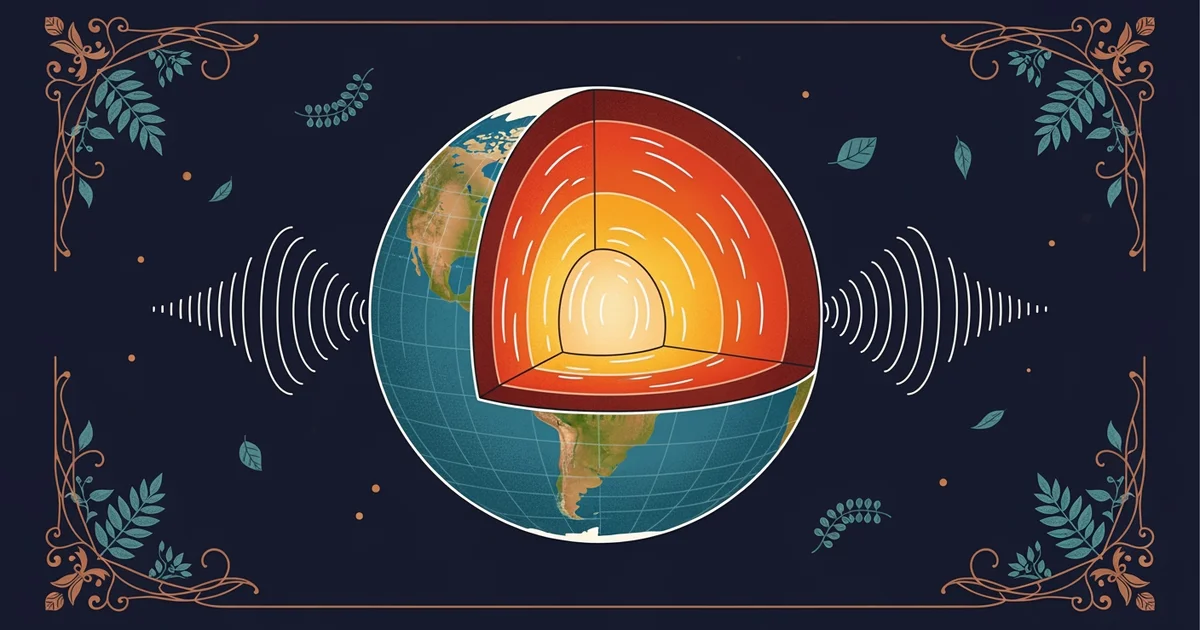
The Nature of Seismic Energy
When a large shift occurs deep beneath the surface, it releases a sudden burst of energy that radiates in all directions. This energy travels as seismic waves, which are vibrations that move through solid rock and liquid layers alike. Think of these waves like the sound moving through different rooms in a house when you play loud music. The sound travels easily through open air but changes its intensity when it passes through walls or thick furniture. In the same way, these ground vibrations change their speed and direction depending on the density of the material they cross.
Key term: Seismic waves — the pulses of energy generated by underground shifts that travel through the planet and reveal its hidden composition.
Because the Earth contains layers of varying density and heat, these waves do not move in straight lines or at constant speeds. They speed up when they hit dense, solid rock and slow down when they encounter softer or molten materials. By placing sensitive sensors across the surface, scientists catch these waves as they arrive from various depths. They compare the arrival times and the strength of the vibrations to calculate exactly what lies beneath the surface. This process allows us to see through the planet as if we had a giant medical scanner looking inside a human body.
Interpreting Wave Behavior Patterns
To understand how these signals reveal hidden density, we must look at how different wave types react to the environment. The behavior of these pulses provides the data needed to build accurate models of the deep interior.
- Primary waves push and pull through the rock like a spring, moving faster than all other types to arrive at sensors first.
- Secondary waves move in a side-to-side motion that can only travel through solid materials, effectively stopping when they hit liquid layers.
- Surface waves travel along the outer crust and carry the most energy, which causes the ground to roll during major events.
By tracking these differences, researchers can identify if a wave passed through a liquid core or a solid mantle. If a sensor fails to detect a specific wave type, it tells scientists that a liquid barrier must exist in that path. This method is the primary way we know the outer core of the Earth is made of molten metal. Without these waves, our view of the deep interior would remain a total mystery to modern science.
Comparing how these waves behave helps us determine the makeup of the deep interior layers:
| Wave Type | Movement Style | Travel Medium | Speed Status |
|---|---|---|---|
| Primary | Push and pull | Solids/Liquids | Very fast |
| Secondary | Side to side | Solids only | Moderate |
| Surface | Rolling motion | Outer crust | Slowest |
Analyzing this data allows us to build a clear picture of the planet. We use these patterns to distinguish between dense iron cores and lighter rocky mantles. Each wave provides one piece of a complex puzzle that spans thousands of miles below our feet. By combining thousands of these readings, we create a detailed map of the entire planet.
Seismic waves act as natural probes that reveal the density and state of hidden planetary layers by changing their speed and path as they encounter different materials.
Understanding how these waves bend and stop will help us explore how the movement of crustal plates shapes the surface of our world.