
Cave Ecosystems
When researchers entered the Lechuguilla Cave system in 1986, they discovered life forms that had evolved in complete isolation for millions of years. This discovery proved that underground environments are not just empty voids but are instead thriving, complex habitats for highly specialized organisms. While the surface world relies on sunlight to drive energy production, these subterranean systems function on an entirely different biological clock. Understanding these unique networks requires us to look past the darkness and see the survival strategies that allow life to flourish without a single ray of light.
Specialized Survival Adaptations
Because light is absent, organisms living in cave systems must abandon traits that are useless in the dark. Many species undergo troglomorphism, which refers to the physical changes that occur when an animal adapts to a life spent entirely underground. These creatures often lose their pigmentation, becoming translucent or white because color serves no purpose when no predators or mates can see them. Furthermore, their eyes often shrink or disappear completely, as vision is an unnecessary energy expense in a world defined by total blackness. Instead of sight, these animals rely on heightened senses such as touch and vibration to navigate their surroundings.
Key term: Troglomorphism — the evolutionary process where organisms develop specific physical traits to survive the unique pressures of a permanent cave environment.
Think of this adaptation like a business that stops printing expensive paper catalogs when all its customers move to an online-only platform. Just as the business saves money by cutting unnecessary printing costs, these cave dwellers save metabolic energy by not growing useless eyes. They redirect that saved energy into developing long antennae or sensitive skin receptors. These tools allow them to detect the slightest movement of water or prey in the pitch-black tunnels. This efficient energy management is the secret to their long-term survival in such a resource-scarce environment.
The Subterranean Food Web
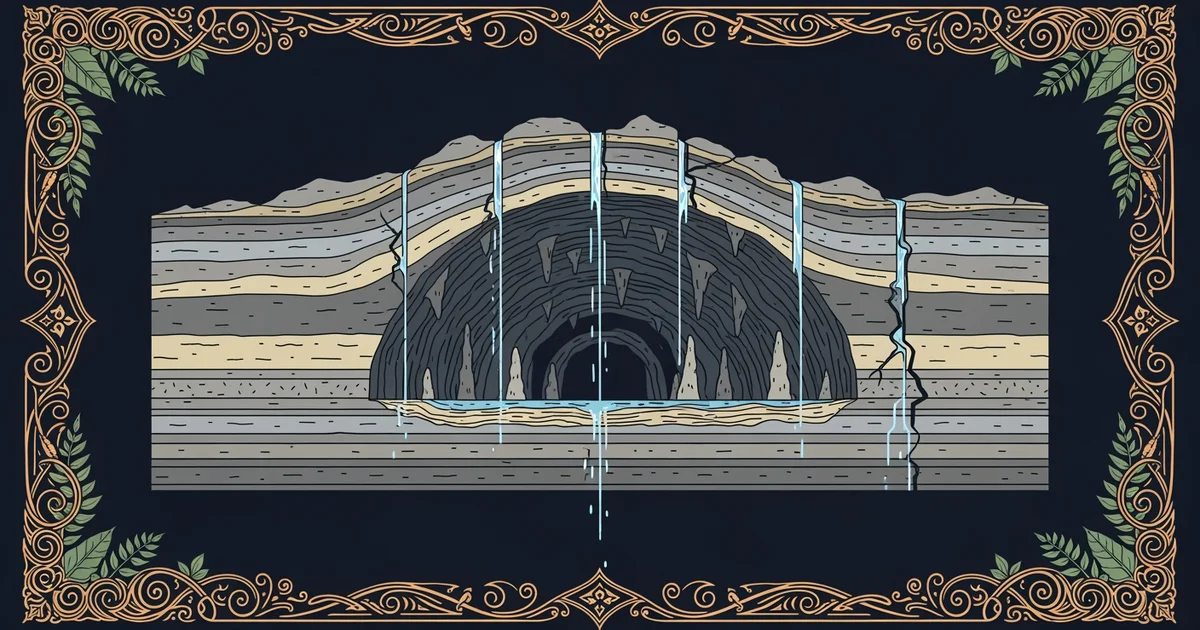
Since photosynthesis cannot occur without light, the base of the cave food web must come from external sources. Nutrients typically enter the system through water runoff, bat guano, or tree roots that penetrate the ceiling of the cave. These organic inputs support a community of microorganisms that act as the primary producers in the ecosystem. Larger creatures like cave crickets or blind beetles then consume these microorganisms or the organic debris. This cycle is a delicate balance, as any disruption to the input of nutrients from the surface can cause the entire cave population to collapse.
To better understand how these organisms are classified, we look at their relationship with the surface world:
- Trogloxenes are animals that use caves for shelter but must return to the surface to find food or reproduce.
- Troglophiles are species that can complete their entire life cycle within a cave but are also capable of living in surface habitats.
- Troglobites are the true cave specialists that are physically and biologically incapable of surviving anywhere outside the dark, stable environment of a cave.
This classification system helps scientists map out the dependency of different species on the subterranean environment. By tracking these groups, researchers can identify which animals are most at risk when human activity impacts the surface landscape above a cave. The survival of a troglobite is tied directly to the health of the surface ecosystem, proving that the ground beneath us is deeply connected to the world above. Protecting the land above is therefore essential for preserving the hidden life forms that have evolved to call the deep darkness their only home.
The survival of life in caves depends on extreme physical specialization and the efficient recycling of limited nutrients imported from the surface world.
But this delicate balance is threatened whenever human development alters the natural water flow that carries nutrients into these sensitive underground networks.