
The Saturation Zone Process
Imagine you are filling a giant sponge with water until it drips from every single tiny pore. The underground world beneath our feet behaves in a very similar way when rain soaks into the soil. Below the surface, water fills every open space between rocks and soil particles in a hidden, saturated layer. This massive, liquid-filled region acts as the primary engine for creating the hollow chambers we call caves. Understanding how this water moves is the key to seeing how solid rock disappears over time.
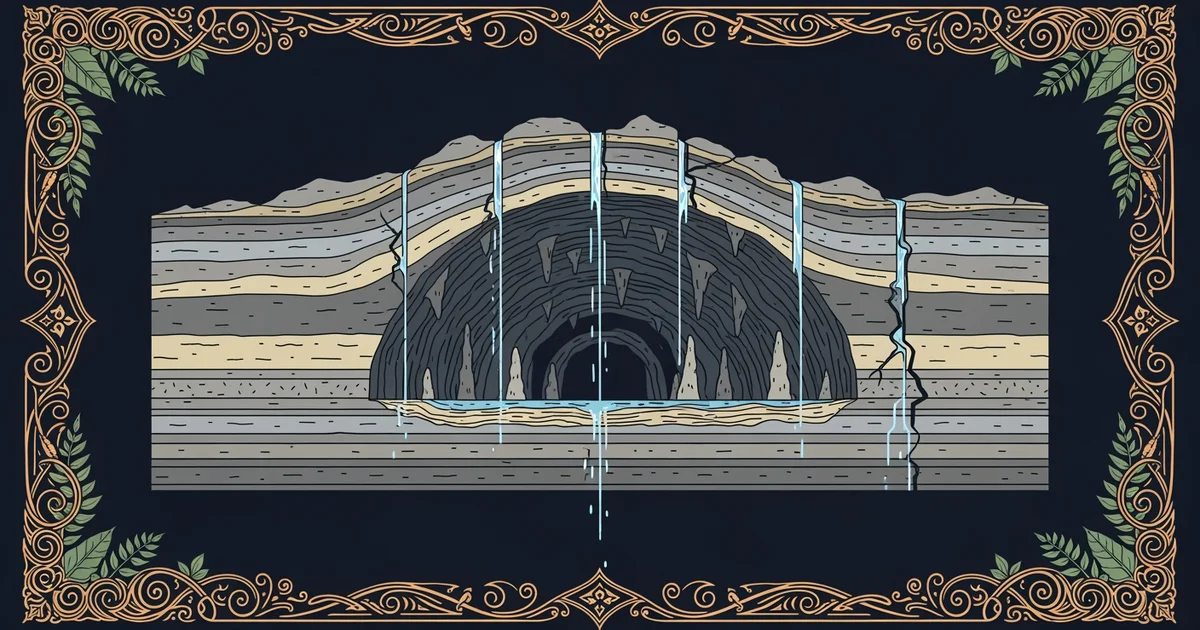
The Two Zones of Underground Water
Geologists divide the ground beneath us into two distinct layers based on how water behaves within them. The upper layer is known as the vadose zone, where air and water share the available space between rocks. In this area, water moves downward due to gravity, trickling through cracks like a leaky faucet in an old house. Below this sits the phreatic zone, where every single crack and pore remains completely filled with water. This lower region is fully saturated, meaning no air can exist because the pressure of the water keeps it packed tight. While the vadose zone relies on gravity to pull water down, the phreatic zone relies on slow, steady pressure to push water through the rock.
Key term: Water table — the underground boundary level that separates the unsaturated vadose zone from the fully saturated phreatic zone below it.
Think of the ground like a massive bank account where the water table acts as a spending limit. If you have plenty of money in your account, your spending power reaches deep, just like water filling the phreatic zone. If the water level drops, those deep areas dry out and lose their ability to dissolve rock. The phreatic zone is where the most intense chemical work happens because the water stays in contact with the rock for longer periods. This constant contact allows the water to become acidic and carve out large, rounded rooms over thousands of years.
Chemical Sculpting in the Saturated Layer
When water sits in the phreatic zone, it eventually becomes rich with minerals that it has pulled from the surrounding stone. This process is similar to how a bank loan works, where the water 'borrows' minerals from the rock to move them elsewhere. Because the water in the phreatic zone moves much slower than the water in the vadose zone, it has more time to react. This slow movement ensures that the water remains in constant contact with the limestone walls. Over time, this slow, steady interaction creates the vast, open galleries that define many of the world's most famous cave systems.
| Feature | Vadose Zone | Phreatic Zone |
|---|---|---|
| Water Status | Partially full | Completely full |
| Movement | Fast gravity drip | Slow pressure flow |
| Primary Action | Downward cutting | Broad chamber growth |
| Air Content | High levels | Zero levels |
The differences between these two zones determine the shape of the caves we find today. Caves formed in the vadose zone tend to be tall and narrow because the water follows a vertical path downward. In contrast, caves formed in the phreatic zone tend to be wide and rounded because the water fills the entire space. By looking at the shape of a cave, scientists can tell which zone was responsible for its creation. This distinction explains why some caves look like tall chimneys while others look like massive underground halls.
The saturation zone acts as a slow-moving chemical basin where water spends enough time in contact with rock to hollow out vast, wide underground chambers.
The next Station introduces Karst Landscape Features, which determine how surface terrain changes as these underground spaces grow.