
High-Speed Flight
When a pilot accelerates a jet past the speed of sound, the air ahead cannot move away fast enough to avoid the craft. This creates a sudden buildup of pressure waves that pile up in front of the nose, forming a physical barrier that the plane must punch through to maintain its high velocity. This is the sound barrier, a phenomenon where air molecules compress into a thin, dense wall of energy. Pilots often describe this transition as hitting a solid object, because the air behaves more like a liquid than a gas at these extreme speeds. This is the practical application of fluid dynamics from Station 12, where we learned how pressure changes dictate the flow of air around wings.
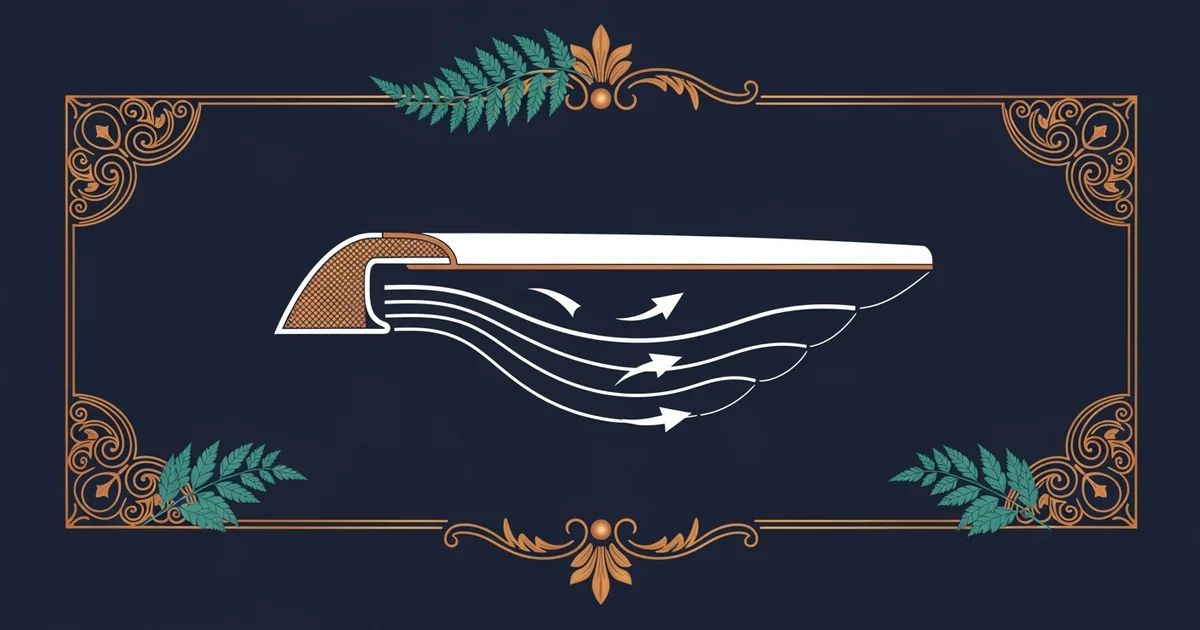
Understanding Shock Waves
As the aircraft nears the speed of sound, measured as , the air particles struggle to communicate their presence to the craft. Normally, pressure waves travel at the speed of sound to alert the surrounding air that an object is approaching. When the plane reaches this same speed, those waves can no longer travel forward, so they stack up on the leading edges of the wings. This creates a shock wave, which is a sharp, abrupt change in air pressure and temperature. Think of this like a busy city street where a car suddenly stops; the cars behind it must slam on their brakes instantly, creating a pileup of vehicles. The shock wave forces air to change its direction and density in a tiny fraction of a second, which creates massive amounts of drag that the engine must overcome to keep moving forward.
Key term: Mach number — the ratio of the speed of an object to the local speed of sound in the surrounding medium.
To manage these forces, engineers design wings that are thin and swept back at sharp angles. This design delays the formation of shock waves, allowing the plane to fly faster before the air becomes too turbulent to control. The following table shows how different speeds affect the way air moves around a wing:
| Speed Regime | Mach Range | Airflow Behavior | Drag Impact |
|---|---|---|---|
| Subsonic | Below $0.8$ | Smooth and steady | Low drag |
| Transonic | $0.8 - 1.2$ | Mixed shock waves | High drag |
| Supersonic | Above $1.2$ | Attached shock waves | Stable drag |
Managing Transonic Flight
When a plane enters the transonic zone, it experiences a mix of subsonic and supersonic airflow across different parts of its structure. This causes the center of pressure to shift backward, which can make the nose of the plane want to drop down unexpectedly. Pilots must use advanced flight control systems to compensate for these shifts, ensuring the aircraft stays level despite the uneven pressure distribution. The transition through this zone is the most difficult part of high-speed flight because the air is not uniform. Just as a runner feels the wind resistance increase when they sprint, a plane feels the air resistance spike as it enters this unstable range. Once the plane fully crosses into the supersonic regime, the shock waves stabilize, and the ride becomes much smoother for the pilot and the passengers on board.
Modern aircraft use variable geometry or specific airfoil shapes to keep this transition efficient. Without these designs, the energy lost to the shock waves would be too great to maintain high speeds for long durations. By managing how the air compresses, we can keep massive metal objects moving through the sky at speeds that would have been impossible only a few decades ago. We are essentially tricking the air into letting us pass through it by shaping the metal to guide the pressure waves away from the body of the aircraft. This mastery of fluid pressure allows for the long-range, high-speed travel that defines modern aviation across the globe today.
The transition through the sound barrier requires managing the sudden compression of air into shock waves by using specific wing shapes that reduce drag during the shift from subsonic to supersonic flow.
But this model of airflow breaks down when the aircraft reaches hypersonic speeds where the air itself begins to change chemically.