
Airfoil Geometry
Imagine a smooth stone skipping across a calm pond during a summer afternoon outing. The stone stays above the water because it pushes against the surface at a specific angle. Wing shapes act exactly like that stone by redirecting air to create upward force. This physical process allows massive airplanes to lift off the ground and stay steady in the sky. Understanding how these shapes work is the first step toward mastering the science of human flight.
The Anatomy of Wing Design
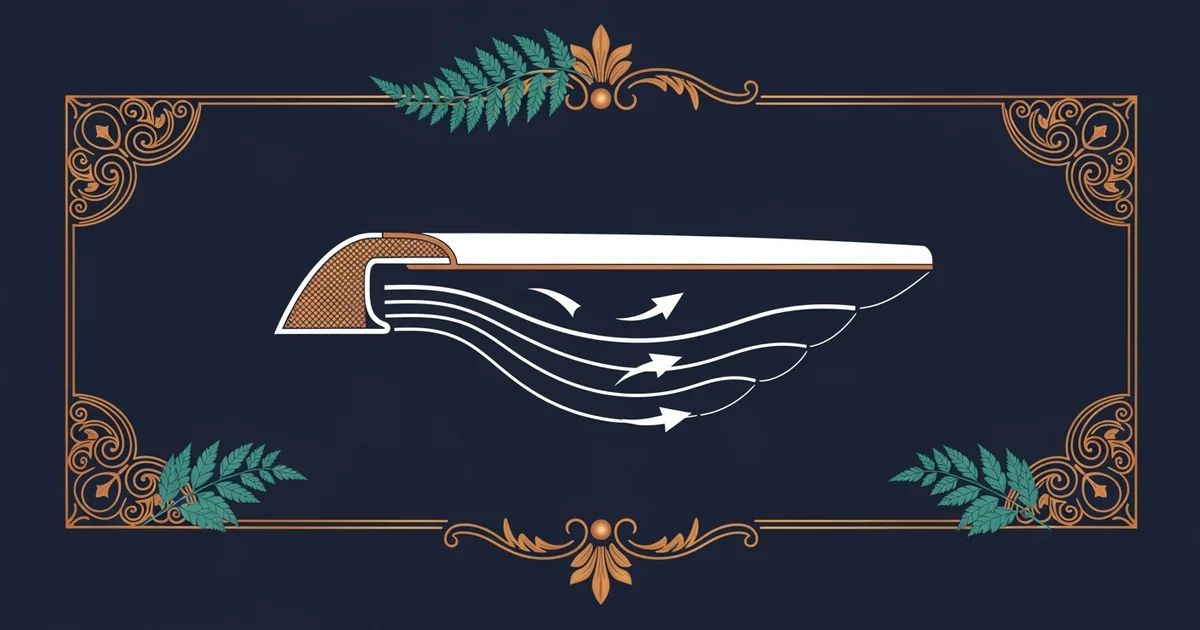
An airfoil is a specially curved shape designed to manipulate air flow patterns efficiently. When air moves over a wing, the shape forces the air to curve around the surfaces. The top of the wing is usually more curved than the bottom side. This creates a difference in how the air travels over each distinct surface area. The air moving across the top surface must travel a longer path than the air below. Because the air follows the surface, the shape dictates the direction of the flow. Engineers spend years refining these curves to maximize lift while minimizing the drag force.
Key term: Airfoil — a specialized wing cross-section designed to create lift by manipulating the flow of air.
Think of the wing like a bicycle rider coasting down a steep hill on a path. The rider must steer the bicycle to stay on the path without falling off the edge. Air particles act like the rider because they must follow the curve of the wing surface. If the wing curve is too sharp, the air cannot stay attached to the surface. This causes the air to break away and creates turbulence that ruins the smooth flight path. Maintaining this smooth attachment is essential for generating the lift needed to keep the plane aloft.
Airflow Patterns and Lift Generation
Once the air flows past the wing, the shape forces the air to deflect downward. This downward movement of air is a reaction to the shape of the wing section. The wing pushes the air down, and the air pushes the wing upward. This interaction is the fundamental reason why planes can overcome the heavy pull of gravity. The specific geometry of the wing determines how much force is generated at different flight speeds. Pilots change the wing shape during takeoff to increase this force when they need it most.
There are three main parts of an airfoil that determine how it handles the air:
- The leading edge is the front part of the wing that first meets the oncoming air stream — it acts as the initial point of contact for the air particles.
- The trailing edge is the sharp rear part of the wing where the air streams from the top and bottom finally meet again — this point controls the final direction of the air.
- The chord line is an imaginary straight line connecting the leading edge to the trailing edge — it serves as a reference for measuring the angle of the wing.
| Feature | Primary Function | Impact on Flight |
|---|---|---|
| Leading Edge | Initial Air Split | Stability Control |
| Trailing Edge | Flow Rejoining | Drag Reduction |
| Chord Line | Angle Reference | Lift Calculation |
By adjusting the angle of the chord line, a pilot changes how much air is deflected downward. This simple mechanical adjustment allows the pilot to manage the climb or descent of the craft. If the angle becomes too steep, the air flow will separate from the top surface. This loss of attachment results in a stall where the wing loses its lifting power. Understanding these limits is critical for safe operation in the sky.
The specific curve and angle of an airfoil determine how air is redirected to produce the upward force needed for flight.
The next Station introduces the Bernoulli Principle, which determines how air pressure changes govern the speed of the air flow.