
Drag Dynamics
Imagine you are running through waist-deep water at the beach while trying to reach the shore. You feel a constant, pushing force against your legs that makes every single step feel heavy. This resistance is exactly what an airplane faces as it moves through the air at high speeds. Even though air feels thin and light, it acts like a fluid that pushes back against any object moving through it. This invisible resistance is known as drag, and it is the primary force that opposes the forward motion of a flight vehicle. Understanding how this force works is essential to keep a plane moving efficiently through the sky.
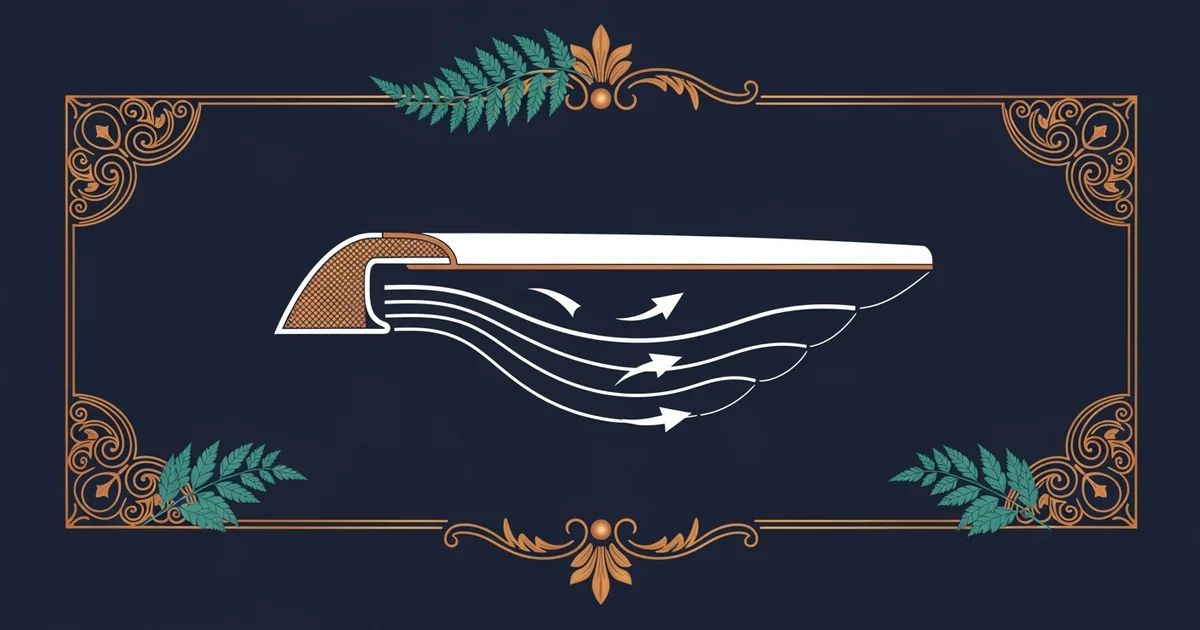
The Physics of Fluid Resistance
When an object moves through a fluid like air, it must push the molecules out of its way to create a path. This process requires energy, and the air molecules push back against the surface of the object in response. You can think of this like trying to walk through a crowded room where every person you bump into slows your progress slightly. The faster you try to move, the more people you hit, and the harder it becomes to maintain your speed. In the same way, an airplane experiences more resistance as it travels faster because it encounters more air molecules per second.
Key term: Drag — the aerodynamic force that acts opposite to the relative motion of any object moving with respect to a surrounding fluid.
This resistance is not just a single force but a combination of different effects that depend on the shape and speed of the vehicle. Engineers spend countless hours refining the outer shell of an aircraft to minimize these negative effects. If a plane has a blunt or irregular shape, the air cannot flow smoothly around it, which creates a large wake behind the craft. This wake acts like a vacuum that pulls the plane backward, making the engines work much harder than they should. By streamlining the design, engineers allow the air to rejoin smoothly at the rear of the plane.
Categorizing Aerodynamic Resistance
To manage these forces, experts break down the total resistance into specific types that affect the airplane differently. Each type of resistance changes based on the speed of the flight and the total surface area exposed to the wind. The following list describes the primary ways that air slows down a moving vehicle:
- Parasite drag is caused by the friction of air moving over the skin of the aircraft, which depends on the smoothness of the surface and the total area exposed to the flow.
- Form drag occurs because of the shape of the object, where a large, flat front surface creates a higher pressure zone that pushes against the forward motion of the vehicle.
- Induced drag is an unavoidable side effect of creating lift, as the air pressure difference between the top and bottom of the wings creates swirling vortices that pull the plane back.
These forces do not act in isolation, and designers must balance them to achieve the best possible fuel efficiency. If you reduce one type of resistance, you might accidentally increase another, which forces a constant trade-off during the design phase. For example, making wings very long might reduce the swirling vortices, but it also increases the total surface area, which leads to more skin friction. Navigating these complex relationships is why modern planes look the way they do today. Every curve and angle on a wing serves a specific purpose in managing the flow of air molecules around the craft.
Drag acts as an invisible barrier that requires constant energy input to overcome, forcing engineers to balance shape and speed for efficient flight.
The next Station introduces thrust production, which determines how planes generate the power needed to overcome drag and sustain forward motion.