
Bernoulli Principle
Imagine you are driving down a narrow city street as cars pass by you in the opposite direction. You might feel a sudden, strange tugging sensation pull your vehicle toward the faster-moving traffic beside you. This experience occurs because the air between the two vehicles speeds up, creating a region of lower pressure that draws objects inward. This simple, everyday road event serves as a perfect introduction to the core rule governing how wings generate lift for heavy aircraft. Understanding this mechanism helps explain how air pressure drops when fluid speeds increase, allowing massive metal wings to support significant weight.
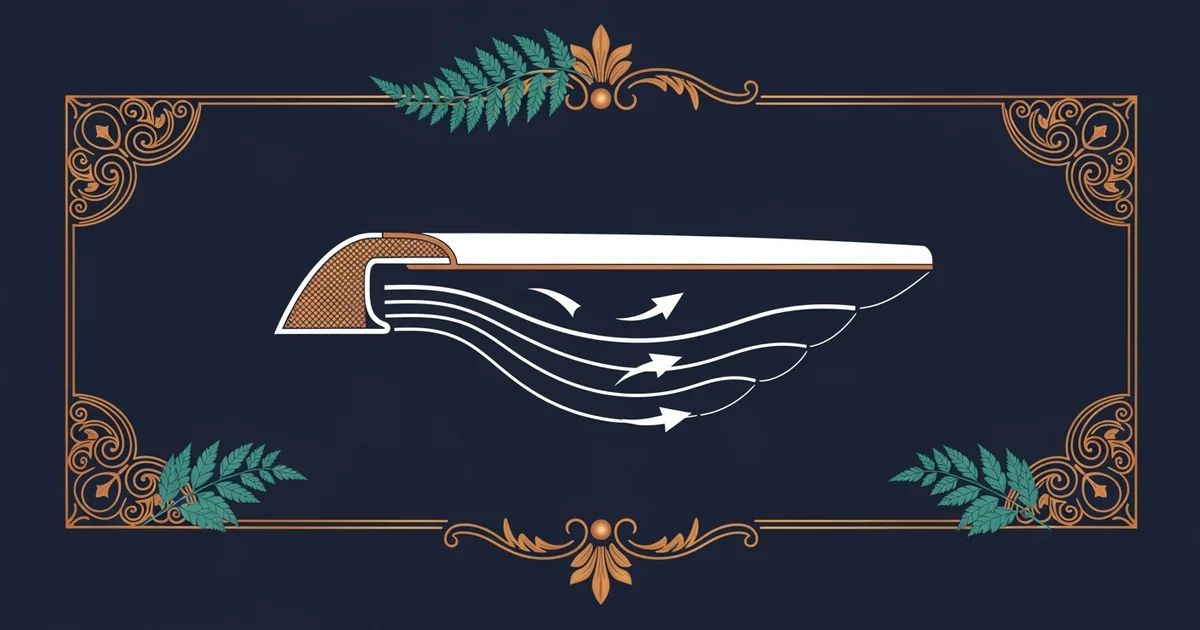
Pressure Dynamics in Moving Fluids
To understand flight, we must look at how air behaves when it flows over curved surfaces. The Bernoulli Principle states that as the speed of a fluid increases, the internal pressure within that fluid decreases. Think of a crowded hallway where people walk slowly; the pressure is high because everyone is packed together and bumping into one another. Now, imagine those same people suddenly start running toward an exit, spreading out as they move faster. Because they are moving quickly, the density of the crowd drops, and the outward pressure against the walls of the hallway decreases significantly. Air molecules follow this same logic when they flow over the top of a wing.
Key term: Bernoulli Principle — a physical rule stating that an increase in fluid velocity results in a simultaneous decrease in static pressure.
When air travels over the curved upper surface of an airfoil, it moves faster than the air passing underneath. This speed difference creates a pressure gap between the top and the bottom of the wing. Higher pressure air beneath the wing naturally pushes upward toward the area of lower pressure above the wing. This upward push is the fundamental force that overcomes gravity to keep the aircraft in the sky. If the air did not speed up on top, this pressure difference would vanish, and the plane would no longer be able to maintain its altitude.
Calculating the Force of Lift
We can express this relationship mathematically to predict how much lift a wing will generate during flight. The total energy in a moving fluid remains constant, meaning any gain in kinetic energy must come from a reduction in pressure energy. We represent this using a specific equation that balances the variables of velocity and pressure:
In this equation, represents the static pressure, is the air density, and is the velocity of the airflow. As the velocity increases, the term must grow larger, which forces the pressure to drop to keep the total sum steady. Pilots and engineers use this relationship to ensure that wings are shaped to maximize speed differences. The following table illustrates how these variables interact under different flight conditions to produce the necessary lift for stable operation.
| Variable | Change | Resulting Effect | Pressure Impact |
|---|---|---|---|
| Velocity | Increase | Higher speed | Pressure drops |
| Velocity | Decrease | Lower speed | Pressure rises |
| Density | Increase | More molecules | Higher force |
By adjusting the angle of the wing or the speed of the engines, the pilot controls these variables. When the plane speeds up, the air moving over the top surface accelerates, causing the pressure to drop even further. This drop creates a larger pressure differential, which generates more lift to support the weight of the aircraft. This process is continuous, requiring constant adjustment to maintain equilibrium during different phases of flight, such as climbing, cruising, or descending toward a runway for a landing.
The Bernoulli Principle explains that faster airflow creates lower pressure, which allows the higher pressure underneath a wing to push the aircraft upward against gravity.
The next Station introduces Drag Dynamics, which determines how air resistance opposes the forward motion created by the engines.