
Future Research Directions
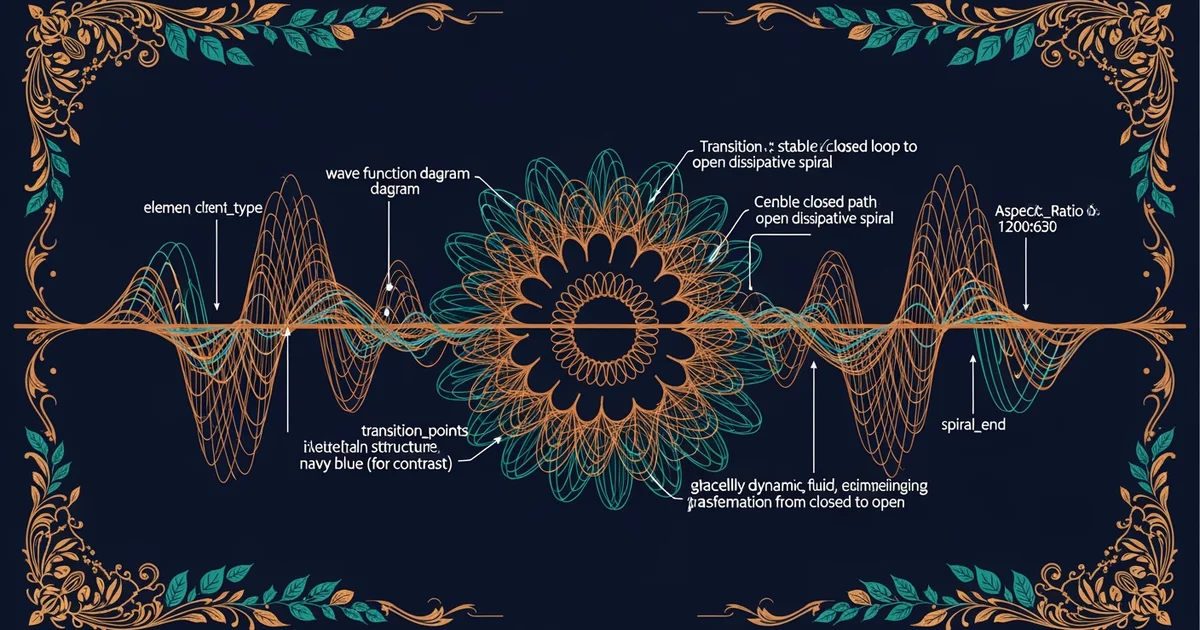
Even the most stable quantum systems eventually leak energy into their surroundings like a slow-draining battery. Scientists now study these open systems to see how they behave when energy flows inward or outward. This field of non-Hermitian quantum mechanics challenges our old ideas about how particles stay balanced. We must ask if these systems follow the same laws as closed systems when they gain or lose energy. Future research aims to map these paths to understand the hidden rules of quantum stability.
Emerging Research Trends
Researchers currently focus on how non-Hermitian systems change near a spectral singularity. This point happens when two energy states collapse into one, creating a unique physical response. Think of this like a busy highway where two lanes suddenly merge into one narrow exit. Traffic slows down and changes its flow pattern to adapt to the new space. Scientists observe similar behavior in quantum circuits where energy levels merge and shift the system state. They hope to use this effect to design better sensors that react to tiny changes.
Another major trend involves using non-Hermitian physics to control light in new ways. By engineering materials that lose and gain photons, experts create one-way paths for light signals. These paths act like a turnstile that only allows movement in a single direction. This technology could improve how we process data in future computers by preventing signal interference. Such control relies on the balance between gain and loss within the material structure. Mastering this balance allows for more stable and efficient energy transmission across complex networks.
Key term: Exceptional point — a special parameter value where the eigenvalues and eigenvectors of a system coalesce into a single state.
Current Research Challenges
One significant challenge remains the measurement of these systems without disturbing their delicate energy balance. When we observe a quantum system, we often force it to change its natural behavior. This interaction makes it hard to confirm if our theories match reality in the lab. Developing non-invasive tools is essential for confirming how these systems maintain their stability over long periods. Without better measurement techniques, we cannot fully test the limits of non-Hermitian quantum field theory.
| Research Area | Primary Goal | Current Barrier |
|---|---|---|
| Light Control | One-way flow | Material loss |
| Quantum Sensing | High precision | External noise |
| Energy Storage | Long stability | System leakage |
The table above shows how different research areas face unique obstacles in the laboratory. Researchers must overcome these barriers to turn theoretical models into functional technology. We must also consider how these systems interact with the environment on a larger scale. The following list highlights key areas for future exploration:
- Investigating how non-Hermitian systems evolve in time when they are far from their equilibrium state — this helps us predict their long-term behavior in real-world devices.
- Designing robust quantum gates that use non-Hermitian properties to correct errors automatically — this could solve the stability issues found in current quantum computing models.
- Exploring the connection between non-Hermitian quantum field theory and traditional thermodynamics — this bridge might explain how energy dissipation creates order in complex systems.
These goals require a deep understanding of how energy flows through open systems. By bridging the gap between theory and practice, we move closer to building stable quantum devices. The tension between gain and loss remains the central puzzle for the next generation of physicists. Addressing this will likely unlock new ways to manage information and energy at the smallest scales.
Future research into non-Hermitian quantum mechanics focuses on mastering energy flow to create stable, efficient, and highly sensitive quantum technologies.
The next station will synthesize these concepts to reveal how non-Hermitian rules integrate into our broader understanding of quantum reality.