
Complex Eigenvalues
Imagine a bank account that automatically gains interest while simultaneously losing a small fee for every transaction you make. In the world of quantum mechanics, this balance between growth and decay defines the behavior of complex systems that interact with their surroundings. While standard physics often assumes systems are perfectly isolated, real-world objects exchange energy with their environment constantly. When we model these open systems, the math requires us to move beyond simple real numbers and into the realm of complex values.
The Nature of Complex Eigenvalues
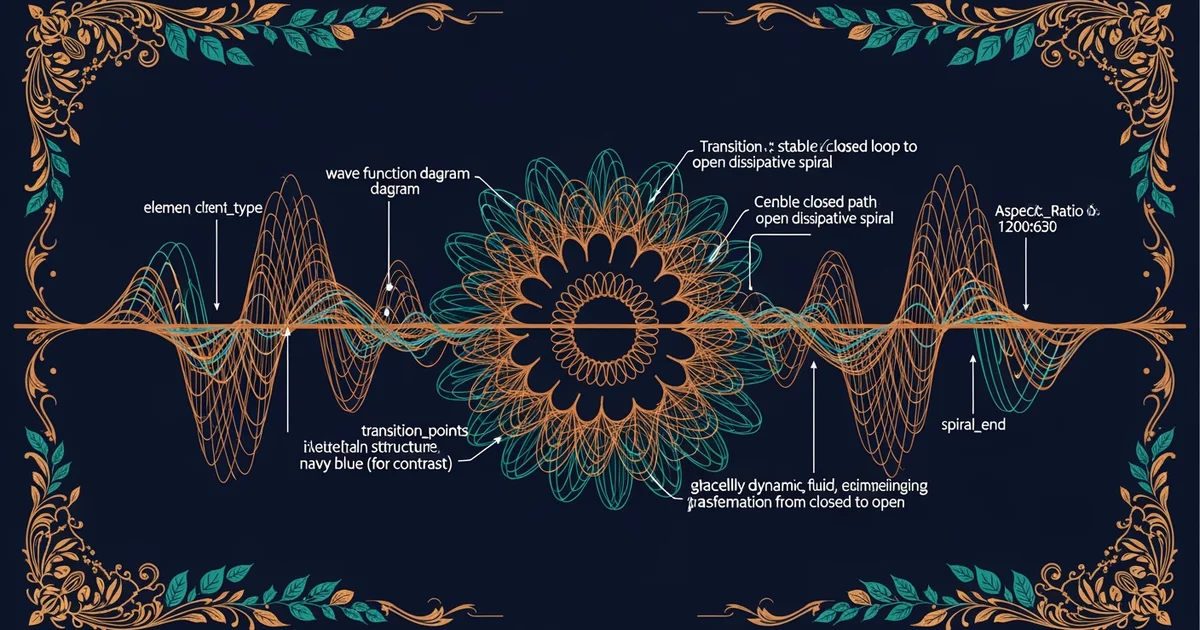
When scientists analyze quantum systems, they use operators to represent physical observables like energy or momentum. In standard closed systems, these operators are Hermitian, which ensures that all predicted energy levels are real numbers. However, open systems that gain or lose particles require non-Hermitian operators to describe their unique dynamics. These operators produce complex eigenvalues, which contain both a real part and an imaginary part. The real part corresponds to the oscillation frequency of the system, while the imaginary part tells us if the system is growing or shrinking over time. Think of this like a vibrating guitar string that slowly loses energy to the air until it eventually stops moving entirely.
Key term: Complex eigenvalues — values that include an imaginary component, representing the rate at which energy or probability enters or leaves a physical system.
This mathematical structure allows physicists to track how much energy a system retains during its evolution. If the imaginary part of the eigenvalue is positive, the system gains energy from the environment. If the imaginary part is negative, the system loses energy, leading to decay. This duality is essential for studying lasers, where light gain must balance against natural cavity losses. Without these complex numbers, we would lack a formal way to describe systems that are not perfectly stable or isolated from external forces. The math provides a precise map of how energy flows across the boundaries of a quantum object.
Energy Flow and System Stability
Understanding how these values influence stability helps us predict the lifespan of quantum states in various materials. If a system has a purely real eigenvalue, it remains stable and does not change its total energy over time. Once an imaginary component appears, the system enters a state of flux that dictates its future behavior. This transition is similar to a business that must balance its daily income against its operating expenses to remain open. If expenses consistently outweigh income, the business eventually closes, just as a quantum state with negative imaginary components eventually decays into nothingness.
We can summarize how these imaginary components dictate the physical state of a system through the following relationships:
- Positive imaginary parts indicate a growth in the system's probability amplitude, often representing an influx of energy or particles from an external source.
- Negative imaginary parts signal a decay in the system's probability amplitude, which shows that energy is leaking out into the surrounding environment.
- Zero imaginary parts identify a steady state where the system is perfectly balanced, maintaining its energy levels without any net gain or loss.
By monitoring these values, researchers can design synthetic materials that control light or electron flow with incredible precision. This ability to tune the gain and loss in a system is the foundation for modern sensing and communication technologies. The transition from real to complex values marks the exact moment a system stops being a closed box and starts interacting with the wider world. Mastering this concept is essential for anyone looking to build reliable quantum devices that function outside of a perfect laboratory vacuum. These mathematical tools turn the messy reality of energy loss into a predictable and manageable part of quantum design.
Complex eigenvalues provide the mathematical language to describe how open quantum systems gain or lose energy through their interaction with the environment.
But what does this non-Hermitian behavior look like when we observe the evolution of a quantum state over time?
Want this with sources you can check?
Premium Learning Paths for Physics & Quantum Mechanics are researched against open-access libraries — PubMed, arXiv, government databases, and more — with their distinctive claims cited to real sources and independently checked.
See what Premium includes