
Exceptional Points
Imagine two musical instruments playing notes that slowly drift toward each other until they merge into one single sound. This strange phenomenon happens in physical systems when specific parameters align in a unique way to collapse the state space. While typical systems maintain distinct identities for their energy levels, these special locations force those levels to collide and vanish. We call these unique locations Exceptional Points, which represent a fundamental departure from standard quantum behavior. Understanding these points helps us see how open systems behave when they gain or lose energy in controlled environments.
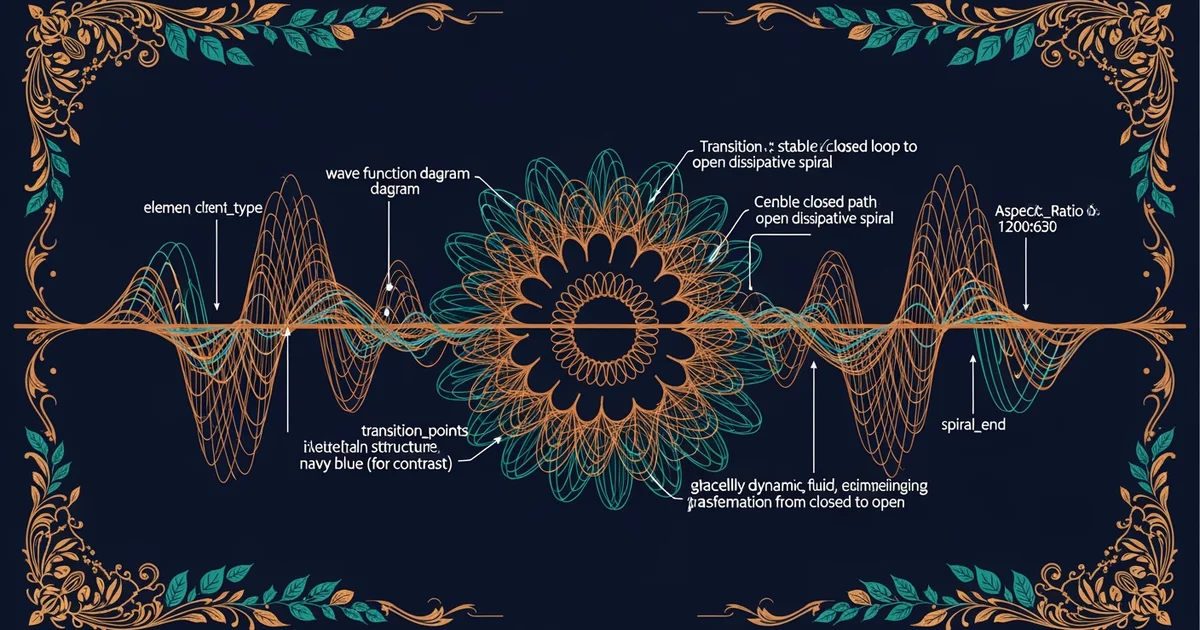
The Geometry of Collapsing States
When we study quantum systems, we often look at how energy levels shift as we change external factors. In most physical setups, energy levels move past each other without ever truly touching or merging. However, at an Exceptional Point, the system reaches a condition where both the energy levels and the underlying state vectors become identical. This creates a singularity where the standard rules of linear algebra no longer function as expected. Think of this like a bridge where two separate roads suddenly merge into a single, narrow lane that cannot support two cars at once. The system loses its ability to distinguish between different modes, effectively collapsing the complexity of the quantum state into a singular, degenerate point.
Key term: Exceptional Point — a specific parameter value in a non-Hermitian system where two or more eigenvalues and their corresponding eigenvectors coalesce into one.
This collapse is not just a mathematical curiosity but a real physical event that changes how the system responds to external forces. When a system approaches this point, it becomes incredibly sensitive to tiny changes in its environment. This sensitivity is similar to a balancing scale that sits perfectly level until a single grain of sand tips it over. Because the states have merged, the system lacks the structural stability to resist small perturbations. This makes these points highly useful for building sensors that detect minute shifts in pressure or light. The transition happens because the system is no longer constrained by the conservation laws that keep energy states separate in closed, isolated environments.
Dynamics Near Singularities
To understand why this happens, we must look at how open systems interact with their surroundings through gain and loss. In a closed system, energy is conserved, and states remain distinct throughout the evolution of the system. In an open system, however, the interaction with the environment allows energy to flow in and out constantly. This flow changes the mathematical description of the system, often requiring the use of non-Hermitian operators to track the evolution. When the parameters of this flow reach a critical balance, the system hits an Exceptional Point. The following table highlights the differences between standard states and these singular points.
| Feature | Standard State | Exceptional Point |
|---|---|---|
| Eigenvalues | Distinct and stable | Coalesced and singular |
| Sensitivity | Low to moderate | Extremely high |
| Topology | Simple mapping | Complex Riemann surface |
This list highlights why these points matter for modern physics research:
- The sensitivity allows for the design of high-precision sensors that outperform traditional optical or mechanical devices by orders of magnitude.
- These points enable non-reciprocal light transport where signals travel in one direction but are blocked when moving in the opposite direction.
- The unique topological structure forces the system to undergo phase transitions that are impossible in standard, closed quantum systems.
By carefully tuning the gain and loss parameters, researchers can trap a system at this threshold. This trap creates a state of matter that is neither fully stable nor fully chaotic. The system exists in a state of constant transition, reflecting the delicate balance between the energy added and the energy removed. As we explore these dynamics, we find that the geometry of the parameter space dictates the outcome of the quantum process. The collapse of the states is a direct result of the system's openness to the environment, proving that loss is not always a disadvantage in quantum design.
Exceptional points represent a critical threshold where quantum states collapse into a single identity due to a precise balance of energy gain and loss.
The next Station introduces Dissipative Quantum Dynamics, which determines how these open systems evolve over time once they move away from the singularity.