
Introduction to Non-Hermiticity
Imagine a bank account that automatically gains interest while also charging fees for every transaction you make. You cannot predict the final balance by simply looking at the initial deposit because the account is constantly interacting with the outside world through these additions and subtractions. In the standard world of quantum mechanics, we usually assume systems are isolated and perfectly closed to avoid such complexity. However, most real physical systems are open and constantly exchange energy with their surroundings, which forces us to look beyond the rigid rules of traditional physics.
Understanding Non-Hermitian Operators
When physicists study systems that gain or lose energy, they must move away from the standard mathematical tools used for closed systems. In traditional quantum theory, we rely on Hermitian operators to represent physical observables like energy because they ensure that probabilities remain constant over time. These operators possess real eigenvalues, which act like fixed points on a ruler that never shift or disappear during an observation. When a system interacts with an environment, the energy is no longer conserved, and the standard mathematical framework fails to describe the behavior accurately. This is where the concept of a non-Hermitian operator becomes essential for modern research.
Key term: Non-Hermitian operator — a mathematical tool used to describe quantum systems that are open to their environment and experience energy gain or loss.
Think of a non-Hermitian system like a leaky bucket that you are simultaneously filling with a garden hose. If you only measure the water inside the bucket, the level changes based on the balance between the inflow and the outflow. A Hermitian system would be a sealed container where the water level remains strictly constant regardless of time. In the quantum realm, these operators allow the energy levels to become complex numbers rather than just real values. This transition represents the physical reality of energy leaking out into the environment or being pumped in from an external source.
Energy Exchange and Quantum Stability
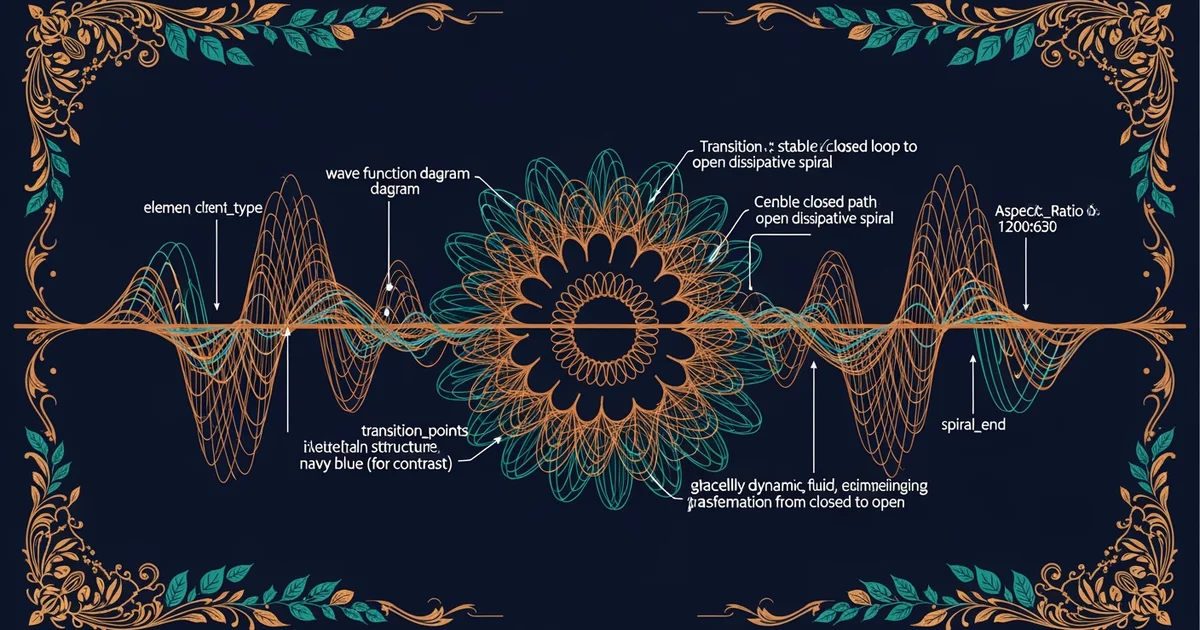
Because open systems exchange energy, the probability of finding a particle in a specific state does not always stay at one. Non-Hermitian operators handle this by allowing the wave function to grow or decay over time, reflecting the physical gain or loss of energy. This behavior is not a mistake in the math but a direct reflection of how the system interacts with its surroundings. By tracking these changes, we can model complex phenomena like lasers or biological sensors where energy flow is the primary driver of the system's function.
To see how these operators differ from standard ones, consider the following comparison of their core physical properties:
| Property | Hermitian Operator | Non-Hermitian Operator |
|---|---|---|
| Energy eigenvalues | Always real numbers | Can be complex numbers |
| Probability density | Stays constant over time | Changes based on energy flow |
| System type | Closed and isolated | Open and interactive |
These differences mean that we can no longer use the simple rules of conservation that define traditional quantum mechanics. Instead, we must account for the specific ways that energy enters or leaves the system through the environment. This shift in perspective allows us to describe systems that were previously considered impossible to calculate using standard quantum methods. By embracing these complex values, we gain a much deeper understanding of how particles behave in real-world conditions where isolation is rarely possible.
Non-Hermitian operators extend quantum theory by providing a mathematical framework to describe systems that exchange energy with their environment.
The next Station introduces PT Symmetry Basics, which determines how these non-Hermitian systems can still remain stable despite losing or gaining energy.