
Dissipative Quantum Dynamics
Imagine a spinning top that slowly loses its momentum because it rubs against the rough ground. This simple loss of energy is exactly what happens to quantum systems when they interact with their surroundings.
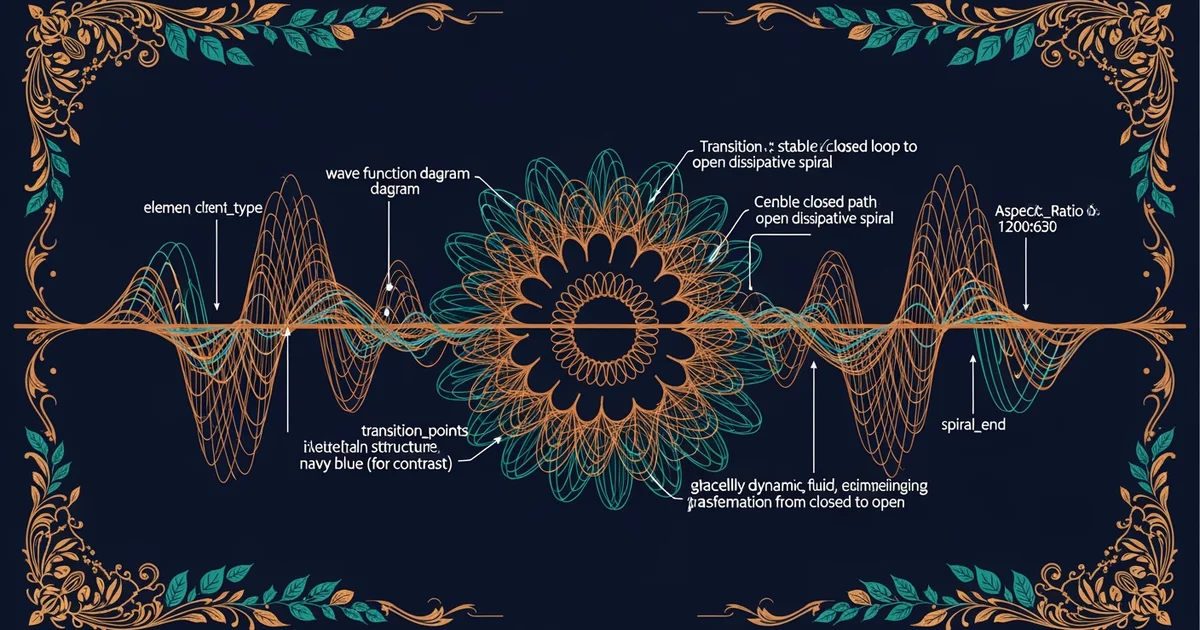
The Nature of Energy Loss
Quantum systems are rarely isolated from the rest of the universe in practical experiments. When a system exchanges energy with its environment, it undergoes dissipative quantum dynamics which alters its evolution. This process is not just a minor noise factor but a fundamental change in how the wave function behaves over time. In an ideal closed system, the total energy remains constant and the state evolves according to unitary operators. However, open systems leak information and energy into the environment through constant interactions. This interaction causes the quantum state to lose its coherence and eventually decay into a mixed state. Think of this like a bank account where small fees are constantly deducted during every transaction. Even if the initial balance is large, these small, hidden costs eventually drain the total value over time. In physics, this leakage prevents the system from maintaining its pure quantum state indefinitely. The environment acts as a sink that absorbs the excess energy from the quantum system. This process forces the system to reach a new equilibrium that reflects the influence of the external world.
Understanding the Mechanism
To manage these losses, scientists use specific mathematical tools to track how probabilities change within the system. The evolution of an open quantum system is often described by a master equation that accounts for these external influences. We can categorize the effects of dissipation on a quantum wave function based on how the environment interacts with the particles. The following list highlights the key consequences of energy dissipation in these delicate physical systems:
- Decoherence occurs when the phase relationship between different parts of the wave function is destroyed by environmental interaction — this prevents the system from showing interference patterns that are typical of pure quantum behavior.
- Energy relaxation happens as the system sheds its excess energy to the surrounding environment until it settles into a stable ground state — this process is similar to a hot cup of coffee cooling down to match the room temperature.
- State mixing transforms a pure quantum state into a statistical mixture of possible outcomes — this makes the system behave more like a classical object that has a definite probability distribution.
Key term: Dissipation — the irreversible process where a quantum system loses energy or information to its environment, leading to the decay of quantum coherence.
These effects demonstrate why maintaining a quantum state requires extreme isolation from heat, light, and vibrations. If we cannot stop the environment from interfering, we must instead model the interaction to predict the final state of the system. By understanding the rate of dissipation, researchers can design better shields or error correction protocols for quantum devices. The interaction is not always a negative force, as it can sometimes be used to steer the system toward a desired configuration. Controlling this flow of energy is the primary challenge for building stable quantum computers that survive in a real-world environment.
Comparing System Types
| System Type | Energy Status | Mathematical Description | Environment Role |
|---|---|---|---|
| Closed | Constant | Unitary evolution | None (isolated) |
| Open | Fluctuating | Master equation | Energy sink/source |
| Dissipative | Decreasing | Non-Hermitian operator | Information drain |
The table above shows how the classification of a system changes based on its relationship with the surrounding space. A closed system is a theoretical ideal that allows for perfect predictability over long durations. In contrast, an open system requires us to track the environment as a partner in the evolution of the state. Dissipative systems specifically focus on the decay process that occurs when energy flows out of the primary system. By tracking these variables, we can predict how long a quantum state will persist before it loses its unique properties. This knowledge is essential for any technology that relies on quantum superposition or entanglement. The transition from pure to mixed states defines the limit of our control over quantum information. Mastering these dynamics allows us to bridge the gap between abstract theory and the messy reality of physical hardware.
Dissipative quantum dynamics describes how open systems lose energy to their environment, causing a transition from pure quantum states to stable, mixed classical states.
The next Station introduces complex eigenvalues, which determine how these dissipative systems change their behavior over long periods of time.