
Beyond Traditional Limits
Imagine a bank account that only allows deposits and never permits any withdrawals, forcing you to hold every dollar you ever earned. Traditional quantum physics works much like this rigid, closed account because it assumes that systems must conserve energy perfectly at all times. This strict rule of conservation creates a mathematical framework where energy cannot leak out or enter from the surrounding environment. While this model describes isolated particles well, it fails to explain the messy, open systems we see in the real world. By clinging to these old rules, we ignore how systems naturally lose or gain energy through constant interaction with their surroundings.
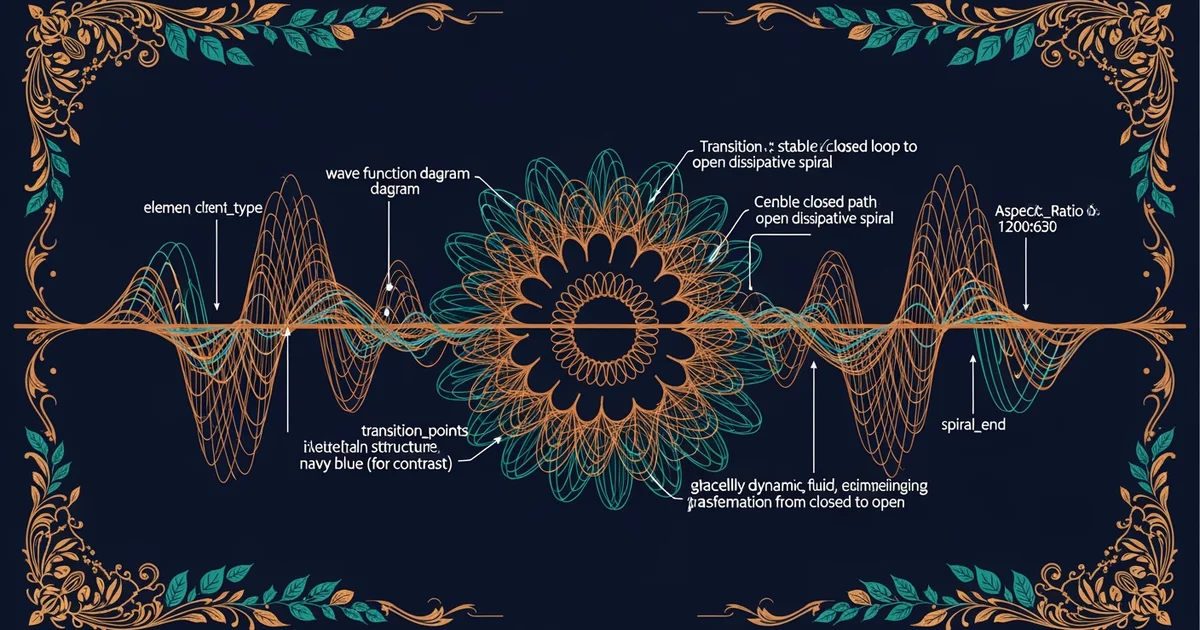
The Rigidity of Hermitian Systems
When physicists use the term Hermitian, they refer to a specific mathematical requirement that ensures all observable energy values remain real numbers. This requirement acts like a locked gate, preventing any energy flow between the system and its environment during the observation process. If a system is truly isolated, this approach provides accurate predictions about how particles behave over time. However, most physical systems are not isolated because they interact with heat, light, or vibrations from the outside world. When we force these open systems into a Hermitian box, we lose the ability to model decay, growth, or energy loss accurately. Researchers look beyond this model because they need tools to describe how energy leaks out of a system into the environment. They also want to understand how external power sources can inject energy into a system to maintain a steady state. These two motivations drive the shift toward models that do not rely on the strict conservation laws of traditional quantum mechanics.
Key term: Hermitian — a mathematical property of operators that ensures all measurable physical values, such as energy, remain real numbers.
Moving Beyond Closed Boundaries
To move forward, we must accept that systems often exchange energy with their environment in ways that traditional models cannot handle. Think of this like managing a business that must account for both incoming revenue and outgoing expenses to stay afloat. A system that only tracks revenue without noting expenses will eventually present a false picture of its actual financial health. In the same way, quantum systems that ignore energy exchange provide a limited view of how particles evolve in real conditions. Scientists now use new mathematical frameworks to account for these open boundaries where energy is not conserved in the traditional sense. This transition allows for a deeper understanding of how systems can remain stable even when they are losing or gaining energy constantly. By relaxing the old constraints, we gain a more flexible language to describe the complex behavior of light and matter in modern experiments.
| Feature | Hermitian Models | Non-Hermitian Models |
|---|---|---|
| Energy Flow | Strictly closed | Open and dynamic |
| Stability | Fixed and rigid | Adaptive and steady |
| Application | Isolated atoms | Interacting systems |
Researchers prioritize these new models because they provide a clearer picture of how energy moves through a system. The following points highlight why this shift is essential for modern physics research:
- Researchers need to account for energy dissipation because real particles lose energy to their surroundings, which traditional models often treat as an error rather than a fundamental process.
- Scientists seek to model gain and loss simultaneously because many modern devices, such as lasers, rely on a balance between energy input and output to function effectively.
- Expanding the mathematical framework allows for the discovery of new physical phenomena that simply cannot exist under the strict rules of traditional quantum mechanics, opening doors for future technology.
By embracing these broader concepts, we move closer to a complete description of the universe that includes both the stable and the changing. We no longer have to view energy loss as a failure of our math, but rather as a feature of the system itself. This change in perspective is the first step toward mastering the physics of open systems.
Understanding quantum systems requires moving beyond models that assume energy is always perfectly trapped within a closed boundary.
The next step involves exploring how we can use non-Hermitian math to describe these open systems without losing our ability to make accurate predictions.