
Non-Unitary Evolution
Imagine a bank account that loses a small fee every time you make a transaction. In the world of standard quantum physics, energy is conserved like a vault that never leaks, but real systems often interact with their environment in ways that remove energy. This process of losing or gaining energy over time is what we call non-unitary evolution, a departure from the perfect preservation of quantum states.
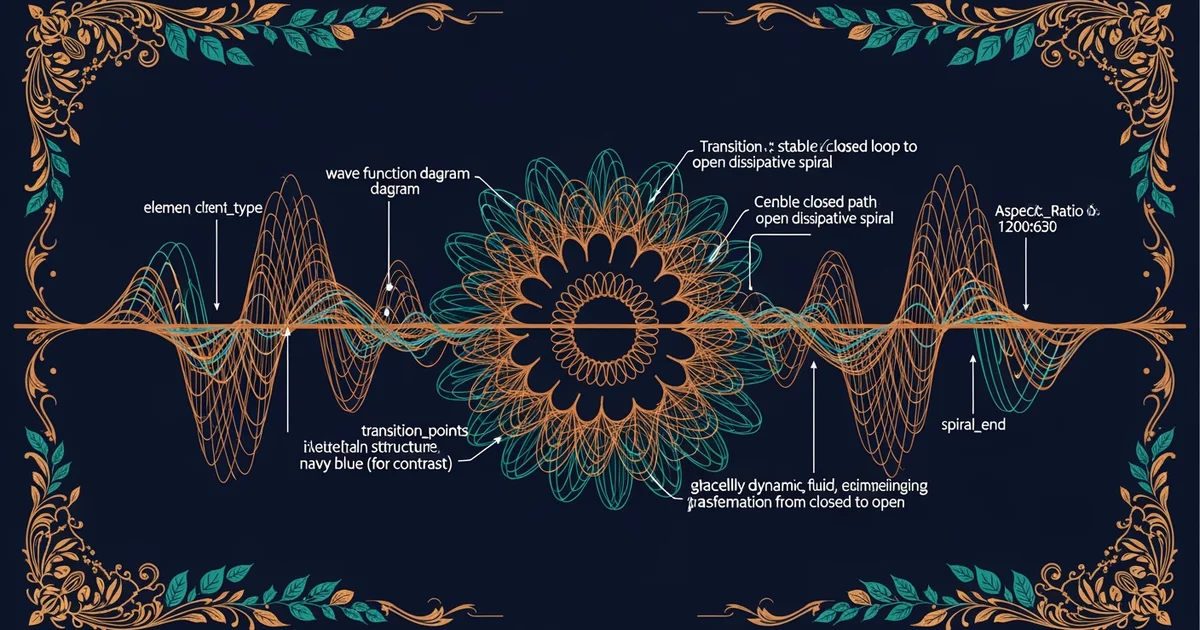
Understanding Unitary Versus Non-Unitary Dynamics
Standard quantum mechanics relies on unitary evolution to ensure that the total probability of a system remains exactly one. When a system is closed, the mathematical operator governing its change is unitary, meaning it preserves the length of the state vector throughout time. Think of this like a perfectly sealed container where no air enters or leaves, keeping the pressure steady regardless of how you move the box around. In contrast, non-unitary processes occur when a system is open and exchanges information or energy with its surroundings.
Key term: Non-unitary evolution — the process where a quantum system changes over time such that the total probability is not conserved within the system itself.
When a system loses energy to its environment, the mathematical description of its state must account for this "leakage" to remain accurate. This transition from unitary to non-unitary behavior often appears when we study systems with gain or loss, such as optical fibers or micro-lasers. If you treat these systems as closed, your predictions will fail because they ignore the external interactions that dictate the system's actual behavior. By using non-unitary operators, we can model how energy dissipates or accumulates, allowing us to describe complex physical phenomena that unitary math alone cannot capture.
Modeling Open Quantum Systems
To effectively track these changes, physicists use specific frameworks that allow the total probability to change, reflecting the physical reality of energy loss. This approach is essential for understanding how quantum information degrades in real-world devices like quantum computers, where noise from the environment acts as a constant drain on the system's stability. The following table highlights the primary differences between these two ways of describing quantum motion:
| Feature | Unitary Evolution | Non-Unitary Evolution |
|---|---|---|
| Energy | Conserved perfectly | Gains or loses energy |
| Probability | Stays constant | Changes over time |
| System | Closed and isolated | Open and interacting |
When we analyze these systems, we must recognize that the loss of energy is not a failure of the theory but a feature of the interaction. Just as a bank account with fees requires a different tracking method than a vault, non-unitary systems require operators that account for the environment. These operators allow us to calculate the decay rates of states, which is vital for designing stable quantum hardware that can withstand the influence of external noise.
- Identify the interaction: Determine if the system is exchanging energy with the outside world.
- Select the operator: Choose a non-unitary operator that accounts for the specific gain or loss.
- Calculate the decay: Use the math to predict how quickly the state will lose its intensity.
- Adjust the model: Refine the parameters to match the observed energy dissipation in the system.
By following these steps, we can predict the behavior of open systems with high accuracy. This allows us to harness the unique properties of non-hermitian physics for new technologies. We are moving beyond the ideal "sealed" systems of early quantum theory to embrace the messy reality of open systems that interact with their environment. This shift is the foundation of modern research into quantum control and stability.
Non-unitary evolution describes how quantum systems change when they exchange energy with an external environment, requiring us to move beyond the assumption of perfectly conserved probability.
But what happens when these open systems reach a point where their internal energy balances perfectly with the environment?