
Topological Non-Hermitian Phases
Imagine a highway where cars can only drive in one direction, yet they somehow disappear and reappear at the start of the road. In the strange world of quantum physics, open systems that exchange energy with their surroundings do exactly this, defying the strict rules of closed systems. These systems are not just leaking energy into the void; they are actively shaping the paths that particles take through space. When we study these non-Hermitian systems, we discover unique topological features that simply do not exist in standard, energy-conserving models. These features allow particles to move in ways that seem to break the laws of physics as we traditionally understand them.
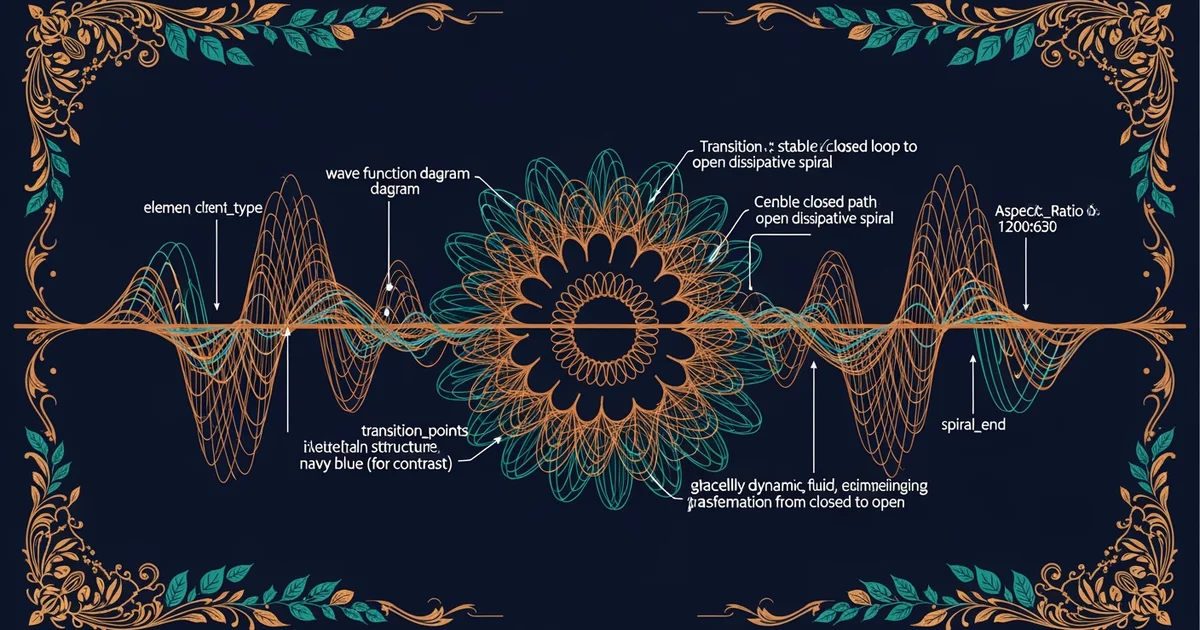
Understanding Topological Non-Hermitian Phases
When a quantum system is open, the mathematical operator describing it—the Hamiltonian—loses its Hermitian property. In a standard system, the energy levels are always real numbers, representing a stable and balanced state. However, in these non-Hermitian systems, the energy levels often become complex numbers, which suggests that the system is either gaining or losing energy over time. This gain and loss creates a specific kind of landscape where particles can become trapped or directed along specific edges. Think of this like a water park slide where the water flow is uneven, forcing the rider into a specific, unavoidable path regardless of their starting position.
Key term: Topological Phase — a state of matter defined by global geometric properties that remain unchanged even if the system is slightly bent or deformed.
These systems exhibit a phenomenon known as the non-Hermitian skin effect, where particles pile up at the boundaries of a material. This effect occurs because the energy landscape is tilted, effectively pushing every particle toward one specific edge of the structure. Unlike a standard material where electrons might spread out evenly, these topological phases force them to cluster together. This clustering is not a result of crowding, but a fundamental outcome of the way the system interacts with its environment. The math behind this involves complex numbers that act like a map, showing particles the only path they are allowed to follow.
Properties of Non-Hermitian Quantum Systems
To categorize these unique states, we look at how the energy spectrum wraps around a point in the complex plane. This wrapping is a topological property that determines how robust the system is against outside noise or interference. We can summarize the primary differences between these systems and standard ones in the table below.
| Feature | Standard Quantum System | Non-Hermitian System |
|---|---|---|
| Energy Levels | Always real numbers | Often complex numbers |
| Particle Flow | Symmetric and balanced | Directional and biased |
| Boundary Effect | Uniform distribution | Skin effect clustering |
When we observe these patterns, we notice that the system acts like a one-way street for quantum information. In a normal crystal, information might bounce back and forth, but here, the topological phase ensures that the signal travels in one direction only. This happens because the gain and loss terms in the Hamiltonian act as a pump, driving the state forward. This directional flow is protected by the topology of the system, meaning that small defects in the material will not stop the particle from reaching its destination.
These topological phases provide a new way to control quantum light and matter by using energy loss as a tool rather than a nuisance. By carefully engineering the rate of gain and loss in a system, researchers can create devices that act as perfect waveguides. These waveguides would not suffer from the usual backscattering that plagues modern electronics, because the topological phase forbids the particle from turning around. The system essentially creates a physical barrier that prevents the particle from ever moving backward, no matter how much it tries to deviate from the path.
Topological non-Hermitian phases use energy gain and loss to create robust, one-way paths for particles that resist interference from environmental noise.
But what does it look like in practice when we apply these principles to actual hardware like photonic crystals?