
Photonic Crystals
When optical engineers at a telecommunications firm design high-speed fiber networks, they face the constant challenge of signal loss. They often struggle to keep light moving efficiently through complex glass structures without it fading into heat energy. This is where the principles of Photonic Crystals become essential for modern hardware design. These materials use periodic structures to control light in ways that standard glass cannot achieve alone. By manipulating the refractive index at a microscopic scale, designers create paths that trap or guide light with high precision. This allows engineers to build devices that act like traffic controllers for individual photons traveling through a system. Using these crystals, we can force light to bend around sharp corners without losing any intensity. This application of non-Hermitian physics allows us to create systems that gain energy from the environment to balance out natural losses. The result is a stable stream of data that remains clear over much longer distances than before.
Engineering Light with Symmetry
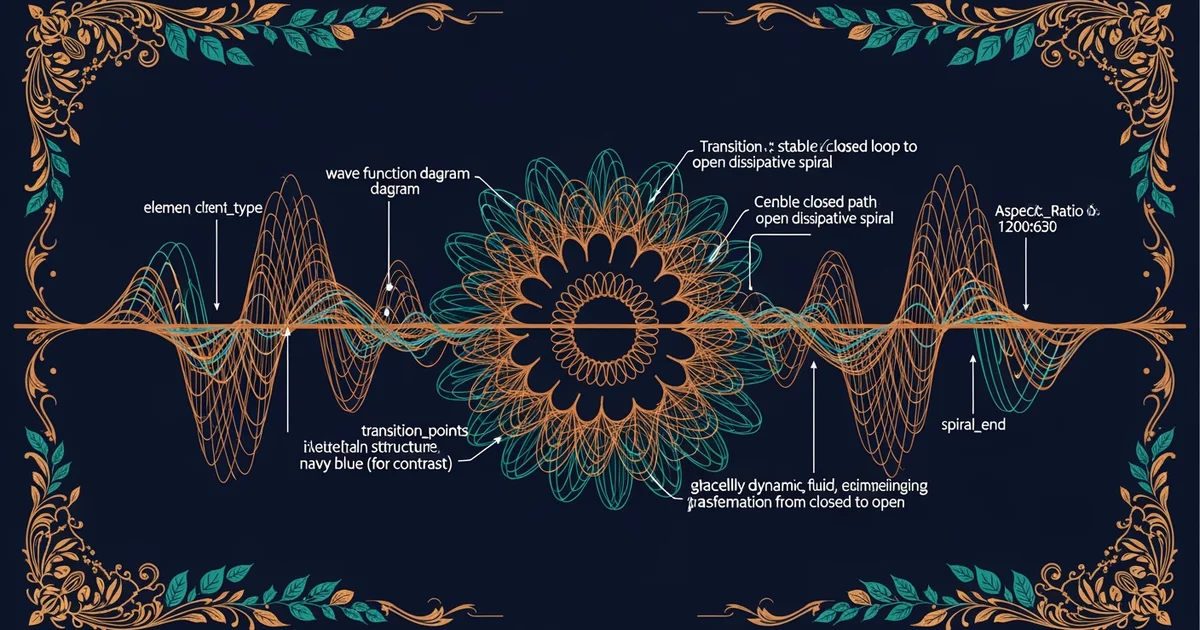
To understand how these crystals function, consider the analogy of a city water system with active pumps. In a standard pipe network, water pressure naturally drops as it moves through friction against the walls. If you add pumps at specific intervals, you replace the lost pressure to keep the flow consistent. Photonic crystals perform this same task for light by using PT symmetry, which stands for parity-time symmetry. This concept ensures that the energy lost by light escaping the crystal is perfectly balanced by energy added from an external source. When a crystal is designed with this balance, it functions as a transparent window that never dims. This is a direct application of the non-Hermitian principles we explored in the previous station. By carefully arranging the gain and loss zones, engineers create a structure that is perfectly stable despite being open to the environment.
Key term: PT symmetry — a property of physical systems where gain and loss regions are perfectly balanced to maintain stable energy states.
Designers must choose materials that respond to light in predictable ways to maintain this delicate balance. They often focus on these three primary characteristics during the initial design phase of the crystal:
- The spatial arrangement of the refractive index must be periodic to ensure that light waves interfere in a constructive manner.
- The inclusion of gain media allows the system to inject energy into the light path to compensate for natural signal degradation.
- The precise control of loss regions prevents the buildup of unwanted energy that could disrupt the signal flow through the device.
These three factors allow the crystal to act as a filter that only permits specific frequencies of light to pass through. By tuning these parameters, we can create sensors that detect even the smallest changes in the surrounding environment.
Practical Applications in Modern Hardware
Beyond simple data transmission, these crystals allow for the creation of incredibly sensitive optical switches. These switches can flip between states using very little power because they operate near a special point called an exceptional point. At this specific threshold, the physical properties of the system change rapidly in response to tiny external inputs. This sensitivity makes them ideal for building advanced sensors that can monitor air quality or chemical concentrations in real time. Because the system is non-Hermitian, it does not require a closed environment to function, which simplifies the physical design of the sensor. This makes the technology much cheaper to manufacture for industrial use cases compared to traditional high-vacuum quantum sensors. Engineers continue to refine these designs to ensure they remain stable under varying temperature conditions found in outdoor settings.
Photonic crystals utilize balanced energy gain and loss to guide light through materials with perfect efficiency and high sensitivity.
But this model breaks down when the external environment introduces too much noise into the system, requiring us to look at sensor sensitivity.