
Sensor Sensitivity
When a high-precision laser gyroscope in a commercial aircraft detects tiny rotations, it relies on the subtle interference of light beams to calculate orientation. Engineers often struggle to maintain this precision because external noise frequently disrupts the delicate light signals that the system must measure to function correctly. This is the practical challenge of maintaining sensitivity in open physical systems, a topic first explored in the foundational concepts of Station 1. By pushing these systems toward an exceptional point, engineers can now amplify the response of a sensor to external inputs, turning a tiny signal into a measurable output that overcomes background noise. This method provides a powerful way to enhance detection limits in modern engineering applications.
Leveraging Exceptional Points for Enhanced Sensitivity
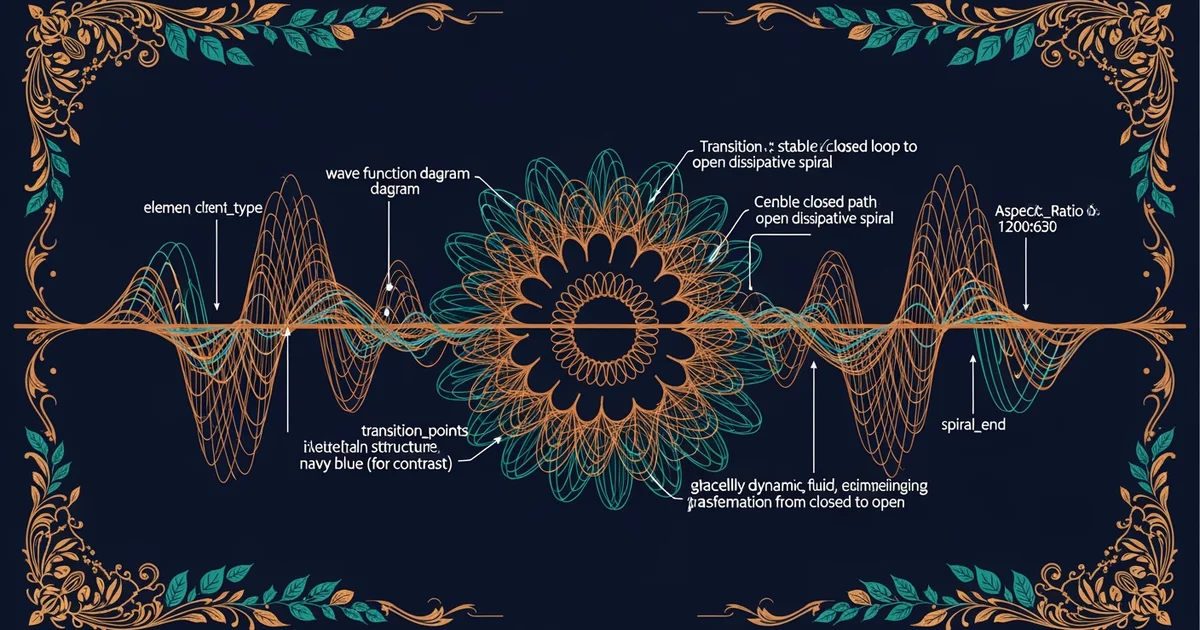
An exceptional point represents a unique state in a non-Hermitian system where two or more modes of the system collapse into one. In standard physical systems, changing a parameter usually leads to a linear response that is often too weak to detect clearly. Near an exceptional point, the system experiences a non-linear response that is much more sensitive to small changes in its environment. Think of this like balancing a pencil on its tip on a smooth glass table. A tiny, almost invisible nudge causes the pencil to fall rapidly in one direction, magnifying a small input into a large, observable motion. This dramatic shift allows sensors to detect changes that would otherwise remain hidden beneath the threshold of standard measurement tools.
Key term: Exceptional point — a specific parameter configuration in a non-Hermitian system where eigenvalues and eigenvectors coalesce, resulting in heightened sensitivity to environmental perturbations.
Engineers utilize this phenomenon by designing sensors that operate precisely at these transition points to maximize their performance. When a sensor sits near this state, the interaction between its internal modes changes how it reacts to external forces. This interaction creates a high-gain environment where small shifts in frequency or phase produce significant changes in the output signal. Such precision is vital for the next generation of navigation systems and micro-scale environmental monitors. The following table highlights how different sensor types benefit from operating near these critical states:
| Sensor Type | Primary Input | Benefit of Exceptional Point |
|---|---|---|
| Optical Gyro | Rotation Rate | Higher angular resolution |
| Mass Sensor | Particle Weight | Smaller detection limit |
| Pressure Gauge | Force Applied | Faster response time |
Overcoming Signal Limitations Through Physics
Understanding why these sensors show higher precision requires looking at the mathematical structure of the system. In a standard Hermitian system, energy remains conserved and the response to change stays predictable and stable. However, in non-Hermitian systems, we allow energy to flow into or out of the system through specific gain or loss channels. This flow changes the governing equations from standard linear forms to more complex, non-linear behaviors. By carefully managing the gain and loss, we force the system to exist in a state where even the smallest external stimulus triggers a massive, detectable shift. This transition is not merely a theoretical curiosity but a practical tool for improving the sensitivity of physical hardware.
- Engineers identify the specific parameter values that lead to the coalescence of system modes.
- They tune the gain and loss elements to ensure the sensor operates exactly at the threshold.
- The system monitors the output for the characteristic non-linear response to external environmental changes.
- This amplified signal is then processed to provide precise data that standard sensors would miss.
This process effectively turns the system into a high-gain amplifier for the signal of interest. By exploiting the mathematical properties of non-Hermitian operators, we bypass the traditional limits imposed by linear measurement techniques. This approach allows for the development of sensors that are smaller, faster, and much more accurate than previous designs. As we continue to refine these methods, the integration of these principles into everyday technology will likely improve everything from medical imaging devices to deep-space communication arrays.
Operating sensors near an exceptional point allows for the massive amplification of weak signals by exploiting the non-linear response characteristics of non-Hermitian systems.
But this enhanced sensitivity creates a new challenge when noise levels fluctuate beyond the system's ability to maintain stability during quantum computing operations.