
Quantum Computing Applications
During the 2023 global supply chain shifts, logistics companies faced extreme pressure to optimize delivery routes across thousands of cities simultaneously. Traditional computers struggled to calculate these vast combinations, as the complexity grew exponentially with every new city added to the map. This real-world bottleneck mirrors the limitations in current quantum architectures that rely on strictly isolated, Hermitian systems. By introducing Non-Hermitian Quantum Mechanics, researchers can now model systems that interact openly with their environments, allowing for faster processing of complex optimization problems. This shift moves beyond the closed-loop constraints established in Station 12, offering a new way to handle energy loss while maintaining quantum coherence.
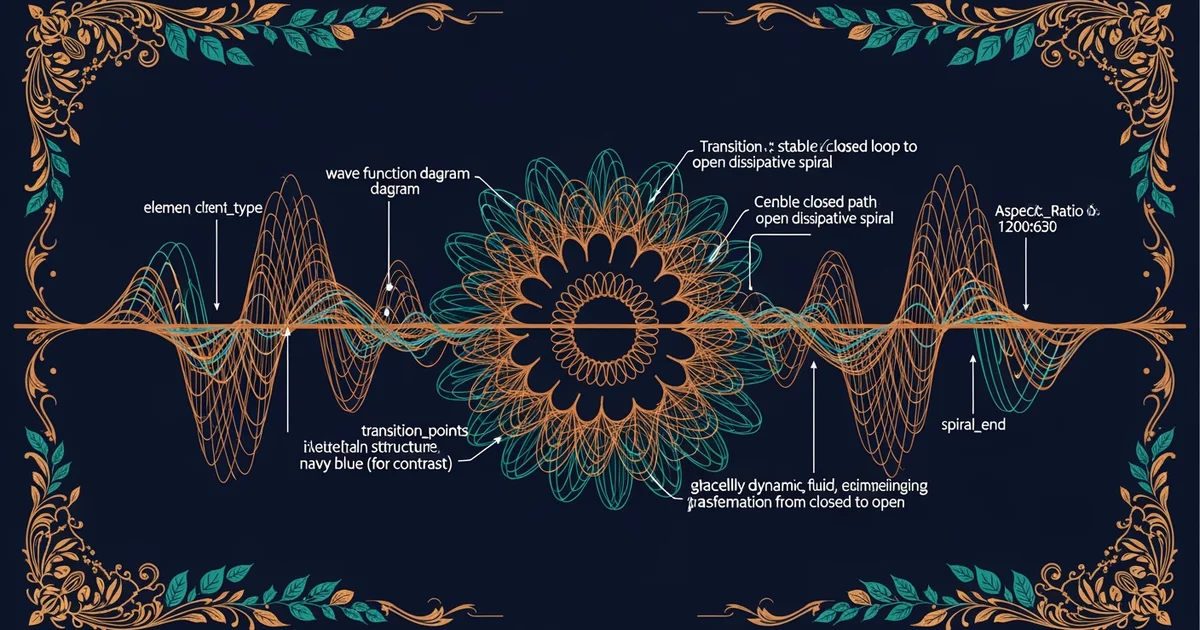
Leveraging Open Systems for Computation
When we treat a quantum computer as an open system, we stop viewing energy loss as a failure and start seeing it as a tool. In a standard setup, any interaction with the outside world causes decoherence, which ruins the delicate quantum state needed for calculations. However, non-Hermitian models use specific mathematical structures to turn these interactions into controlled pathways for information flow. Think of this like a water pipe system in a drought, where instead of losing water to leaks, you design the pipes to redirect that escaping water into smaller irrigation channels for nearby crops. By managing the gain and loss of energy, we can stabilize certain quantum states that would otherwise dissipate too quickly for any meaningful work to be performed.
Key term: Non-Hermitian Quantum Mechanics — a framework for describing physical systems that exchange energy with their surroundings, allowing for unique control over quantum states.
This approach fundamentally changes how we design quantum algorithms for massive data sets. In typical setups, the system must be perfectly shielded from the environment to prevent errors, which requires massive cooling systems and complex hardware. By embracing the non-Hermitian perspective, we can potentially utilize the environment as a resource rather than a hazard. This allows the computer to perform error correction by naturally steering the system toward a desired state through balanced loss and gain. This method provides a robust way to maintain stability without the extreme overhead of absolute isolation.
Advantages in Optimization and Speed
Engineers are currently exploring how these open systems can solve the traveling salesperson problem, which involves finding the shortest path between many locations. Because non-Hermitian operators can exhibit unique features like exceptional points, they can navigate complex landscapes of data much faster than traditional methods. At an Exceptional Point, the system's properties merge in a way that creates high sensitivity to external signals, allowing the computer to detect the optimal solution with incredible precision. This sensitivity is a major leap forward from the sensor methods discussed in Station 13, as it allows the quantum processor to "feel" its way through the solution space.
| Feature | Hermitian Systems | Non-Hermitian Systems |
|---|---|---|
| Energy | Perfectly conserved | Managed gain and loss |
| Stability | Requires isolation | Uses environmental flow |
| Speed | Limited by noise | Enhanced by sensitivity |
These systems offer several distinct benefits for future computing tasks:
- They enable faster state preparation by using controlled dissipation to clear out unwanted quantum information that clutters the processor memory.
- They allow for better scalability because the system does not require perfect shielding from every single external vibration or heat source in the room.
- They provide unique filtering capabilities that ignore background noise while focusing purely on the signal required to complete a complex computational task.
By integrating these features, researchers hope to build machines that operate reliably at room temperature or with much less cooling than current models. This transition from rigid, closed systems to flexible, open architectures represents the next phase of quantum development. The ability to manage energy flux, rather than just blocking it, unlocks new potential for high-speed computation in fields like drug discovery and financial modeling.
Managing energy flow in open quantum systems allows for superior computational stability and faster data processing compared to traditional closed-loop models.
But this model faces significant challenges when scaling to thousands of interconnected qubits in real-world hardware.