
Synthesis of Concepts
Imagine a spinning top that never loses energy because it constantly draws power from the air around it. While traditional systems require isolation to maintain their states, modern physics shows that many real systems exist in a state of continuous exchange with their surroundings. This shift moves us from static models toward a dynamic view where energy flows define the behavior of quantum particles. By viewing these open systems as part of a larger whole, we can predict outcomes that once seemed impossible to calculate. Understanding this requires us to bridge the gap between closed, perfect systems and the messy, real world where energy is always on the move.
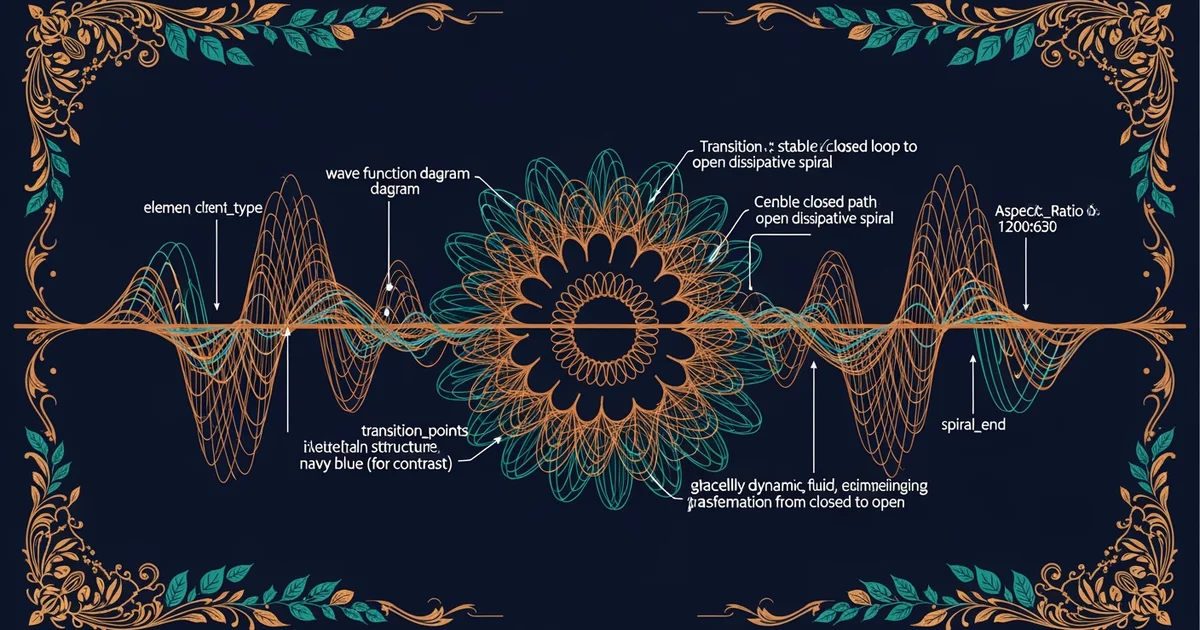
The Shift to Non-Hermitian Dynamics
Traditional quantum mechanics relies on the idea of a closed system that conserves all its internal energy over time. In these models, we use a Hermitian operator to describe the physical state, which ensures that probabilities always add up to one. However, nature rarely functions in such a vacuum because most systems interact with their environment by gaining or losing energy. When we transition to non-Hermitian physics, we stop treating energy loss as an error and start treating it as a fundamental feature of the system. This paradigm shift allows us to model lasers, sensors, and biological structures that maintain stability despite constant energy fluctuations.
Key term: Non-Hermitian — a framework in physics that describes systems which are not isolated and can exchange energy or information with their external environment.
Think of a business that manages its cash flow by balancing incoming revenue against outgoing expenses rather than keeping all its money in a locked vault. If the business only counted the money in the vault, it would fail to explain how it survives for years while spending money every single day. A non-Hermitian system works much like this business by accounting for the flow of energy across the boundary of the system. By including these gains and losses, we gain a complete map of how the system stays predictable even when it is not strictly conserved.
Integrating Concepts into a Unified Framework
When we look at the interaction between energy gain and loss, we find that these systems often reach a balance point where they appear stable. One major concept we have explored is the exceptional point, where the properties of the system become highly sensitive to even the smallest changes in the environment. This sensitivity is not a flaw, but a powerful tool for building high-precision sensors that detect minute vibrations or chemical shifts. By synthesizing these ideas, we can see that the boundary between an open system and its environment is actually a bridge for information transfer.
To better understand how these elements interact, we can compare the core features of different quantum modeling approaches:
| Feature | Closed Hermitian System | Open Non-Hermitian System |
|---|---|---|
| Energy | Perfectly conserved | Gained or lost over time |
| Balance | Static equilibrium | Dynamic steady state |
| Sensitivity | Uniform and stable | High at exceptional points |
These differences show that we are not abandoning old laws but expanding them to cover more ground. The move toward non-Hermitian models allows us to describe complex phenomena like light trapping and wave propagation in ways that were previously hidden from our view. By combining the math of gain and loss, we can finally answer the foundation question of how open systems remain predictable. They follow predictable paths because the exchange of energy follows strict, measurable rules that we can now define with high precision.
Ultimately, the study of non-Hermitian physics is a move toward a more realistic description of the universe. We no longer have to pretend that systems exist in perfect isolation to understand their basic quantum nature. Instead, we embrace the flow of energy as a core component of the system itself. This synthesis of concepts provides the tools to engineer new technologies that work in harmony with their environment rather than fighting against it. As we continue to refine these models, we open doors to advancements in computing, medicine, and material science that rely on the very energy exchanges we once tried to ignore.
Predictable quantum behavior in open systems emerges when we mathematically account for the continuous exchange of energy between a system and its environment.
Learning about non-Hermitian physics provides a framework for understanding how complex, interactive systems maintain stability in a world defined by constant change.