
Robustness Testing
Imagine a busy warehouse where a single automated worker suddenly stops moving in the middle of a shift. If the entire operation halts because one small unit failed, the system is fragile and inefficient for real-world tasks. Swarm robotics must survive these unexpected losses to maintain high performance in complex environments. Engineers use robustness testing to see if a group of robots can still finish a goal after losing some members. This process helps designers find the exact point where a swarm loses its ability to function safely.
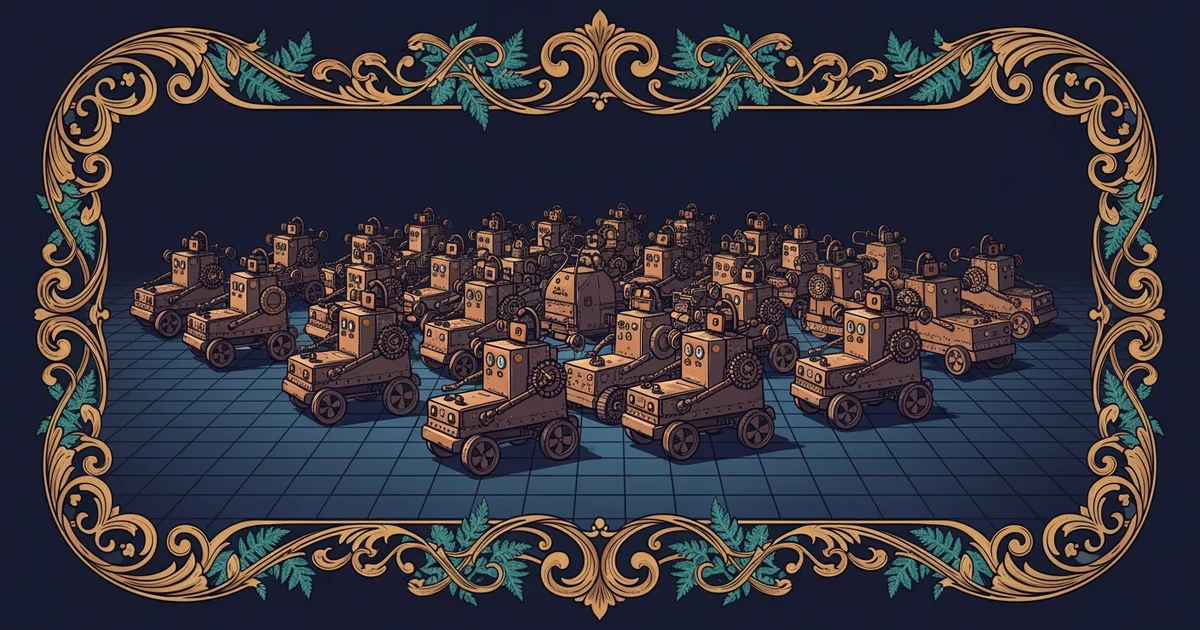
Evaluating System Resilience Under Stress
When we test for robustness, we intentionally remove robots from the active group to observe the remaining machines. A swarm is only as strong as its ability to reorganize when a peer disappears from the communication network. If one robot fails, the others must compensate by adjusting their spatial distribution or by taking over the missing tasks. Think of this like a professional kitchen crew during a dinner rush where a cook suddenly quits their station. The remaining staff must shift their focus and divide the extra work quickly to ensure the customers still receive their meals on time. If the kitchen stops working entirely, the management team knows they need a better plan for staff absences. Robotics teams apply this same logic by measuring how much the total output drops when they disable a specific percentage of the swarm. They look for a threshold where the system stops behaving as a single unit and starts breaking down into disconnected parts.
Designing Failure Recovery Protocols
Engineers build recovery protocols to help the swarm maintain its collective behavior despite the loss of individual agents. These protocols often rely on local rules that allow robots to fill gaps left by their fallen counterparts.
- Dynamic Reallocation: Robots constantly monitor their neighbors to detect missing signals, which triggers an immediate shift in task assignment to cover the empty space left behind.
- Redundancy Buffers: Designers include extra robots in the swarm beyond the minimum required count to ensure that the mission continues even if several units stop working.
- Communication Mesh: The swarm maintains a decentralized network that automatically reroutes data paths when a node disappears, keeping the remaining robots synced without needing a central leader.
These strategies ensure that the group remains functional even when the environment becomes hostile or hardware components reach their expected end of life.
Analyzing Performance Thresholds
To understand how a swarm reacts to stress, researchers use a structured approach to record data during failure events. This helps them refine the algorithms that govern robot behavior and communication.
| Test Stage | Action Taken | Expected Outcome |
|---|---|---|
| Baseline | Run swarm at full capacity | Establish normal mission completion time |
| Stress Test | Remove 10 percent of units | Minor delay in task completion speed |
| Critical Test | Remove 50 percent of units | Failure of non-essential secondary tasks |
By documenting these results, engineers can decide if the swarm needs more robust sensors or faster processing power to handle unexpected losses. If the swarm fails too early in the test, the team must rewrite the coordination logic to be more flexible. This rigorous testing cycle ensures that robots can handle real-world accidents without needing human intervention to restart the entire process. The goal is to build a system that degrades gracefully rather than suffering a sudden or total collapse when things go wrong. Reliability is the hallmark of a well-designed swarm because it allows for continuous operation in unpredictable and dangerous conditions.
Key term: Robustness — the ability of a complex system to maintain its core functionality even when individual components stop performing as expected.
Robustness testing ensures that a swarm can dynamically adapt its internal coordination to complete missions even when a significant number of individual units fail.
But what happens when these robots must apply this resilience to a high-stakes search and rescue mission?