
Simple Rules
Imagine a flock of birds moving in perfect harmony across the sky without a single leader guiding them. This natural phenomenon relies on individual creatures following simple rules rather than listening to complex commands from a central authority figure.
The Mechanics of Individual Movement
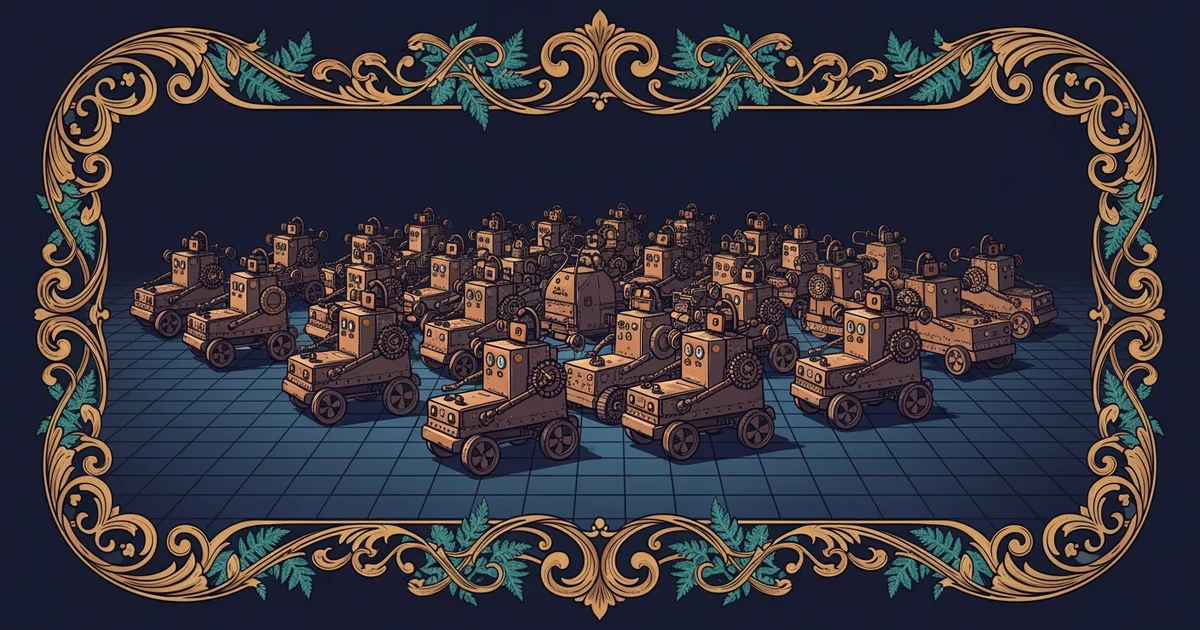
When we look at swarm robotics, we apply this same logic to groups of mechanical agents. Each robot operates based on a set of simple rules that dictate how it interacts with its immediate neighbors. These rules typically involve maintaining distance, matching velocity, and moving toward the center of the group. By focusing only on local information, robots avoid the need for a massive, central processing unit to manage every single movement. Think of this like a busy intersection where drivers follow basic traffic signs rather than waiting for a police officer to direct every single car. If every driver follows the stop sign or yield rule, the traffic flows smoothly without needing a central controller to dictate the exact timing of every turn. This local interaction creates a global behavior that emerges from the bottom up instead of being forced from the top down.
Key term: Simple rules — a small set of local instructions that guide individual agent behavior to produce complex group patterns.
To ensure these robots maintain a cohesive shape, we program them to balance three specific forces that keep the swarm together while preventing collisions. These forces act like invisible springs that pull or push the robots into their correct positions within the larger formation.
- Separation forces prevent robots from crashing by pushing them away if they get too close to one another.
- Alignment forces encourage each robot to match the speed and direction of its neighbors to maintain a unified flow.
- Cohesion forces pull robots toward the center of the group to ensure that no single unit drifts off into empty space.
Implementing Coordination Through Local Logic
Once we define these rules, we can translate them into code that runs on each individual unit. The robot constantly scans its surroundings to find the location and velocity of its closest peers. It then calculates its next move by adding these three forces together to find the best path forward. This process happens many times every second, allowing the swarm to adapt instantly to obstacles or changes in the environment. Because each robot makes these calculations independently, the entire group becomes incredibly resilient to individual failures. If one robot stops working, the rest of the group simply adjusts its local rules to fill the gap and continue the mission. This decentralized approach allows for large swarms to operate in environments where a single central signal might be blocked or lost. The robots treat the group as a single fluid entity that can navigate tight spaces or split around large objects without needing a complex map of the entire area. By trusting the local logic of each member, we gain a system that is robust and flexible enough to handle unpredictable challenges in the real world.
| Rule Type | Primary Goal | Physical Effect |
|---|---|---|
| Separation | Safety | Avoidance of collisions |
| Alignment | Efficiency | Consistent group speed |
| Cohesion | Unity | Maintaining group shape |
This table summarizes how basic instructions influence the physical performance of the swarm. Each rule serves a unique purpose in keeping the group functional and organized during movement. By layering these rules, we create a system that appears intelligent even though each robot only knows its immediate surroundings. The beauty of this design lies in its simplicity because it does not require expensive sensors or massive memory banks to function correctly. We focus on building reliable local interactions that scale well as we add more units to the swarm. This foundation ensures that our engineering efforts remain focused on the most critical aspects of robot behavior.
Coordinated swarm movement emerges when individual robots follow basic local rules to interact with their neighbors without requiring a central leader.
The next Station introduces scalability challenges, which determine how these simple rules perform when the swarm grows from ten robots to thousands.