
Local Communication
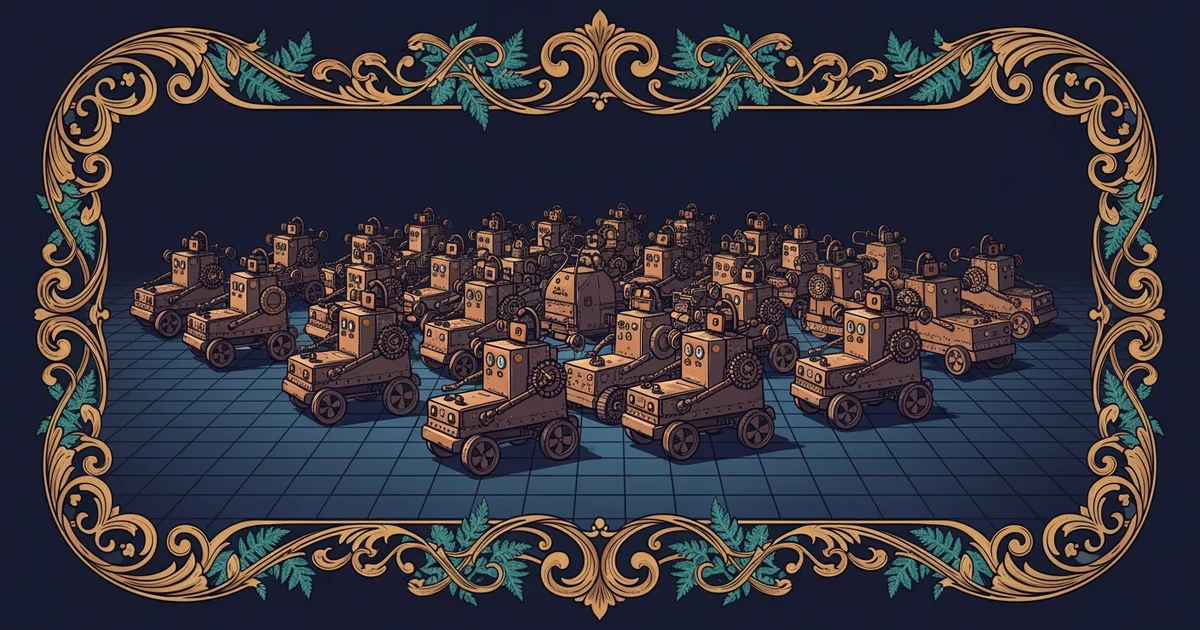
Imagine a crowded room where everyone tries to talk at once without a single person leading the discussion. To share information effectively, people naturally turn to those standing right beside them to whisper important updates. Robots in a swarm operate in this exact way, using local interaction to manage complex tasks without needing a central boss. When robots only listen to their immediate neighbors, they form a web of shared data that flows through the entire group. This method prevents the system from crashing if one single unit fails or loses its connection to the rest of the swarm.
Mechanisms for Sharing Data
Because robots need to sense their surroundings, they rely on physical hardware to broadcast and receive signals. One common method involves infrared light, which acts much like a television remote control sending pulses across a short distance. Another popular approach uses radio waves, allowing robots to transmit digital packets of information to any peer within a specific radius. These signals carry basic data, such as the robot's current position, its battery level, or a detected obstacle in the path. By processing these simple inputs, each robot makes independent choices that align with the goals of the larger group.
Key term: Local communication — the process of exchanging data only with nearby peers rather than sending information to a central hub.
Think of this process like a bucket brigade used to put out a fire during a busy summer day. No single person knows exactly how much water is left in the distant well or how large the fire has grown. Instead, each person simply passes the bucket to the next neighbor in line based on a quick touch or a nod. The water reaches the fire because everyone follows a simple, local rule about passing the container along. Similarly, robots pass state information to their neighbors, which allows the collective to move or react as one cohesive unit.
Managing Information Flow
When we look at how these signals travel, we see that the speed and range of the communication define how the swarm behaves. If the range is too short, the robots might become isolated and fail to coordinate their movements across large distances. If the range is too long, the robots might get overwhelmed by too much conflicting data from too many sources at once. Engineers must carefully tune these sensors to ensure that each robot receives just enough information to make smart decisions. This balance keeps the swarm agile while ensuring that every member stays synchronized with the group objectives.
| Method | Primary Use Case | Range Capability | Signal Type |
|---|---|---|---|
| Infrared | Proximity sensing | Very short | Light pulse |
| Radio | Data transmission | Medium range | Wave signal |
| Acoustic | Underwater teams | Variable range | Sound pulse |
These methods allow the swarm to adapt to changing environments without human intervention or centralized control systems. By using these tools, robots can maintain their formation even when they encounter unexpected barriers or sudden changes in the terrain. The following list highlights why this local approach is so effective for large groups of machines:
- Robots maintain high levels of autonomy because they process information locally instead of waiting for external commands from a distant server.
- The system becomes incredibly resilient because the failure of one robot does not stop the entire swarm from completing its assigned task.
- Scalability increases significantly since adding more robots does not increase the workload on a central processor or a main control unit.
By focusing on these nearby interactions, engineers can design systems that handle massive complexity through simple, repeatable, and robust local rules. This strategy transforms a group of basic machines into a powerful, unified force that can solve tasks far beyond the reach of any single robot. Every signal sent between neighbors builds a stronger foundation for the entire collective to function as a smart, responsive, and highly efficient robotic network.
Reliable coordination emerges when individual robots process data from their immediate neighbors to make collective decisions without a central leader.
The next Station introduces Decentralized Control, which determines how these local communication signals translate into coordinated group movement.