
Sensor Fusion
Imagine you are trying to cross a busy road while wearing a thick blindfold and heavy earplugs. You might guess where the cars are located by feeling the vibrations of the ground beneath your feet. However, your chances of crossing safely increase significantly if you remove the blindfold and listen to the traffic sounds simultaneously. Robots face a similar challenge when they navigate complex environments using only one type of sensor for information. By combining data from multiple sources, they create a much clearer picture of their surroundings.
Integrating Diverse Data Streams
When a robot relies on a single sensor, it often struggles because every device has inherent limitations. A camera might struggle to see clearly in low light, while a laser scanner might fail to detect glass surfaces. Sensor fusion is the process of combining data from various hardware sources to produce a more accurate and reliable estimate of the environment. Imagine a team of detectives where one person is an expert at reading maps, another is great at interviewing witnesses, and a third is skilled at finding physical evidence. If they share their findings, they solve the mystery much faster than if they worked in isolation. Robots use this same logic to merge raw data into a single coherent map of their current location.
Key term: Sensor fusion — the technical process of combining sensory data from disparate sources to reduce uncertainty and improve the precision of robotic environmental perception.
This method allows the robot to compensate for the flaws of individual sensors. If the camera reports an obstacle that the laser scanner does not see, the robot can compare the two inputs to determine if a real object exists. This prevents the robot from stopping unnecessarily due to a simple sensor glitch or a minor lighting change. By relying on multiple inputs, the robot gains a level of redundancy that protects it from hardware failures. If one sensor stops working, the system can still function using the remaining data streams to maintain basic operations.
Improving Decision Accuracy
Once the robot has fused its sensor data, it must use this information to make smart movement choices. The process of turning raw data into actionable knowledge requires sophisticated mathematical models that weigh the reliability of each sensor input. If the robot knows that its ultrasonic sensors are unreliable in windy conditions, it will automatically give more weight to the data coming from its cameras. This dynamic adjustment ensures that the robot always prioritizes the most trustworthy information available at any given moment. The following list outlines how this process improves overall performance during complex tasks:
- Noise reduction occurs when the system averages out errors from multiple sensors to find the true position of an object.
- Increased reliability happens because the robot can cross-reference data to confirm if an obstacle is truly blocking its path.
- Better situational awareness develops as the robot combines distance data with visual identification to understand what is around it.
| Sensor Type | Primary Strength | Common Weakness | Best Use Case |
|---|---|---|---|
| Camera | Rich visual detail | Poor low-light performance | Object identification |
| Lidar | High precision distance | Expensive and bulky | Mapping spaces |
| Ultrasonic | Cheap and simple | Limited range and accuracy | Proximity detection |
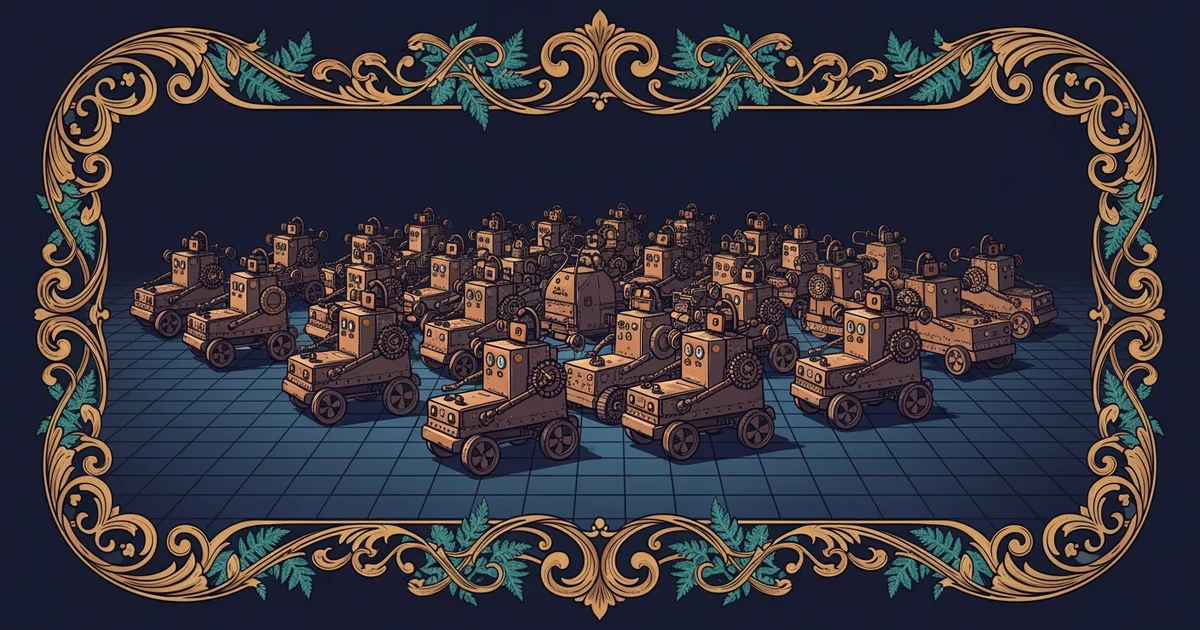
By carefully comparing these different inputs, the robot builds a robust internal representation of the world. This internal model serves as the foundation for every decision the robot makes while navigating through a swarm. When the robot understands its environment with high confidence, it can move faster and more efficiently without risking collisions. This level of coordination is essential when dozens of simple robots must operate in the same space without a central leader to guide them. The ability to trust its own fused data allows the robot to act independently while remaining synchronized with the rest of the swarm.
Reliable robotic navigation depends on the ability to merge imperfect data streams into a single, high-confidence map of the surrounding environment.
But what does it look like when these robots actually start moving together in a coordinated swarm?
Want this with sources you can check?
Premium Learning Paths for Engineering & Robotics are researched against open-access libraries — PubMed, arXiv, government databases, and more — with their distinctive claims cited to real sources and independently checked.
See what Premium includes