
Biological Inspiration
Imagine a massive flock of starlings turning in perfect unison against the evening sky. No bird acts as the leader, yet the entire group moves like a single, fluid organism. This natural display of coordination provides a blueprint for engineers building robot swarms. When robots mimic these biological patterns, they can perform tasks that are impossible for a single machine. By observing nature, researchers find efficient ways to distribute control across many small units.
Learning from Natural Systems
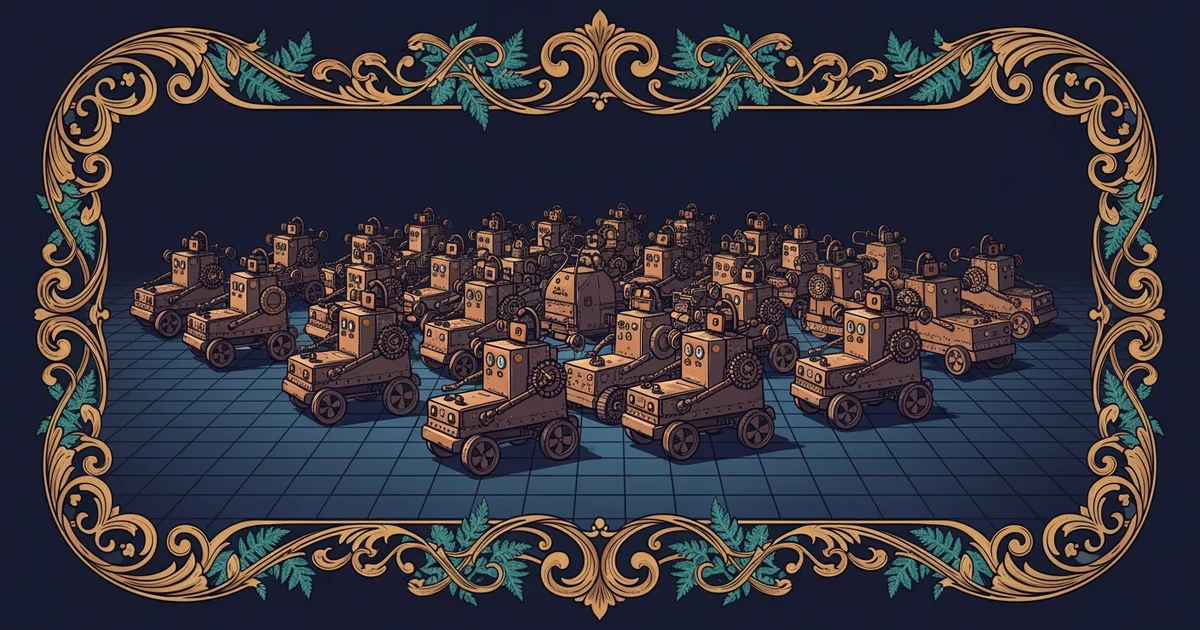
Nature excels at solving complex problems through simple local interactions between many individual agents. A colony of ants, for instance, manages to find the shortest path to food without a central map. Each ant leaves a chemical trail that others follow, creating a smart system from basic behaviors. When we apply this logic to robotics, we call it swarm intelligence. This approach allows us to design machines that react to their environment in real time. Instead of giving one robot a complex brain, we give many robots simple rules to follow. This strategy is like a group of people at a concert deciding where to stand. No one person controls the crowd, yet the space fills up evenly and efficiently.
Key term: Swarm intelligence — the collective behavior of decentralized, self-organized systems that emerge from simple rules followed by individual agents.
Engineers look at these biological models to create systems that are robust and flexible. If one ant disappears, the colony continues its work without any major disruption to the group. A swarm of robots built on this principle can survive the failure of several units. This resilience is a major advantage over systems that rely on one central server. If that server fails, the entire machine stops working, which creates a single point of failure. By spreading the tasks across many robots, we ensure that the mission can continue despite losses.
Principles of Biological Coordination
Coordination in nature relies on specific traits that allow groups to function as a cohesive unit. These traits ensure that every member contributes to the common goal without needing constant guidance. By studying how animals interact, we identify patterns that translate well into robotic control algorithms. We can organize these traits into a clear structure for better understanding.
| Biological Trait | Description for Robotics | Benefit for the Swarm |
|---|---|---|
| Local Sensing | Detecting nearby neighbors | Maintains group shape |
| Simple Rules | Following basic movement | Reduces memory usage |
| Self-Organization | Forming patterns naturally | Handles task changes |
These traits allow a swarm to adapt to changing conditions in the environment. For example, local sensing ensures that robots stay close enough to communicate but far enough to avoid collisions. Simple rules allow the robots to process information quickly, which is vital for fast-moving tasks. Self-organization means the swarm can rearrange itself if an obstacle appears in its path. These behaviors are not programmed as a complete map but as reactions to the immediate surroundings.
When we implement these traits, we must ensure the robots communicate effectively using limited data. Much like bees use vibrations to signal the location of flowers, robots use light or radio signals. These signals convey enough information for the group to maintain its structure. If the robots send too much data, the network becomes clogged and slow. If they send too little, the swarm loses its ability to function as a team. Finding this balance is the core challenge of modern swarm engineering. We want the group to act as one while keeping each robot simple enough to be inexpensive. This balance mimics the efficiency of biological systems that have evolved over millions of years.
Biological systems provide a blueprint for swarm robotics by using simple, local interactions to create complex, resilient, and self-organizing group behaviors.
Next, we will explore how these individual behaviors combine to form a collective intelligence that exceeds the sum of its parts.