
Scalability Challenges
Imagine trying to coordinate a school cafeteria lunch line that grows from ten students to ten thousand students without any teachers present. As the crowd expands, the simple task of moving through the doors becomes a chaotic mess of bumping bodies and missed steps. This scenario perfectly captures the primary obstacle in swarm robotics known as scalability, which describes how a system functions as you add more individual units. Engineers must design robots that maintain order even when the group size grows exponentially, ensuring that the collective behavior remains stable and predictable regardless of the total robot count.
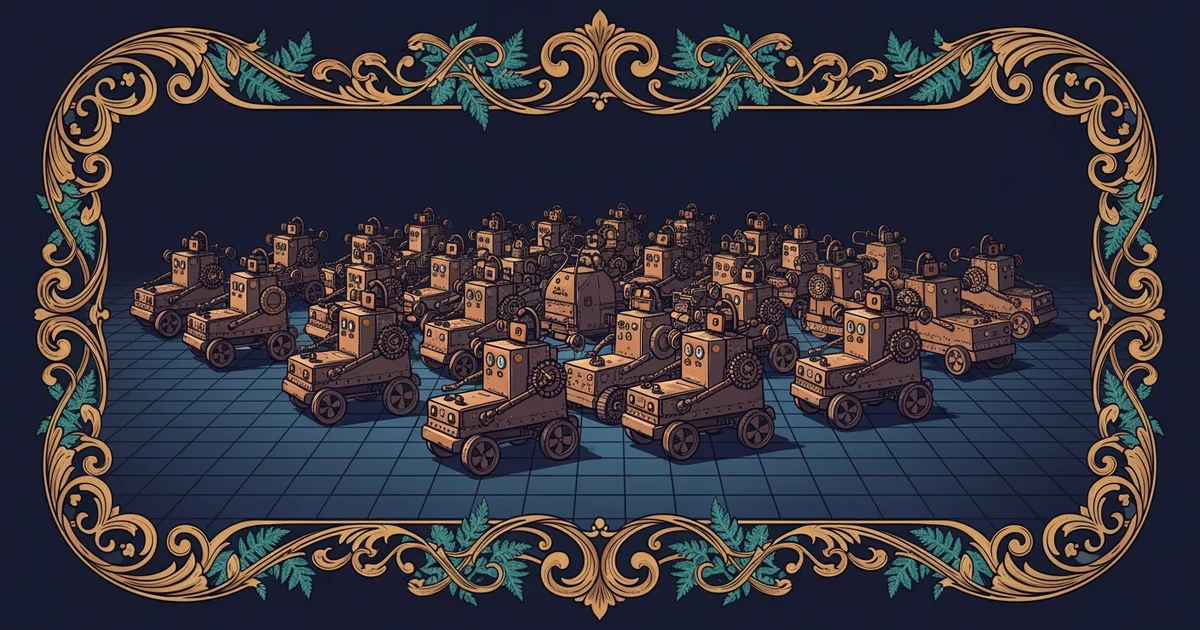
The Hidden Costs of Growing a Robot Swarm
When we increase the number of robots in a swarm, the amount of data flowing through the system grows much faster than the number of robots themselves. If every robot must talk to every other neighbor, the communication network quickly becomes overwhelmed by the sheer volume of signals. This is like a small group of friends chatting at a dinner table versus a stadium full of people all shouting at once. In the stadium, the noise becomes so loud that individual messages get lost, and the system fails to coordinate effectively. Designers must therefore limit how many neighbors each robot listens to so the group can function without crashing.
Key term: Scalability — the ability of a robotic system to maintain efficient performance and coordination while the total number of individual units increases.
Beyond communication, the physical space required for movement creates another significant bottleneck for large groups of autonomous machines. As more robots enter a confined area, they naturally block each other's paths and increase the frequency of accidental collisions. This density issue forces robots to spend more time avoiding their peers than actually completing their assigned tasks. To solve this, engineers often implement local interaction rules that prioritize movement patterns which naturally disperse the robots across the available environment. By spreading out, the machines reduce the pressure on local space and keep the overall mission moving forward at a steady pace.
Balancing Efficiency Through Local Rules
To manage these growth challenges, researchers often use specific strategies that keep the system lightweight and responsive. The following list highlights the core methods used to maintain control as the swarm size increases significantly:
- Decentralized decision making allows each robot to act based only on nearby information, which prevents the central processor from becoming a bottleneck during large-scale operations.
- Limited communication ranges ensure that robots only react to their immediate neighbors, which keeps the data traffic manageable and prevents the network from becoming completely saturated.
- Probabilistic task assignment uses random choices to distribute work across the group, which prevents too many robots from focusing on one single area at the same time.
These strategies ensure that the swarm remains flexible and capable of handling complex environments without needing a massive central computer. By relying on simple local interactions, the system avoids the fragility of a single point of failure and remains robust. If one robot breaks or runs out of battery, the rest of the swarm simply adjusts and continues the mission. This resilience is the hallmark of a well-designed swarm, proving that small, local actions can indeed create large, impressive results.
| Challenge Type | Primary Impact | Mitigation Strategy |
|---|---|---|
| Communication | Signal saturation | Localized messaging |
| Spatial | Traffic jams | Dispersion protocols |
| Computational | Overloaded CPUs | Decentralized logic |
The table above illustrates how different growth pressures require specific engineering adjustments to keep the swarm operational. By addressing these areas, developers create systems that thrive in diverse environments rather than failing under the weight of their own complexity. As we move forward, we must remember that the goal is not to have the smartest robot, but to have the smartest collective interaction. This balance is what allows a swarm to perform tasks that would be impossible for a single, complex machine to handle alone.
Effective swarm coordination relies on limiting individual robot data and physical interaction to ensure that the group remains functional as it grows in size.
The next Station introduces sensor fusion, which determines how robots combine different data sources to understand their surroundings.