
Decentralized Control
Imagine a flock of birds moving through the sky without a single leader telling them where to fly. Each bird simply watches its closest neighbors to decide when to turn or speed up. This behavior creates a fluid, organic motion that looks like a single living organism in flight. In robotics, we call this decentralized control, where no single unit dictates the actions of the entire collective group. By removing the need for a central brain, engineers allow robot swarms to survive even if several individual units fail during a task.
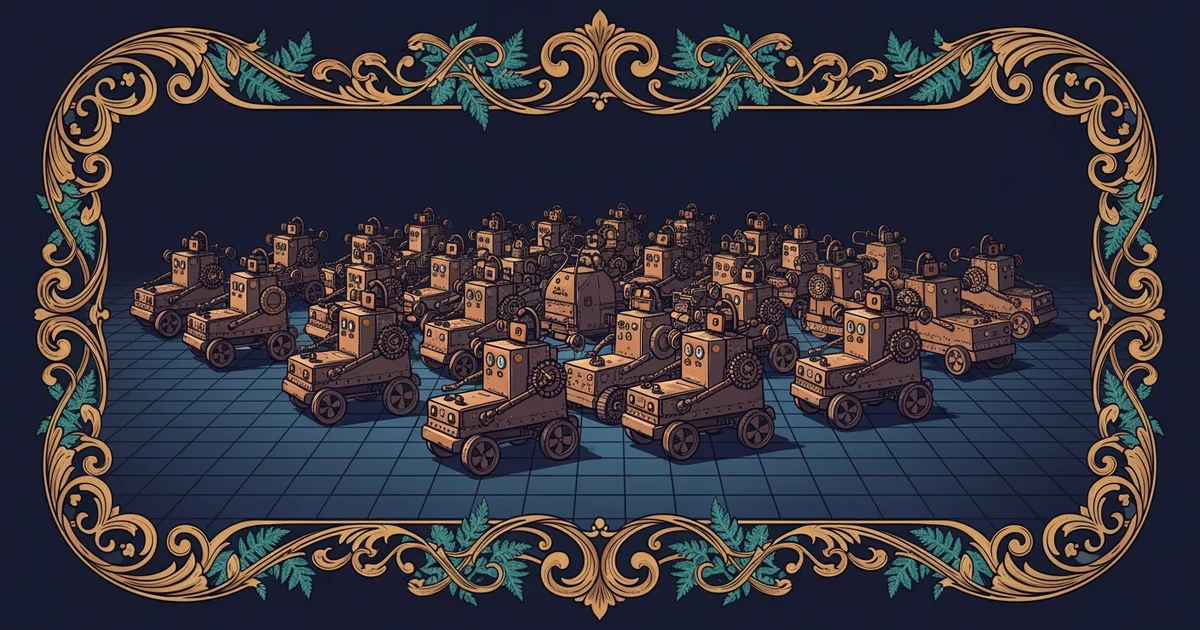
Understanding Centralized Versus Decentralized Logic
When engineers design a robot system, they must choose between a top-down or a bottom-up approach to intelligence. A centralized system relies on a master controller that sends specific commands to every sub-unit in the network. If the master controller breaks or loses its connection, the entire system stops functioning immediately because the robots have no instructions. In contrast, decentralized systems distribute the decision-making process across every single robot in the swarm. Each robot processes local data from its sensors to make independent choices that benefit the group goal.
Key term: Decentralized control — an architecture where individual agents make decisions based on local interactions rather than following instructions from a central master unit.
Think of this difference like the way a professional orchestra functions compared to a school of fish. An orchestra needs a conductor to keep every musician in sync, or the music will quickly fall apart. If the conductor leaves, the music stops because the musicians rely on that single central source for timing. A school of fish works differently because every fish follows a set of simple patterns based on the movement of its peers. There is no lead fish, yet the school moves as one cohesive unit to avoid predators or find food efficiently.
The Benefits of Distributed Decision Making
When you move away from centralized command, you gain massive advantages in terms of system resilience and flexibility. A decentralized swarm can adapt to changing environments in real time without waiting for a signal from a remote base. If a robot is destroyed or blocked by an obstacle, the rest of the swarm simply adjusts its formation to fill the gap. This makes the swarm incredibly robust, as the loss of one unit does not compromise the mission objectives of the remaining robots.
| Feature | Centralized Control | Decentralized Control |
|---|---|---|
| Decision Point | Single central master | Individual robot unit |
| Failure Impact | Total system collapse | Minimal local impact |
| Scalability | Limited by bandwidth | High and flexible |
| Response Time | Slower due to latency | Fast local reactions |
This table illustrates why developers prefer decentralized logic for large-scale operations in unpredictable zones. Because each robot only needs to communicate with its neighbors, the system avoids the data bottlenecks found in large centralized networks. This local interaction method reduces the energy required for long-distance communication. It also ensures that the swarm can operate in areas where external signals or satellite connections are unavailable or unreliable.
By focusing on local rules rather than global commands, you enable robots to solve complex problems that would overwhelm a single processor. The swarm acts like a collective brain that emerges from the interaction of many simple parts. This bottom-up strategy is the foundation for modern robotics in search and rescue missions. It allows small machines to map unknown environments or perform tasks that require constant, rapid coordination across large geographic areas.
Decentralized control creates robust systems by replacing a single point of failure with independent agents that coordinate through local interactions.
The next Station introduces simple rules, which determines how those individual units know exactly what to do in any given situation.