
Individual vs Collective
Imagine a single ant trying to move a large crumb across a kitchen floor. The ant struggles alone, often losing its way or failing to lift the heavy weight. Now, watch a whole colony of ants work together to move that same crumb with ease. This simple difference highlights the core challenge in modern robotics: how to balance individual tasks with group goals. We must understand why a single machine is limited, while a group can achieve complex missions through shared effort.
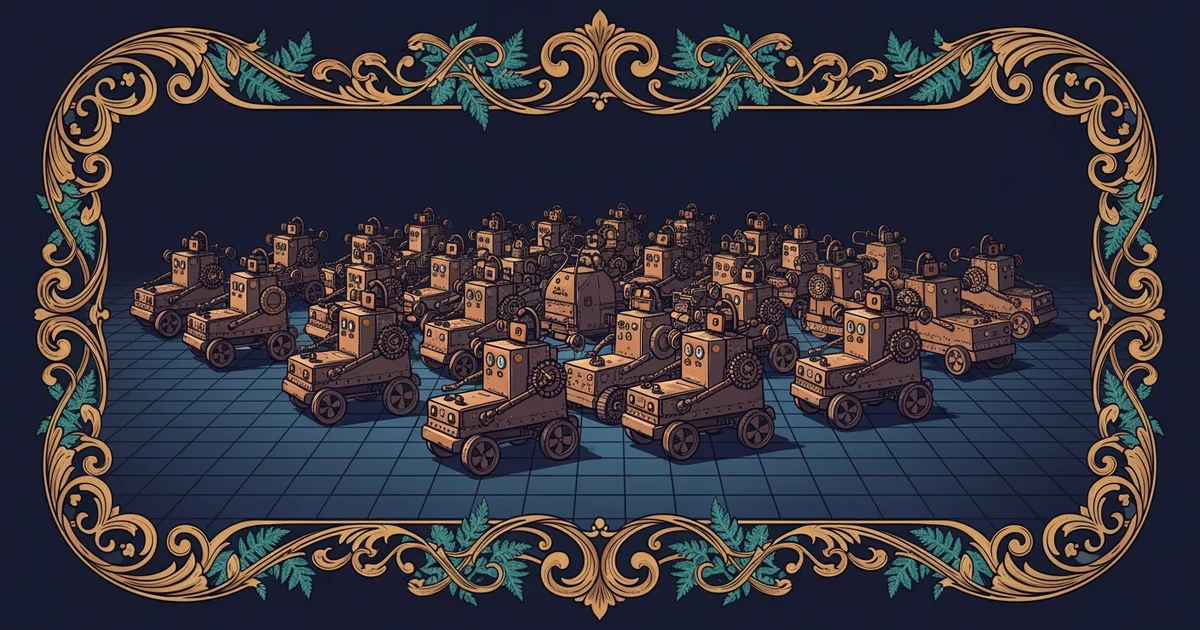
The Limits of Individual Robot Capability
Every robot is built with specific sensors and motors to execute a pre-programmed set of tasks. A single robot might excel at sensing light or avoiding obstacles, but it lacks the scale to solve large problems. If a task requires covering a wide area or lifting a heavy object, one unit will eventually hit a physical wall. This limitation exists because a single robot has a finite battery life and a limited range of vision. When a robot operates in isolation, it cannot compensate for its own mechanical failures or sensor errors. If its primary sensor fails, the robot becomes useless until a human technician provides a manual repair or reset. Relying on one unit creates a single point of failure that stops the entire mission in its tracks.
Key term: Swarm Robotics — a field of study focusing on coordinating large numbers of simple robots to perform complex tasks as a unified group.
Building a more capable robot often leads to higher costs and increased mechanical complexity. Engineers sometimes try to solve this by adding more sensors to a single unit. This approach creates a fragile system that is expensive to maintain and difficult to program correctly. Instead of making one robot smarter, we can deploy many simple robots that interact with their neighbors. This shift in strategy allows the group to handle tasks that would be impossible for any single, isolated machine to complete alone.
Collective Intelligence Through Simple Interactions
When many robots act as a group, they form a collective intelligence that exceeds the sum of their parts. Think of this like a group of commuters trying to exit a crowded stadium after a major concert. Each person only knows what they see immediately in front of them, yet the crowd flows steadily toward the exits. No single person directs the entire crowd, but local movements create a smooth pattern that benefits everyone. Robots use this same principle by reacting to the actions of their nearest neighbors instead of following a central command.
| Feature | Individual Robot | Robot Swarm |
|---|---|---|
| Complexity | High per unit | Low per unit |
| Robustness | Very low | Very high |
| Scaling | Expensive | Affordable |
| Strategy | Central control | Decentralized |
This decentralized approach provides several distinct advantages for engineers designing modern autonomous systems:
- Fault tolerance ensures that the mission continues even if several individual robots stop working during the operation.
- Scalability allows the system to grow by simply adding more units without needing to rewrite the main control code.
- Flexibility enables the group to reorganize itself if the environment changes or if new obstacles appear during the task.
By focusing on simple local rules, we create systems that are much more resilient than any single, complex machine could ever be. The robots do not need to know the global goal, only how to interact with the entities nearest to them. This creates a robust network that can adapt to unexpected challenges without human intervention. The transition from individual effort to group behavior marks the true beginning of scalable engineering in the field of robotics.
Coordinated group behavior allows simple, low-cost robots to solve complex problems that are physically impossible for a single, sophisticated machine to handle alone.
Now that we understand why groups matter, we will explore the local communication methods these robots use to stay connected.