
Swarm Kinematics
Imagine a flock of birds turning in perfect harmony without a single leader guiding their path. This seamless movement relies on simple rules that each bird follows to stay close without colliding. When robots replicate this behavior, they use specific mathematical models to manage their positions and velocities in space. Understanding these patterns helps engineers design groups that function as a single, efficient unit during complex tasks.
Principles of Swarm Movement
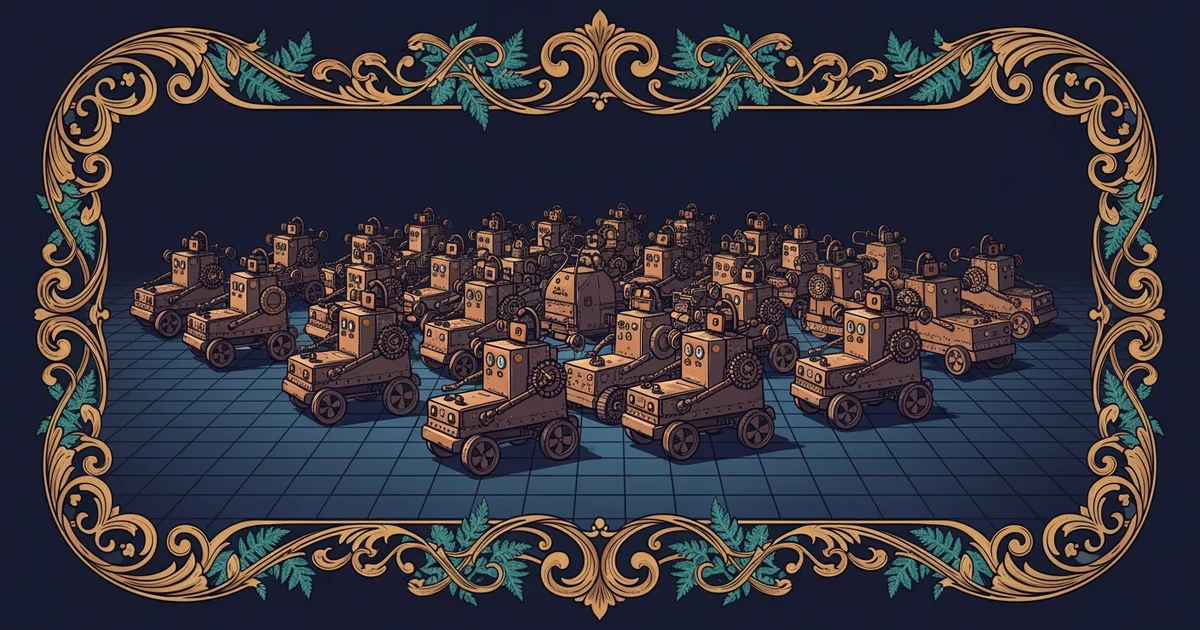
Swarm robots calculate their motion by constantly checking the positions of their neighbors in the group. Each unit uses kinematics, which is the study of motion without considering the forces that cause the movement. By measuring the distance to nearby robots, a unit determines if it should speed up, slow down, or turn to stay in formation. This process is similar to drivers on a highway who adjust their speed based on the cars ahead to maintain a safe flow of traffic. If one car brakes suddenly, the others react quickly to avoid a pileup, keeping the entire line moving smoothly. Robots use this same reactive logic to ensure the swarm maintains its shape while traveling through an environment.
Key term: Kinematics — the branch of mechanics that describes the motion of objects without referencing the forces that cause the movement.
When these robots move, they must balance three specific behaviors to avoid chaos and maintain cohesion. These behaviors allow the group to act as one entity while navigating around obstacles or through tight spaces. The math behind these movements requires constant updates to the velocity vectors of every robot in the system. If the update rate is too slow, the swarm loses its shape and the robots may crash into one another. Engineers must ensure the processing speed matches the physical speed of the robots to prevent these errors.
Variables Affecting Swarm Speed
Several factors determine how fast a swarm can travel while staying safely in a tight formation. These variables interact to dictate the overall efficiency of the group when it moves from one point to another. The following list highlights the primary components that influence how quickly a swarm can safely traverse a given area:
- Communication latency creates a delay between the time one robot detects a change and when its neighbor receives that data — if this delay grows too large, the swarm becomes unstable because the robots are reacting to outdated information.
- Sensor range limits define how far away a robot can detect its peers — if the range is too short, robots might lose track of the group, but if it is too long, the robot becomes overwhelmed by too much data.
- Computational overhead represents the time the robot spends processing the math required for movement — high complexity in the code can slow down the physical response time of the robot, which limits the top speed of the entire swarm.
To visualize how these variables affect the group, we can categorize the impact of each factor on the swarm performance. The table below compares how these elements change when we increase the size of the robot swarm. As the group grows, the demands on the system increase in predictable ways that engineers must manage to keep the movement fluid.
| Variable | Small Swarm Impact | Large Swarm Impact | Primary Risk |
|---|---|---|---|
| Latency | Minimal delay | High cumulative lag | Collision |
| Sensing | Local coverage | Dense data overlap | Confusion |
| Processing | Fast response | Slow update cycles | Stagnation |
When a swarm expands, the density of the robots often increases, which requires more frequent adjustments to maintain safety. Each robot must filter out unnecessary data to focus only on the neighbors that pose a collision risk. By prioritizing local data over global data, the swarm remains agile even as it grows in size. This focus on local interaction allows the group to solve complex problems without needing a central brain to manage every individual move. The efficiency of the swarm depends entirely on how well each unit handles these local calculations in real time.
Swarm kinematics relies on robots processing local neighbor data to maintain formation speed and safety without needing central control.
But what does it look like in practice when these robots encounter an unexpected obstacle?