
Biodiversity Loss
When the Amazon rainforest loses vast tracts of land to cattle ranching, the local species effectively lose their bank accounts of survival. Just as a business shuts down when the capital runs dry, entire ecosystems collapse when the physical space for life disappears.
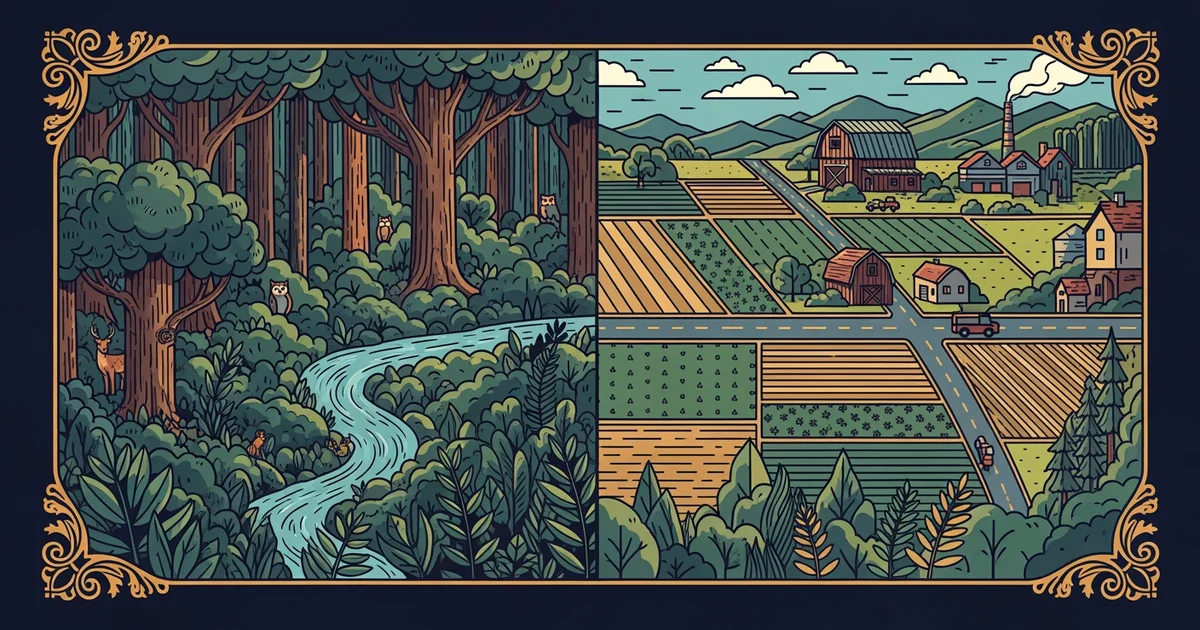
The Mechanics of Habitat Fragmentation
Human expansion often breaks large, continuous forests into small, isolated patches of land that cannot support diverse life. This process, known as habitat fragmentation, forces animals into smaller areas where resources are scarce and competition for food becomes deadly. Imagine trying to run a massive grocery store with only one tiny shelf for all your inventory; the system fails because it lacks the necessary space to sustain variety. When species cannot move between these patches, they lose access to mating partners and essential food sources, which leads to a rapid decline in their population size. This is a direct application of the principles of spatial ecology discussed in Station 3 regarding resource distribution. As these islands of habitat shrink, the number of species that can survive within them drops sharply because smaller areas naturally hold fewer resources and support fewer unique organisms.
Key term: Habitat fragmentation — the process where large, continuous natural areas are divided into smaller, disconnected pieces by human activities like road building or farming.
Quantifying the Loss of Biodiversity
Scientists measure the health of an environment by looking at the total variety of life, which we define as biodiversity loss. When we remove the complex layers of a forest, we are not just removing trees; we are deleting the biological infrastructure that supports thousands of specialized creatures. A single acre of cleared land might result in the extinction of dozens of insect species that provide pollination services for plants. These plants then fail to reproduce, which creates a ripple effect throughout the entire food chain. The following table illustrates how different human activities contribute to this decline by altering the physical landscape in specific ways that reduce the capacity for life to persist.
| Activity Type | Primary Impact on Species | Long-term Consequence |
|---|---|---|
| Urban Sprawl | Total habitat removal | Permanent local loss |
| Agriculture | Massive land conversion | Reduced genetic flow |
| Road Building | Dangerous fragmentation | Increased death rates |
The Domino Effect of Ecological Collapse
Once a species begins to disappear from a fragment, the remaining species often struggle to fill the empty roles. This loss creates a domino effect where the disappearance of one predator or plant leads to the starvation of others that relied on them. You might think of this like removing structural beams from a building; the first few might not cause a collapse, but eventually, the entire roof caves in because the support is gone. This is why biodiversity is not just about the number of animals present, but about the web of connections that keep the environment stable. When these connections break, the land loses its ability to provide clean water, fertile soil, and climate regulation for the humans living nearby.
Human activities fundamentally reshape the physical surface of our planet by shrinking the living space available to all other species. We must understand that every acre of land converted for our own use represents a permanent reduction in the biological potential of the earth. We are essentially trading the long-term stability of our global life support system for short-term gains in land use and resource production. This trend of simplification is the primary driver of modern extinction rates across every continent on the planet today.
Human activity reshapes the planet by partitioning natural habitats into isolated zones that cannot sustain the complex biological networks required for long-term species survival.
But this model of isolated patches breaks down when we consider how climate change forces species to migrate across fragmented landscapes that no longer support travel.