
Infrastructure Networks
Imagine you are trying to walk through a dense forest, but every few hundred feet, a massive, smooth wall blocks your path. You might find a small gap, but the wall forces you to change your direction and slows your progress significantly. This is exactly how wildlife experiences the modern world when we build sprawling infrastructure networks across the natural landscape. Roads and highways act as hard barriers that slice through once-continuous habitats, turning large, healthy ecosystems into small, isolated islands of green. These barriers stop animals from moving to find food, mates, or shelter, which ultimately threatens the long-term survival of entire species.
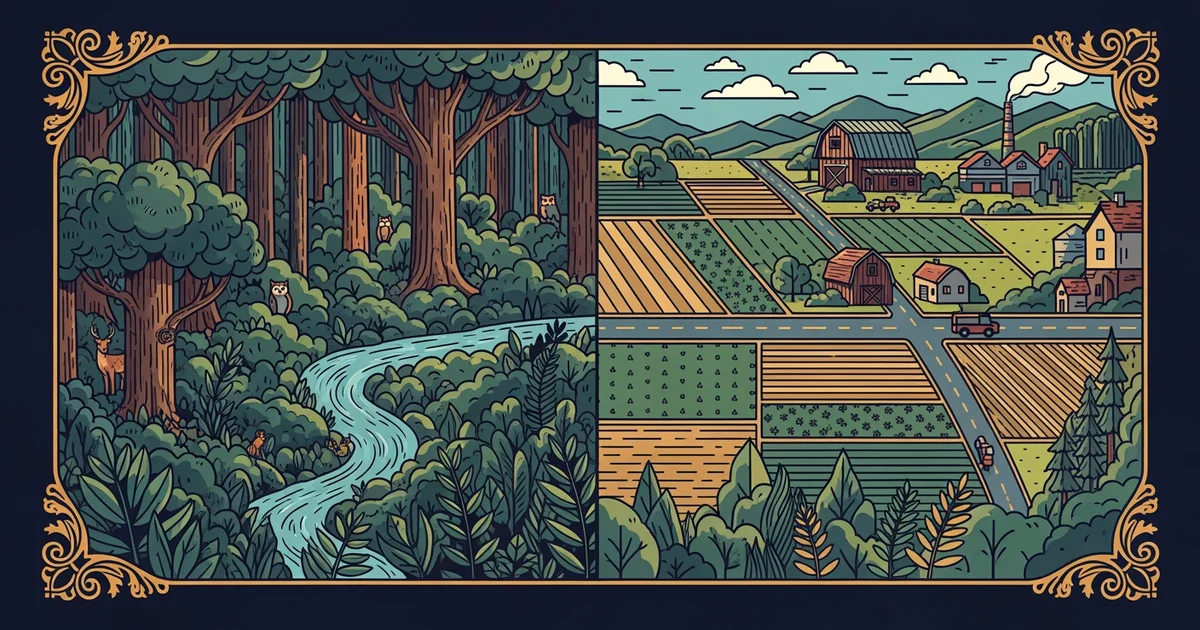
The Mechanics of Habitat Fragmentation
When we build roads, we do more than just lay down asphalt and concrete for our vehicles. We create a permanent fragmentation of the landscape that changes how energy and life flow through an environment. Think of a road like a giant, invisible fence that only certain creatures can cross safely. For a small turtle or a ground-dwelling insect, a highway is as impassable as a mountain range might be for a human. This process breaks large, stable populations into smaller groups that struggle to survive on their own. Over time, these isolated groups lose the ability to mix with others, which weakens their genetic health and makes them more vulnerable to disease.
Key term: Fragmentation — the process where large, continuous habitats are divided into smaller, isolated patches by human-made infrastructure like roads.
Because these patches are so small, animals often find themselves trapped within borders that cannot support their needs. They might run out of food during a harsh winter because they cannot migrate to a better area. Alternatively, they may fail to find a mate because the road blocks their path to a different group. The road essentially acts as a filter, allowing only the most mobile or lucky animals to pass while trapping the rest. This creates a ripple effect throughout the entire food web, as predators lose their prey and plants lose the animals that help them spread their seeds.
Mapping the Impact of Connectivity
To understand the true scale of this issue, we must look at how infrastructure networks overlap with wild spaces. We often measure the impact of these roads by looking at the density of the network in a specific region. A high density of roads usually correlates with lower biodiversity because the landscape is sliced into tiny pieces. We can visualize this by creating maps that highlight the remaining "core" areas where animals can live without being disturbed. These core areas are the heart of a healthy ecosystem, and every new road we build shrinks them further.
| Feature | Effect on Habitat | Impact Level |
|---|---|---|
| Paved Roads | Creates hard barriers | High |
| Power Lines | Disrupts nesting sites | Moderate |
| Fences | Blocks small movement | Moderate |
| Trails | Increases human access | Low |
This table shows how different types of infrastructure change the landscape in unique ways. While a paved highway creates a major barrier for large mammals, something as simple as a fence can be a total disaster for smaller animals. By mapping these features, scientists can see where connectivity is broken and where it might be restored. We can then design solutions, such as wildlife bridges or tunnels, to help animals cross safely and reconnect their fragmented homes. These structures act like doors in the walls we built, allowing life to move freely once again across the landscape.
Understanding how these networks function helps us make better choices about where we build our future cities. If we plan our roads to avoid critical wildlife corridors, we can keep the natural world connected while still meeting our own needs for travel. It is a balancing act between our desire for speed and the planet's need for space. When we prioritize connectivity, we ensure that the natural world remains a vibrant, working system rather than a collection of lonely, dying islands. By mapping these impacts today, we can design a more sustainable way to share the Earth with all other living things.
Human-made infrastructure networks reshape the planet by breaking large, functional ecosystems into isolated fragments that limit the movement and survival of wildlife.
The next Station introduces hydrological alterations, which determines how infrastructure changes the flow of water across the land.