
Holistic Earth Chemistry
Imagine you are trying to balance a complex budget where every dollar spent in one department instantly changes the available funds for every other department in your company. Earth functions much like this delicate financial system, where the air we breathe acts as the primary currency for life and climate stability. If we change the concentration of one gas, the entire balance shifts in ways that ripple through the ocean, the soil, and every living organism. We often view the atmosphere as a simple blanket of air, but it is actually a dynamic reactor that connects the ground beneath our feet to the distant reaches of outer space.
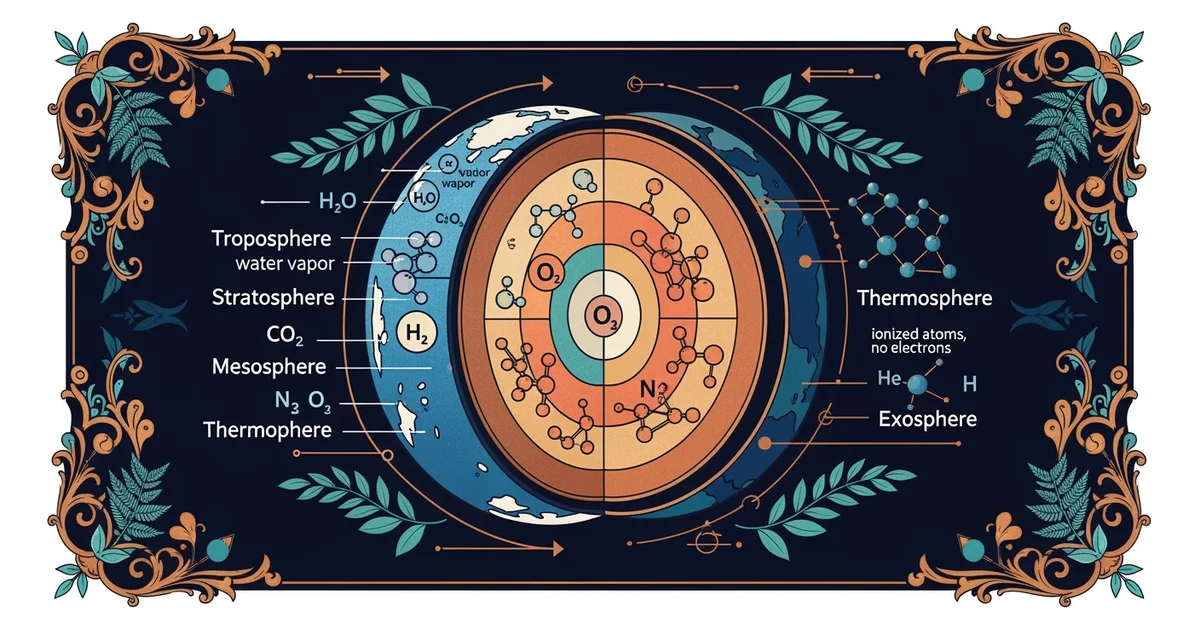
The Interconnected Web of Earth Systems
Chemical cycles do not operate in isolation because the atmosphere constantly exchanges energy and matter with the oceans and the land. Consider the way that carbon cycling moves through the planet like a massive, slow-moving conveyor belt that never stops. When plants pull from the air, they lock that carbon into their tissues, which eventually feeds the soil or the ocean floor. This process demonstrates that the air is not just a container for gases, but a vital participant in the physical growth of the planet. If we ignore these links, we fail to see how atmospheric changes directly dictate the health of our forests and the acidity of our seas.
Key term: Biogeochemical cycles — the pathways by which chemical substances move through biotic and abiotic components of the Earth system.
These systems rely on specific chemical reactions to maintain a state of balance that supports life as we know it today. The atmosphere acts as a regulator, much like a thermostat in a house that adjusts the heating and cooling based on the outside weather. For example, the presence of trace gases like methane and nitrous oxide creates a greenhouse effect that keeps our planet from freezing solid. However, these same gases can become problematic when their concentrations rise too quickly, overwhelming the natural buffer capacity of the oceans and forests. We must understand that every chemical emission represents a deposit or a withdrawal from this planetary account.
Synergies and Atmospheric Feedbacks
We can see how these systems interact by looking at the specific chemical feedback loops that define our modern climate. A feedback loop occurs when the result of a process influences the start of that same process, creating a cycle of change. For instance, as the planet warms, the oceans release more water vapor, which is a potent greenhouse gas that traps even more heat. This creates a reinforcing loop that accelerates the initial warming trend. Understanding these loops requires us to track how different elements move across boundaries:
- Atmospheric-Oceanic Exchange: Gases like dissolve into the surface waters, which alters the pH level and impacts the ability of marine life to build shells.
- Terrestrial-Atmospheric Interaction: Soil microbes process nitrogen and carbon, releasing gases that influence the overall composition and chemistry of the air we breathe.
- Solar-Chemical Coupling: High-energy ultraviolet light hits molecules like in the stratosphere, providing the energy needed to drive complex chemical transformations.
These interactions show that atmospheric chemistry is not a static subject but a living, breathing set of relationships. By studying how these components trade atoms and energy, we gain a clearer picture of why our environment changes over time. The stability of our atmosphere depends on the health of these interconnected cycles, which serve as the foundation for every ecosystem on the globe. We are essentially watching a massive, planetary-scale chemistry experiment that has been running for billions of years without a single pause.
| Process | Primary Element | System Impact |
|---|---|---|
| Photosynthesis | Carbon | Reduces atmospheric gases |
| Denitrification | Nitrogen | Recycles nutrients to soil |
| Calcification | Calcium | Stores carbon in oceans |
This table illustrates how different natural processes manage the flow of elements between the atmosphere and the surface. Each row highlights a critical exchange that maintains the balance of life. When we disrupt one of these pathways, we inevitably create pressure on the others, leading to shifts that can be difficult to reverse. The complexity of these interactions serves as a reminder that Earth is a singular, unified system rather than a collection of separate parts. We must view the atmosphere as the central hub where all these environmental threads meet and weave together.
The atmosphere functions as a complex, interconnected chemical hub that balances the movement of elements between the land, oceans, and life to maintain a stable environment.
Earth's atmospheric chemistry represents a unified system where every local change influences the global climate balance.