
Future Atmospheric Trends
Rising global temperatures act like a complex financial debt that our atmosphere must eventually repay through volatile shifts in chemical stability. We often view the sky as a static background, yet it functions as a dynamic system that reacts to every molecule we add to its delicate balance. If we consider the atmosphere a bank account, our current emissions represent high-interest loans that will eventually demand a heavy price in environmental stability. Just as a business owner must forecast future market trends to remain solvent, scientists use chemical models to predict how our air quality will change over the next century. These models help us understand the long-term consequences of our current industrial choices on the global climate.
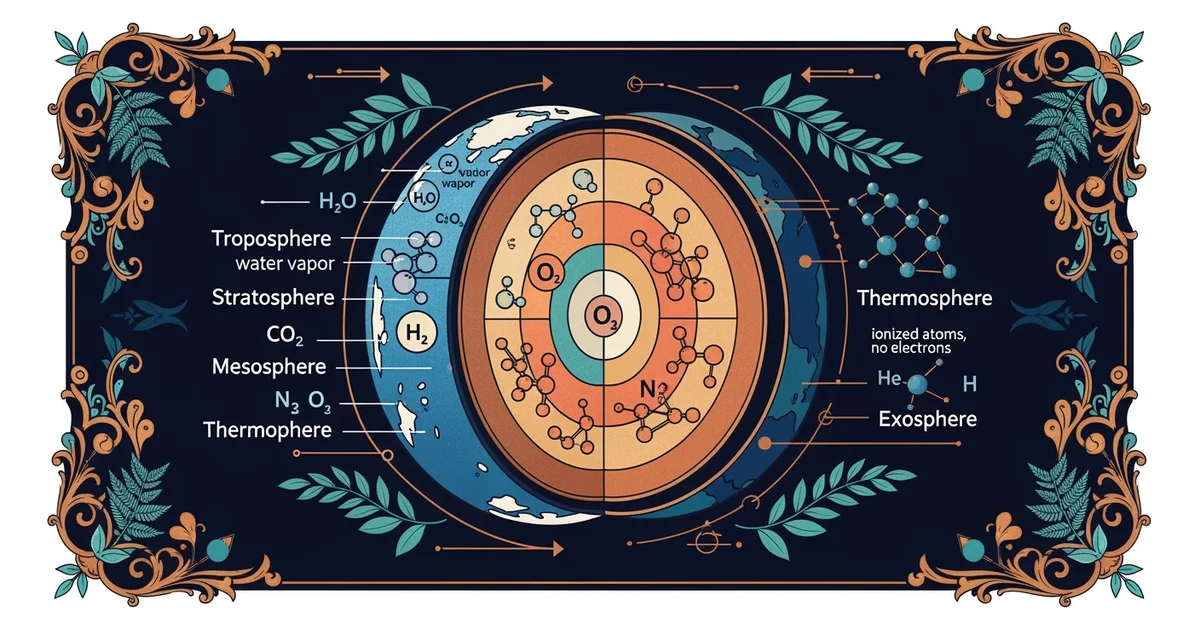
Predicting Chemical Shifts in the Atmosphere
Predictive models rely on understanding how greenhouse gases like interact with solar radiation and trap heat within the troposphere. These gases act like a thermal blanket that gets thicker as we burn fossil fuels, leading to a steady increase in the average kinetic energy of air molecules. When we look at future trends, we must account for the feedback loops that occur when warming oceans release trapped gases back into the air. This process creates a cycle where warming leads to more gas release, which in turn causes even more warming. Scientists track these interactions to see if the atmosphere will reach a tipping point where chemical regulation becomes impossible to manage manually. The goal is to identify which specific chemical precursors will likely cause the most significant damage to the ozone layer or regional air quality.
Key term: Predictive modeling — a mathematical approach that uses current data and chemical laws to forecast future changes in atmospheric composition.
To visualize these complex changes, we look at how different gases behave under various conditions. The following table highlights three major gases that will dominate future atmospheric chemistry and their primary impact on the environment:
| Chemical Gas | Primary Source | Atmospheric Effect | Future Trend |
|---|---|---|---|
| Fossil fuels | Traps thermal energy | Increasing steadily | |
| Agriculture | Potent heat retention | Rapidly rising | |
| Fertilizers | Ozone layer depletion | Slow steady growth |
Challenges for Future Air Quality
As we look forward, the primary challenge involves managing the chemical interactions that degrade air quality in densely populated urban centers. Previous stations established how aerosols and particulate matter can block sunlight, but future trends suggest that chemical smog will become more reactive as temperatures climb. This increased reactivity means that pollutants will form hazardous ground-level ozone more quickly than they do today. We must also consider how changing weather patterns will alter the distribution of these chemicals across the globe. Some regions may experience stagnant air that traps pollutants for weeks, while others might see increased storm activity that scrubs the atmosphere clean. Solving these problems requires a holistic approach that integrates our knowledge of molecular science with global policy standards.
SMILES notation · Educational reference only
Understanding these future trends allows us to prepare for the chemical reality of a changing planet. By tracking the concentration of these molecules, we gain the ability to adjust our industrial output before the damage becomes irreversible. This synthesis of knowledge from previous stations shows that air quality is not just a local issue but a global chemical challenge. We are essentially managing a planetary-scale reaction that requires precise control over our chemical inputs to ensure a stable outcome for all living systems. As we continue to refine our models, we improve our capacity to predict and mitigate the most severe impacts of our modern lifestyle on the atmosphere.
Future atmospheric stability depends on our ability to predict how chemical concentrations shift in response to both natural feedback loops and human industrial activity.
The next station explores how all these chemical components combine to form the holistic earth chemistry that supports our global ecosystem.