
Chemical Reaction Kinetics
Imagine you are trying to bake a cake in a cold oven that never reaches the necessary temperature. No matter how long you leave the batter inside, the chemical changes needed to turn liquid into a fluffy sponge will simply never occur. Atmospheric chemistry works in a very similar way, as the speed of chemical reactions determines how our air stays balanced or shifts over time.
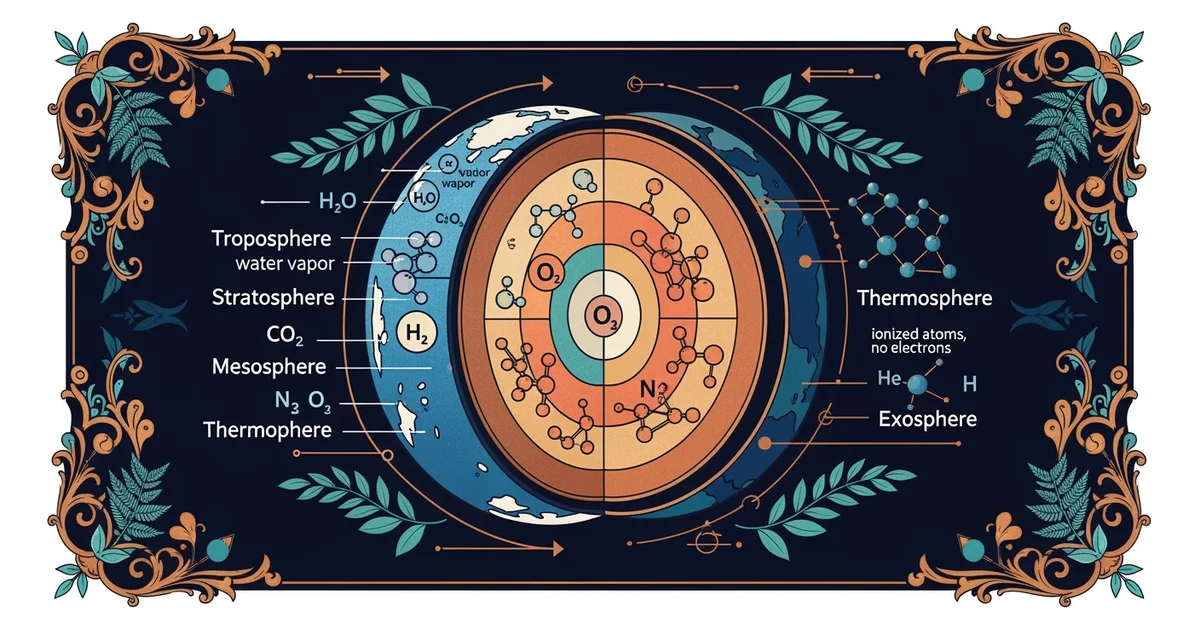
The Engine of Atmospheric Change
Chemical reaction kinetics is the study of how fast or slow specific molecular transformations happen within our atmosphere. When we talk about the composition of the air, we are looking at a dynamic balance between gases being created and gases being destroyed. If a reaction occurs too slowly, a gas might build up to dangerous levels before it can break down. Conversely, if a reaction happens too quickly, essential molecules might disappear before they can perform their vital roles for life. Think of this process like managing a busy kitchen during the dinner rush. You have a constant stream of orders arriving, and your staff must prepare each dish at a specific speed to keep the service running smoothly. If the chefs work too slowly, the customers wait forever, but if they work too fast, the quality of the food suffers. Molecules in the atmosphere follow this same logic, as they collide and react based on environmental conditions like heat and pressure.
Key term: Activation energy — the minimum amount of energy required for a chemical reaction to occur between colliding molecules.
To understand these rates, we must look at the frequency and force of molecular collisions in the air. Molecules are constantly moving and hitting each other, but not every collision results in a chemical change. Only those collisions that possess enough energy to break existing bonds will succeed in forming new substances. This energy barrier acts like a toll booth on a highway, where only vehicles with enough fuel can pass through to the other side. By controlling this energy, the environment dictates which reactions dominate our atmosphere at any given moment.
Influencing the Speed of Reactions
Several environmental factors directly influence the pace of these atmospheric transformations, creating a complex web of chemical activity. Temperature serves as the most significant driver, as higher heat gives molecules more kinetic energy to overcome the activation energy barrier. When the air warms up, molecules move faster and collide with greater force, leading to a higher frequency of successful reactions. Pressure also plays a critical role by crowding molecules closer together, which increases the likelihood of frequent, productive encounters.
We can summarize the factors that change reaction rates in the table below:
| Factor | Impact on Rate | Mechanism of Action |
|---|---|---|
| Temperature | Increases | Higher kinetic energy leads to more successful collisions |
| Concentration | Increases | More molecules in a space mean frequent contact |
| Catalysts | Increases | Lowers the energy barrier for the reaction to proceed |
Catalysts are another fascinating component of atmospheric kinetics, as they allow reactions to happen much faster without being consumed themselves. In the upper atmosphere, certain particles act as catalysts to speed up the breakdown of ozone, which would otherwise take a very long time. This process is similar to using a shortcut on your commute to work, where the path is shorter and faster but the destination remains the same. By understanding these variables, scientists can predict how human activity or natural events might alter the delicate chemical balance of our planet. The interplay between these factors ensures that the atmosphere remains in a state of constant, yet predictable, flux.
The rate at which atmospheric gases transform depends on the energy of molecular collisions and the presence of environmental factors that lower the barrier to change.
The next Station introduces stratospheric chemistry loops, which determine how these reaction rates create self-sustaining cycles in the ozone layer.