
Composition of the Atmosphere
Imagine you are taking a deep breath of fresh air while standing on a high mountain peak. You likely feel that you are inhaling pure oxygen, but the reality is much more complex than that simple feeling. The air surrounding our planet is actually a massive mixture of invisible gases that work together to sustain every living thing. Understanding what makes up this thin layer is the first step toward grasping how our entire world functions. We rely on this mixture every single second, yet we rarely stop to consider the specific ingredients that keep us alive.
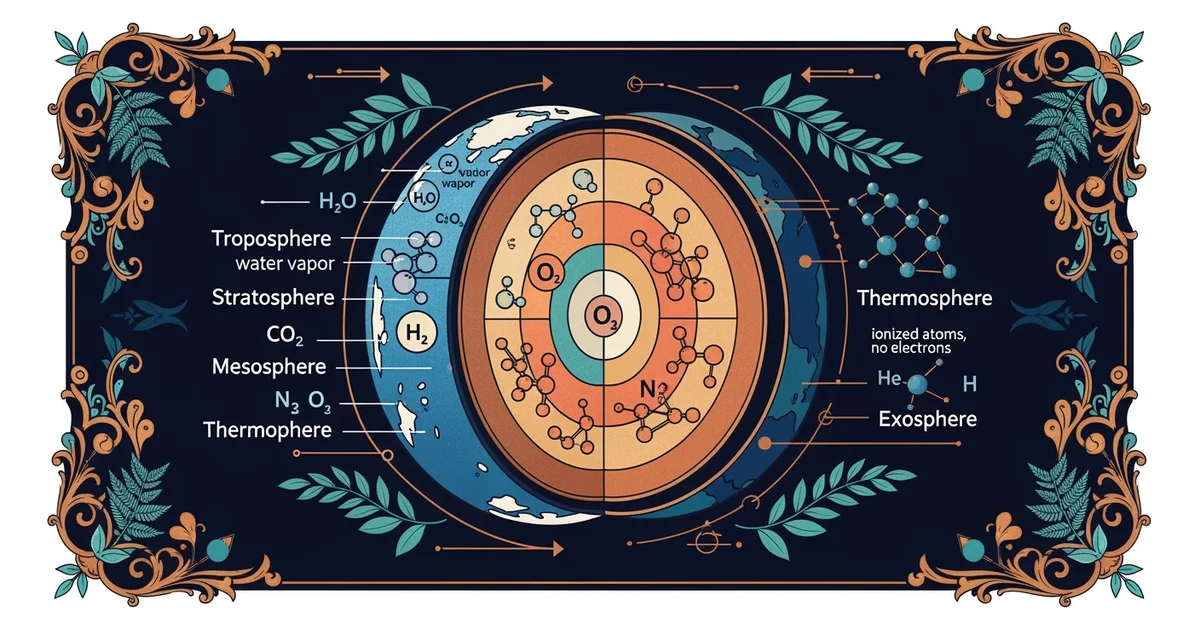
The Primary Components of Our Air
When we analyze the chemical makeup of the atmosphere, we find that two main gases dominate the total volume. Nitrogen makes up about seventy-eight percent of the air, while oxygen accounts for nearly twenty-one percent of the total. Think of these gases like the budget of a large company where nitrogen is the massive operating cost and oxygen is the essential profit. Even though we focus on oxygen for breathing, the nitrogen acts as a vital buffer that prevents fires from burning too quickly. Without this specific balance, our environment would be far too unstable for complex life to thrive or evolve successfully.
Key term: Atmosphere — the invisible layer of gases surrounding the Earth that provides protection and essential chemical elements for life.
While nitrogen and oxygen provide the foundation, the remaining one percent consists of several trace gases that play critical roles. Argon is the most abundant of these minor components, making up almost the entire remaining fraction. We also find trace amounts of water vapor and carbon dioxide, which are essential for regulating global temperatures through natural cycles. These gases behave like a thin blanket that traps heat from the sun to keep our planet at a comfortable temperature. If these trace elements vanished, the Earth would likely become a frozen desert unable to support any liquid water.
Understanding Chemical Proportions
The chemical composition of our air remains remarkably consistent across the globe because of constant movement. Wind patterns and air currents mix these gases thoroughly so that the ratios stay stable regardless of your location. We can visualize this consistency by looking at the specific volume percentages of the most common gases present in our breathable air:
- Nitrogen represents seventy-eight percent of the atmosphere and serves as a stable, inert gas that fills space without reacting easily with other substances.
- Oxygen accounts for twenty-one percent of the total volume and acts as the primary fuel source for cellular respiration in almost all living organisms.
- Argon makes up nearly one percent of the air and is a noble gas that does not participate in chemical reactions under normal conditions.
- Carbon Dioxide exists in very small amounts but provides the necessary carbon source for plants to perform photosynthesis and build their physical structures.
To see how these elements interact, we can look at the chemical symbols for the most active components. Carbon dioxide, for instance, is represented as , while the oxygen we breathe exists as . These molecules are constantly moving and colliding within the atmosphere, yet they maintain their specific proportions through natural planetary processes. This balance is not a static state but a dynamic system that responds to biological and geological changes over long periods of time. By studying these proportions, scientists can track how human activity might be shifting the delicate equilibrium of our shared environment.
SMILES notation · Educational reference only
This collection of gases provides a protective shield that filters harmful radiation while allowing life-sustaining energy to reach the surface. Every breath you take is a direct interaction with this chemical mixture that has been refined over billions of years. As you continue through this learning path, you will discover how these gases interact with pressure and temperature to create the weather patterns we experience daily. By the end of this series, you will have a complete understanding of how atmospheric dynamics shape the environment and sustain life on our planet.
The atmosphere is a precise mixture of gases that creates the stable conditions necessary for life to survive on Earth.
This foundational knowledge prepares us to explore how atmospheric pressure changes as we move through different layers of the sky.