
The Ozone Layer Function
Imagine standing under a bright sun without wearing any protective sunscreen on your exposed skin. You would quickly feel the burning intensity of solar rays reaching your delicate skin cells directly. High above our heads, the planet possesses a natural shield that acts exactly like that sunscreen. This invisible layer of gas prevents harmful energy from reaching the surface of our home planet. Without this essential shield, life as we know it would struggle to survive the harsh radiation.
The Chemistry of Ozone Formation
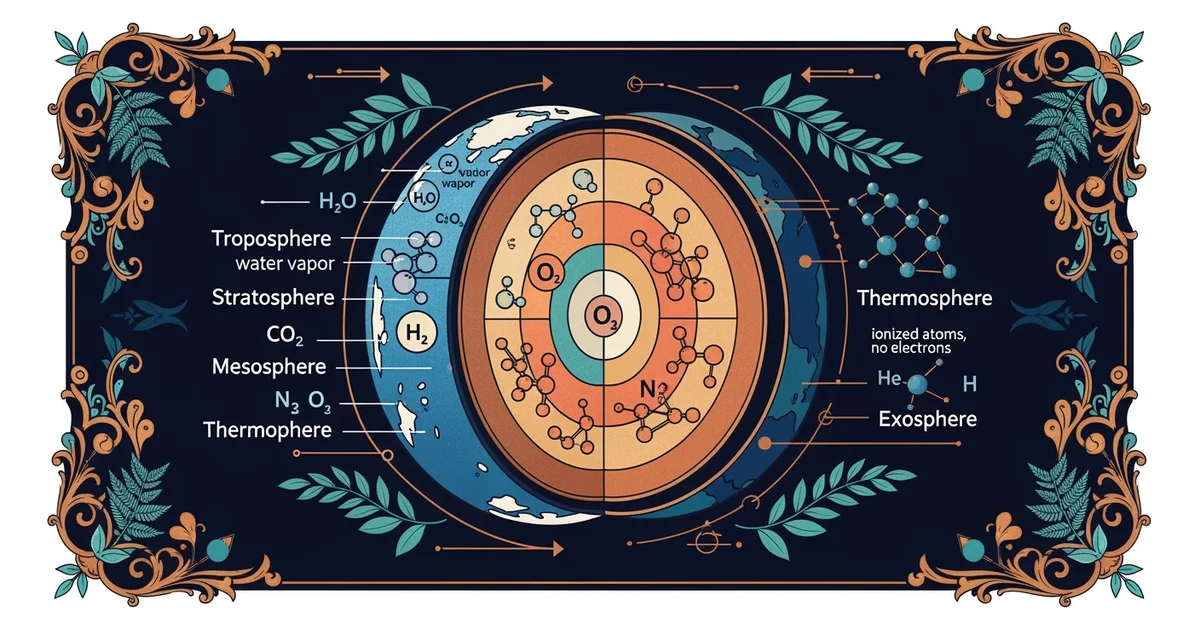
When we look at the stratosphere, we see a complex dance of molecules forming a protective barrier. This process begins when high-energy light from the sun strikes a standard oxygen molecule. The light energy is strong enough to snap the bond between the two oxygen atoms. These individual atoms are highly reactive and hunt for other partners to become stable again. They quickly collide with existing oxygen molecules to create a new, three-atom arrangement called ozone. This chemical reaction is represented by the equation
ightarrow ext{O}_3 inside the upper atmosphere.
Key term: Ozone — a reactive gas made of three oxygen atoms that absorbs dangerous ultraviolet radiation from the sun.
This continuous cycle of breaking and reforming happens millions of times every single second of every day. The ozone layer acts like a bouncer at a crowded club, filtering out the most dangerous guests. It allows gentle light to pass through while blocking the aggressive rays that cause damage. This balance keeps the temperature of the stratosphere stable and protects the biological health of every living creature below. If the formation process slowed down, the planet would lose its primary defense against deep space radiation.
Protecting Life Through Molecular Absorption
To understand how this layer functions, consider the analogy of a high-tech security window in a bank. The window allows light to pass through so employees can see outside during the day. However, the glass is specially treated to block forced entry or heavy projectiles from breaking through. The ozone layer acts as this specialized glass for the entire Earth. It lets visible light reach the ground to support plant growth while stopping harmful rays. The chemistry of the molecule itself is the secret to this incredible natural filtering ability.
When radiation hits an ozone molecule, the molecule absorbs that energy to break its own bonds. By sacrificing itself to absorb the incoming radiation, the ozone molecule prevents the energy from reaching us. The atoms then quickly reform into new ozone molecules to continue the protective work. This constant cycle ensures that the shield remains active despite the heavy bombardment of solar energy. The following table highlights the primary components involved in this atmospheric safety system:
| Component | Role in Process | Chemical State |
|---|---|---|
| Oxygen Gas | Raw material | Stable diatomic |
| Free Oxygen | Reactive agent | Unstable atom |
| Ozone | Primary shield | Protective triatomic |
This protective system relies on the constant presence of oxygen in our thin atmosphere. If the density of these gases were to drop, the shield would become too thin to function. We rely on this molecular chemistry to maintain the delicate balance required for our survival. The stability of our environment depends entirely on these invisible reactions happening miles above our heads. Understanding this cycle provides insight into how our planet maintains its unique ability to support diverse life forms.
The ozone layer functions as a self-repairing chemical shield that absorbs high-energy solar radiation to protect life on the surface.
The next Station introduces greenhouse gas mechanics, which determines how our atmosphere traps heat to maintain planetary temperatures.