
Greenhouse Gas Mechanics
Imagine you are wearing a thin cotton shirt on a very cold winter day while standing outside. You feel the chill immediately because your body heat escapes through the fabric into the freezing air around you. Now, imagine you add a thick, heavy wool blanket over that same thin shirt to trap your warmth. The blanket acts like a barrier that prevents your body heat from leaving your immediate personal space. This simple act of trapping heat is exactly how the atmosphere keeps our planet warm enough for life to exist. Without these invisible gases acting like a blanket, Earth would be a frozen rock in space.
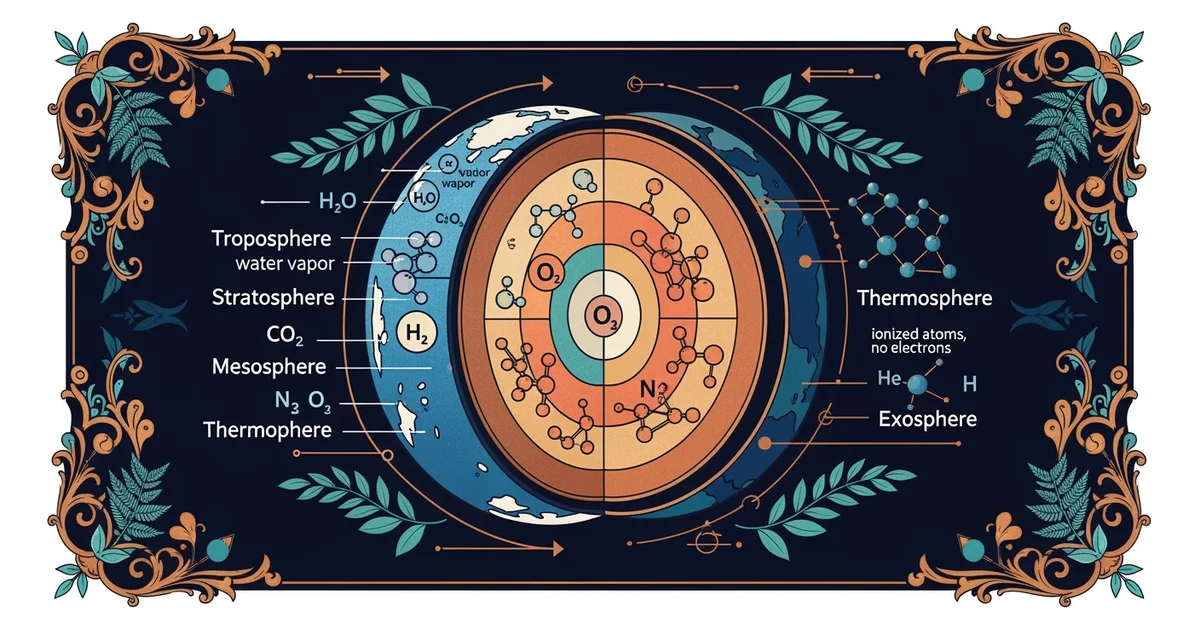
The Role of Atmospheric Gases
Certain molecules in our atmosphere are specialized to trap thermal energy that radiates from the surface. When sunlight hits the ground, the Earth warms up and releases that energy back toward space as infrared radiation. Most gases in the air, such as nitrogen and oxygen, let this energy pass through them without catching it. However, specific gases like carbon dioxide and methane have unique shapes that allow them to absorb this outgoing heat. These molecules vibrate when they encounter the energy, effectively holding onto it before sending it back down to the surface. This process creates a stable temperature range that supports diverse ecosystems across the globe.
SMILES notation · Educational reference only
Key term: Greenhouse effect — the natural process where atmospheric gases trap thermal energy to keep the planet surface warmer than it would be otherwise.
This warming effect is a delicate balance that relies on the exact concentration of these specific gases. If the concentration increases, the atmosphere traps more heat than it releases, similar to adding a second blanket to your bed. The heat that would normally escape into space stays near the surface, raising the overall temperature of the planet. Scientists study these molecular interactions to understand how human activities might change this balance over time. The following table highlights the primary molecules responsible for this heat-trapping activity in our atmosphere:
| Molecule | Chemical Formula | Primary Source | Atmospheric Impact |
|---|---|---|---|
| Carbon dioxide | Fossil fuel use | Long-term warming | |
| Methane | Organic decay | Intense heat trap | |
| Water vapor | Natural evaporation | Short-term cycle |
Understanding Molecular Vibrations
To understand why these gases trap heat, you must look at how they move at the microscopic level. Simple molecules with only two atoms, like oxygen, are very stable and do not change their shape easily. In contrast, complex molecules like or have more ways to move and wiggle when they hit infrared light. Think of these molecules like tiny springs that stretch and bend when you pull on them. When an infrared photon hits the molecule, the molecule absorbs that energy and begins to vibrate more vigorously. This vibration eventually causes the molecule to emit the energy again, often back toward the Earth instead of out into space.
- Absorption: The gas molecule captures an incoming infrared photon from the warming Earth surface.
- Vibration: The molecule gains energy and begins to stretch or bend its chemical bonds rapidly.
- Re-emission: The molecule releases the stored energy as heat in a random direction, including downward.
This continuous cycle of absorption and re-emission is what keeps the lower atmosphere warm. Because these molecules are always moving, they create a persistent thermal buffer that protects the surface from extreme cold. Understanding these mechanical properties helps researchers predict how changes in gas levels influence the global climate system. By focusing on these tiny molecular interactions, we gain a clearer picture of how our entire planet functions as a unified system.
Greenhouse gases act like a thermal blanket by absorbing infrared radiation and re-emitting that energy back toward the Earth surface.
The next Station introduces aerosols and particulates, which determine how sunlight reflects off the atmosphere before it even reaches the ground.