
Tropospheric Smog Formation
Warm summer days often hide a dangerous chemical reaction occurring right above our busy city streets. While the air might look clear, invisible ingredients are constantly mixing to form a thick, irritating haze.
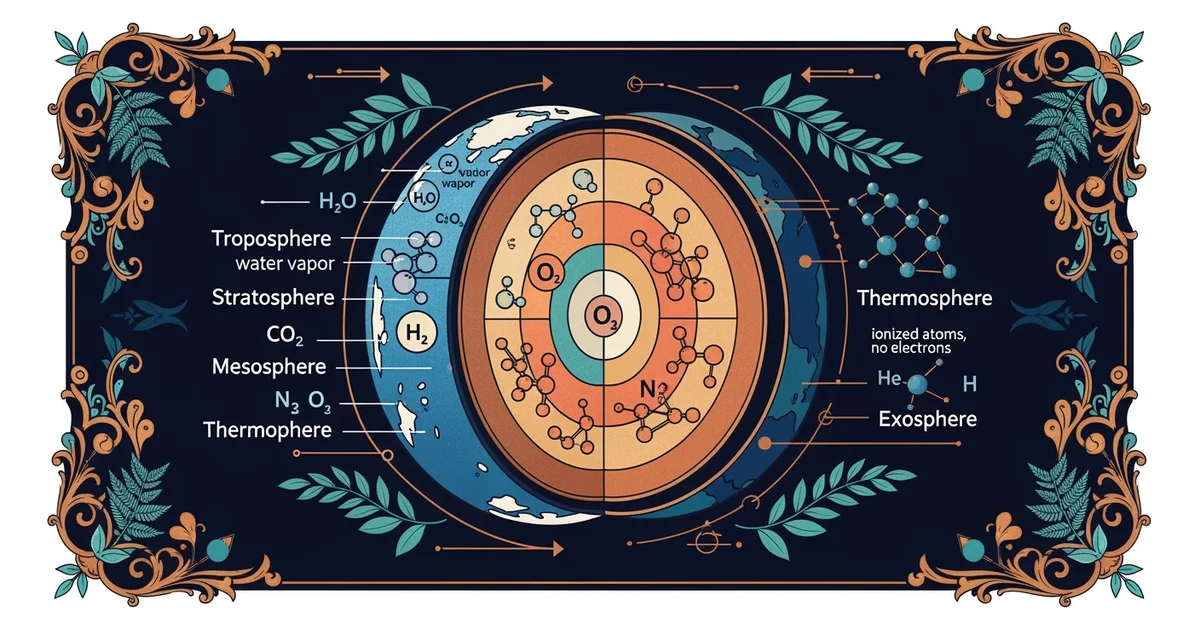
The Ingredients of Urban Smog
Ground-level smog begins when specific gases from human activities meet the energy of direct sunlight. These gases primarily include nitrogen oxides and various types of volatile organic compounds that drift into the air. Nitrogen oxides usually come from burning fuels in cars and large industrial factories during daily operations. Volatile organic compounds enter the atmosphere from paint, gasoline vapors, and even some household cleaning products used daily. When these ingredients gather in a confined urban space, they become the raw materials for a complex chemical factory. Think of this process like baking a cake where the sun acts as the oven. Without the heat from the sunlight, the ingredients simply sit there without changing into the final product. The presence of these gases creates a volatile mix that waits for the right conditions to trigger a reaction.
Key term: Photochemical smog — the complex mixture of ground-level pollutants formed when sunlight reacts with nitrogen oxides and organic compounds.
Once the sun begins to shine brightly, the energy breaks apart the nitrogen dioxide molecules. This reaction releases a single oxygen atom that is highly reactive and seeks a new partner. The released oxygen atom quickly finds a molecule of oxygen gas to form ozone near the ground.
This ground-level ozone is the main component of smog and causes respiratory issues for many people. Unlike the protective layer high above us, this ozone is harmful because it reacts with delicate lung tissues. The cycle continues as long as the sun provides energy and traffic adds more nitrogen oxides.
The Chemical Cycle of Pollution
The chemistry of smog relies on a continuous loop that keeps pollutants active for many hours. Nitrogen oxide reacts with the volatile organic compounds to prevent the ozone from breaking down too quickly. This interaction allows the ozone levels to climb higher throughout the afternoon as the sun reaches its peak. We can view the accumulation of smog through the following stages:
- Emission phase: Vehicles and factories release nitrogen oxides and organic vapors into the local atmosphere.
- Activation phase: Solar radiation provides the necessary energy to split nitrogen dioxide into reactive oxygen atoms.
- Formation phase: Oxygen atoms bond with diatomic oxygen to create ozone while organic compounds stabilize the process.
- Accumulation phase: The smog lingers in the lower atmosphere because the chemical reactions reinforce the pollutant concentration.
This process creates a persistent health hazard that remains trapped near the surface until the sun sets. As the light fades, the production of new ozone stops and the existing ozone slowly reacts away.
| Pollutant | Primary Source | Role in Smog |
|---|---|---|
| Nitrogen Oxides | Car Engines | Initiates the reaction sequence |
| Organic Compounds | Solvents and Fuels | Stabilizes the ozone production |
| Ground-level Ozone | Chemical Reaction | Causes respiratory irritation |
This table shows how different chemicals work together to build a dangerous environment for city residents. Each component plays a specific role in ensuring the smog remains potent during the warmest hours. Understanding these mechanics helps us see why air quality worsens on hot, sunny days with heavy traffic. The chemical pathways demonstrate that our daily choices directly influence the air quality in our own neighborhoods. By reducing the emissions of nitrogen oxides, we can effectively starve the smog of its primary fuel source. This action stops the entire cycle before it can even begin to form harmful ozone.
Ground-level smog forms because solar energy triggers a series of chemical reactions between vehicle exhaust and volatile organic compounds.
But what happens when these pollutants interact with moisture to create acidic rain in our environment?