
Atmospheric Pressure Basics
Imagine you are standing at the base of a tall mountain while a heavy stack of books rests on your head. As you begin to climb toward the peak, your friends start to remove those books one by one until you reach the summit. You feel much lighter because the weight pushing down on you has decreased significantly during your long journey upward. This simple physical experience perfectly mirrors how our atmosphere behaves as you move away from the surface of the earth.
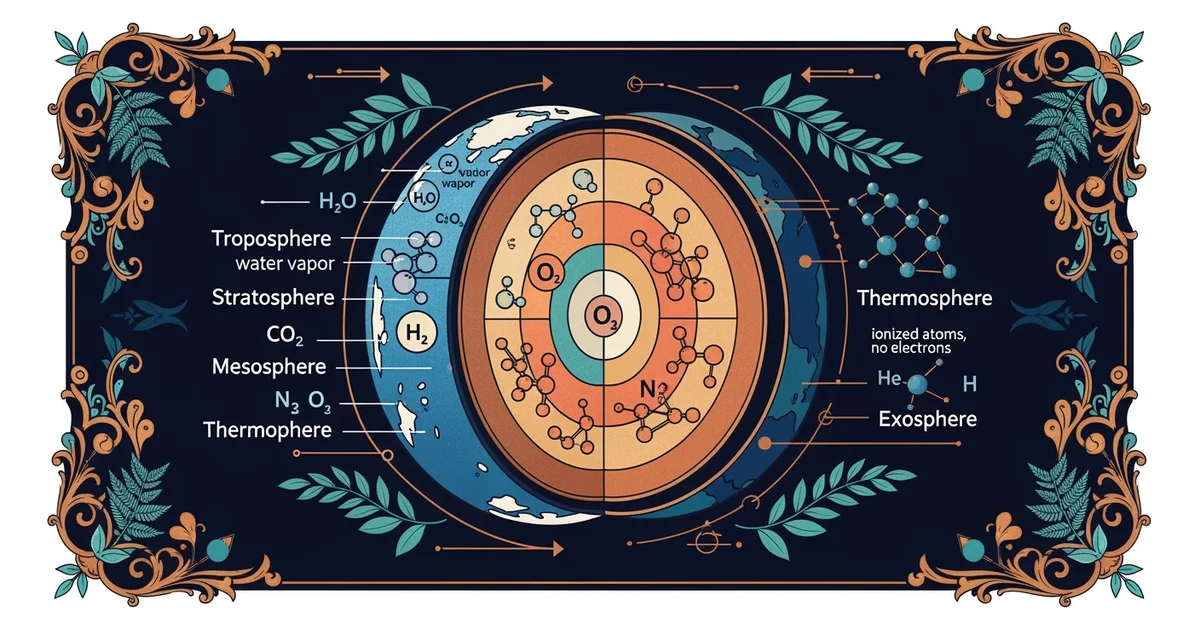
The Weight of the Air Column
We live at the bottom of a massive ocean of gases that constantly presses down upon us. Gravity pulls these gas molecules toward the planet, creating what we call atmospheric pressure in every direction. Think of this pressure like the weight of a deep swimming pool pressing against a diver at the bottom. The deeper you go into the water, the more weight presses on your body from the liquid above. Similarly, the air near the ground must support the weight of all the air molecules located above it. This vertical column of gas is quite heavy because our atmosphere extends for many miles into space. Because the gas molecules are packed tightly together near the ground, they exert a strong force on everything they touch. This force remains invisible to our eyes, yet it impacts how our lungs function and how weather patterns shift across the globe.
Key term: Atmospheric pressure — the force exerted on a surface by the weight of the air column above it.
As you ascend to higher altitudes, the density of these gas molecules changes in a very predictable way. The air particles become much more spread out because there is less gravity pulling them toward the surface. With fewer molecules pressing down from above, the total force pushing against your body drops significantly. You can visualize this as a pyramid of stacked blocks where the base supports the most weight while the top carries almost nothing. The higher you travel, the thinner the air becomes and the lower the pressure reading will be on a gauge. This drop happens because the column of air above you is shorter and contains fewer total particles to generate force.
Pressure Changes and Human Experience
Understanding these shifts helps us explain why breathing feels different when you visit high mountain ranges. At sea level, the air is thick and rich with molecules that your body needs for survival. As you climb higher, the reduced pressure means that each breath contains fewer oxygen molecules than you would find below. Your body must work harder to process the same amount of oxygen because the air is less compressed. Pilots and mountain climbers often use specialized gear to manage this change in pressure and ensure their systems stay healthy. The following table illustrates how pressure values shift as we move further away from the surface of our planet:
| Altitude Category | Relative Air Density | Pressure Level | Breathing Difficulty |
|---|---|---|---|
| Sea Level | High | Standard | Minimal |
| Mid Altitude | Moderate | Reduced | Noticeable |
| High Altitude | Low | Very Low | Significant |
These variations in pressure dictate how gases behave and interact with our environment on a daily basis. The atmosphere acts like a giant spring that is compressed near the ground but expands as it reaches outward. This expansion is the primary reason why pressure decreases as you gain elevation during your travels. If you consider the air as a resource, the density of that resource is highest where we live and lowest where the atmosphere fades into the vacuum of space. Understanding this basic rule of physics allows scientists to predict weather and manage safety for those moving through the sky.
The weight of the air column decreases as you climb because gravity holds fewer gas molecules at higher elevations.
The next station explores how solar radiation interacts with these layers of gas to influence our climate.