
Solar Radiation Interaction
Imagine standing under a bright summer sun and feeling your skin grow warm after only minutes. This warmth is not just a simple physical sensation but the result of invisible energy waves hitting you. These waves travel millions of miles from the sun to reach our planet and interact with the air. While we often think of the atmosphere as empty space, it is actually a busy chemical factory. Sunlight provides the energy needed to drive complex reactions that keep our world running smoothly. Without this constant input of solar energy, the chemical balance of our atmosphere would collapse entirely.
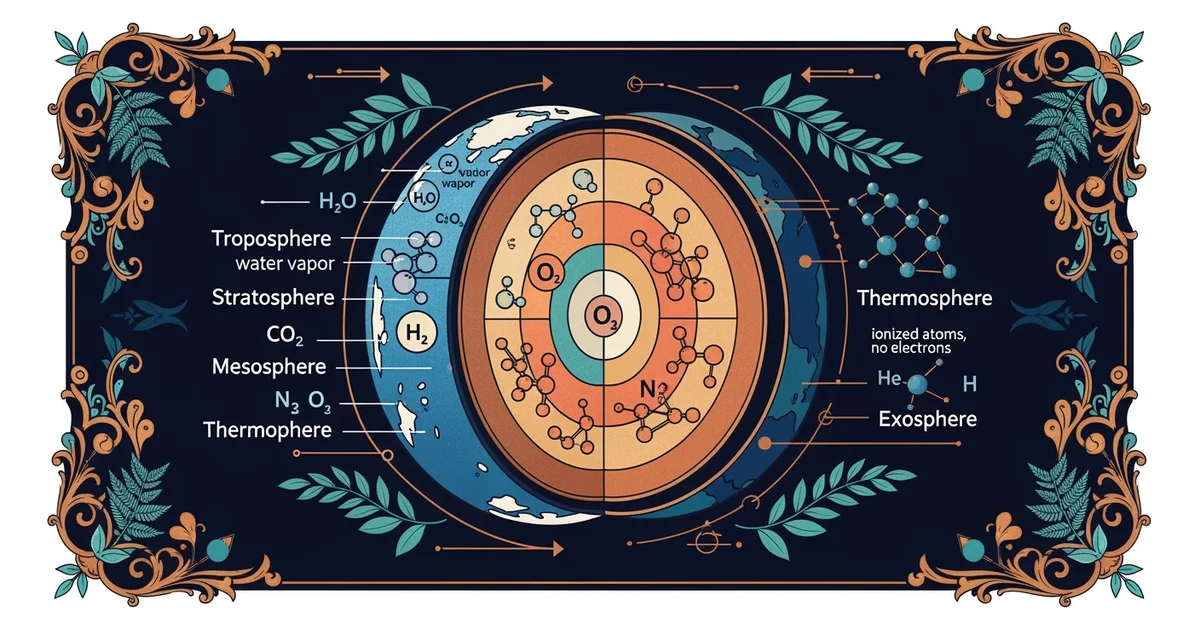
The Engine of Atmospheric Change
Solar radiation acts like a massive battery that powers every chemical process within our thin air. When high energy light from the sun enters the upper layers, it strikes gas molecules with great force. This impact can cause a molecule to split into smaller, highly reactive pieces that seek new partners. Think of this process like a crowded dance floor where the music suddenly speeds up. Dancers must let go of their current partners and spin around to find someone new to hold. This constant rearranging of chemical bonds defines how our atmosphere cleans itself and creates new compounds. You can see the result of this energy transfer in the way certain gases fluctuate throughout the day.
Key term: Photolysis — the process where light energy breaks chemical bonds within molecules to create new, reactive chemical species.
This interaction happens at a molecular level that we cannot see with our eyes. High energy light, specifically ultraviolet radiation, carries enough force to snap the strong bonds holding oxygen atoms together. When sunlight hits a molecule of oxygen, it can force the atoms to split and drift apart. These lone atoms are extremely unstable and will quickly attach to other nearby molecules. This chain reaction creates substances like ozone, which protects life by filtering out even more harmful light. The atmosphere essentially uses sunlight to build its own protective shield through these continuous chemical cycles.
Energy Transfer and Chemical Stability
Understanding how light interacts with gases requires looking at the different types of solar energy. Not all light hitting the atmosphere has the same effect on the gases it encounters. Some wavelengths pass through the air easily, while others are absorbed and used for chemical work. We can categorize these interactions based on the energy level of the light and the gas molecules involved in the process.
| Radiation Type | Energy Level | Primary Interaction | Resulting Effect |
|---|---|---|---|
| Infrared | Low | Heat vibration | Warming the air |
| Visible | Medium | Light scattering | Daytime brightness |
| Ultraviolet | High | Chemical splitting | Ozone formation |
This table shows how the atmosphere acts like a filter for incoming solar energy. The high energy light is consumed to drive chemical reactions, while the lower energy light warms the planet. If the atmosphere did not absorb this specific energy, the surface would be far too hot for life to survive. The gases act as a gatekeeper, allowing only the safest light to reach the ground while using the rest for necessary chemistry. This delicate balance ensures that the air remains stable enough for complex life to thrive on the surface.
- Sunlight enters the upper atmosphere carrying intense energy from the sun.
- Molecules absorb this energy and begin to vibrate or break apart entirely.
- Reactive pieces collide with other gases to form new chemical compounds.
- The process releases heat or stable molecules back into the environment.
This cycle repeats millions of times every second across the entire globe. Each reaction contributes to the overall health and composition of the air we breathe daily. By studying these interactions, we learn how human activity might change the balance of these vital chemical cycles. The sun remains the ultimate driver of everything happening in the sky above us.
Solar radiation serves as the essential power source that constantly reshapes our atmosphere by breaking and reforming chemical bonds.
The next step in our journey explores how these specific chemical reactions create the protective ozone layer.