
Stratospheric Chemistry Loops
A single chlorine atom floating in the high atmosphere can destroy thousands of ozone molecules before it finally leaves the sky. This invisible process functions like a persistent debt collector that keeps demanding payment long after the original loan is settled.
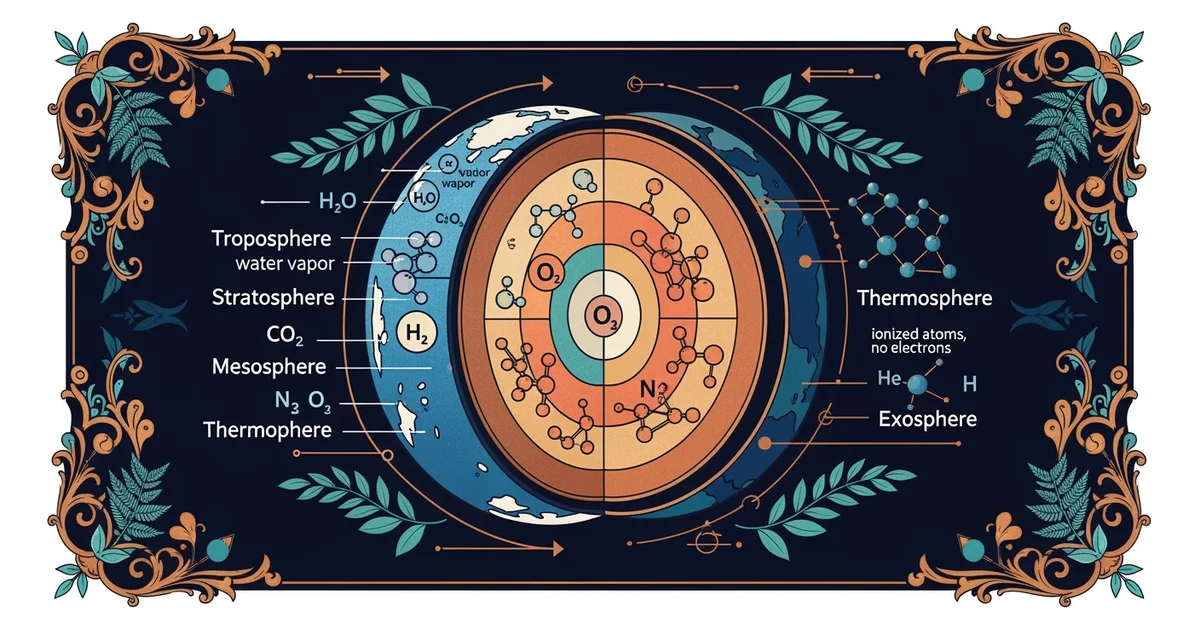
The Mechanics of Stratospheric Cycles
When we look at the upper atmosphere, we see a complex dance of gases that move in repeating loops. These cycles rely on specific chemical reactions that sustain the balance of our protective ozone layer. The stratosphere contains high concentrations of ozone, which acts as a shield against harmful ultraviolet radiation. This layer remains stable because the rate of ozone creation roughly equals the rate of natural destruction. However, certain human-made compounds introduce catalysts that disrupt this delicate equilibrium. These catalysts are substances that speed up a reaction without being consumed themselves. Think of a catalyst like a high-speed trading algorithm that executes thousands of trades while the original investor remains unchanged. The algorithm initiates the process, completes the task, and then moves to the next available target.
Key term: Catalytic cycle — a series of chemical reactions where a substance acts as a catalyst to speed up a process while remaining available to repeat the action.
To understand how these cycles function, we must observe the interactions between free radicals and ozone molecules. A free radical is an atom or molecule with an unpaired electron, making it highly reactive. When a chlorine radical encounters an ozone molecule, it strips away one oxygen atom to form chlorine monoxide. This reaction leaves behind a standard oxygen molecule. The chlorine monoxide then reacts with another free oxygen atom to release the original chlorine radical. Because the chlorine radical returns to its initial state, it remains free to repeat the cycle over and over again. This process is represented by the following chemical equations:
ightarrow ext{ClO} + ext{O}_2
ightarrow ext{Cl} + ext{O}_2
Understanding Catalytic Efficiency
The efficiency of these cycles depends on the availability of reactive species and the environmental conditions of the stratosphere. High altitudes provide the necessary energy from sunlight to break down stable molecules into these reactive radicals. Once the cycle begins, it can continue for years until the catalyst eventually drifts into the lower atmosphere or binds with another substance to become inactive. The following table summarizes the primary agents that participate in these destructive loops within our upper atmosphere.
| Catalyst Source | Reactive Radical | Primary Target | Relative Impact |
|---|---|---|---|
| Chlorofluorocarbons | Very High | ||
| Nitrous Oxide | Moderate | ||
| Bromine Gases | Extreme |
These agents do not all behave with the same intensity, yet they share the common trait of recycling themselves through the atmosphere. Bromine, for example, is significantly more efficient at destroying ozone than chlorine because it participates in even faster reaction loops. Understanding these differences helps scientists predict how the atmosphere will respond to changes in chemical emissions over long periods. By modeling these loops, we can estimate the lifetime of various pollutants and their total potential impact on the environment. This knowledge is essential for managing the health of the stratosphere and protecting the life-sustaining shield that covers our planet. We must view these cycles as dynamic systems rather than static chemical equations, as they are constantly influenced by temperature, pressure, and the presence of other trace gases. The persistence of these catalysts highlights why even small amounts of specific pollutants can cause widespread changes in our global climate systems over many decades of activity.
The stratospheric chemistry loop acts as a self-sustaining mechanism where a single reactive catalyst molecule repeatedly destroys ozone without being consumed in the process.
But what does it look like in practice when these cycles interact with the lower layers of our atmosphere?
Want this with sources you can check?
Premium Learning Paths for Chemistry & Molecular Science are researched against open-access libraries — PubMed, arXiv, government databases, and more — with their distinctive claims cited to real sources and independently checked.
See what Premium includes